Zoltan’s choice: Ray’s Grocery Store or the great wide sea
Issue 23 : Mar/Apr 2002
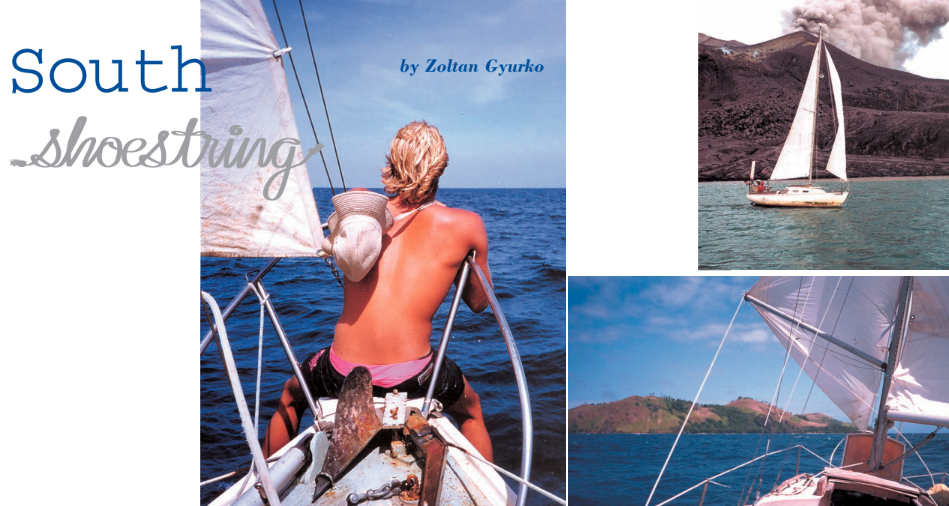
It was my lifelong dream to buy a sailboat and take a voyage through the South Pacific. Countless times I stood on the edge of the ocean, vowing that someday I would see its scattered islands and exotic peoples, exposing myself to ideas and challenges far beyond my experience. But like many sailors, I lacked the funds for such a trip.
On lunch breaks at Ray’s Grocery Store, I often sat alone, calculator in hand, punching numbers and hoping I would come up with a feasible financial plan. But after figuring in the purchase of a seaworthy 35-foot boat, a plethora of Makita power tools to maintain it, a 24-mile range Raytheon radar, a new hard-bottomed Avon, and full-coverage health insurance, I always came to an amount that was too large to handle.
As the months went by — slowly turning into years — stocking the dairy section grew unbearable. I began altering my expectations, sometimes even dropping them completely. First to go was the new hard-bottomed Avon; next I convinced myself a 30-footer would do; finally, I gave up on health insurance. Sure enough, my number punching was getting closer to realistic. A few months later, when my sister telephoned to tell me there was a full-keeled 26-foot Pearson Commander for sale in Santa Barbara for $3,000, I took the big dive and gave my two-week notice.
Seven weeks later, on August 9, 1994, I was underway on my Commander, The Way, ready to traverse the Pacific . . . and realize my dream. My first passage was a grueling one: 2,400 miles to Hawaii. Like many beginners, I committed every blunder possible during my 20 days en route. These mistakes — like dropping my spinnaker into the water in 18-foot seas — gave me plenty to do when I reached Hawaii. I spent more than a few days sewing all the rips back together. The rest of the week was spent hammering out the jib pole I had made into an “L” during the same incident.
Free advice
Because of my strict budget, getting a new pole or having my spinnaker professionally sewn was out of the question. I was forced to do it all myself. Luckily, the sailing community in Hawaii was willing to give me lots of free advice. I listened to it all and learned much in the two months I was there. By far the best and most unusual advice I received was to check the marina’s dumpster on Thursday afternoons.
“The trash truck,” my Hawaiian friend, John, told me, “takes away the goodies on Friday morning.”
I was skeptical about climbing into a dumpster looking for loose boat items, but I decided to chance it. What I found amazed me. Bits of useful teak, canvas, and stainless steel filled the thing. My first major score was under an empty 5- gallon paint bucket: a Class B EPIRB that needed a battery. Later I pulled out a ripped storm jib that required just two hours of fixing. For the next few weeks that I stayed in the Ilikai Marina, I was a regular on Thursday afternoons at the dumpster.
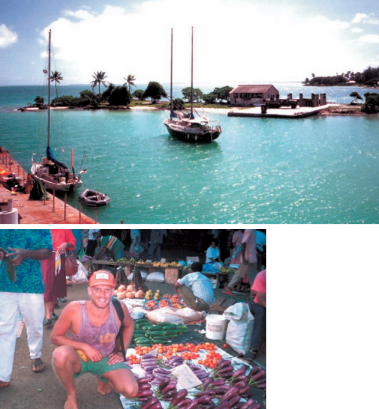
After Hawaii, I made my way south to Tabueran, a tiny atoll in Kiribati. In spite of the dumpster, Hawaii had really dented my budget, and I only had a few hundred dollars for the remainder of my journey. Soon I would be forced to find work if I wanted to carry on. Miraculously, after six months of anchoring for free off Tabueran and getting to know the locals like family, I still had a few hundred dollars left. In fact, I hadn’t spent a cent. There just wasn’t anywhere to spend it on Tabueran. Another great secret was revealed. I simply needed to stay in areas where I couldn’t spend money. When my canned food and supplies ran low, the islanders taught me to climb coconut trees, catch lobster in the coral, and pick the best papayas. It was the ideal island life.
Cultural experiences
After Kiribati I made my way to Western Samoa, Tonga, and Fiji. I avoided the capitals and main ports in hopes I’d save money. It worked well, and by sticking to the isolated islands, I found authentic cultural experiences with the people there; I was also able to put off the job hunt. I thought all was going perfectly until I made a huge, costly mistake.
I was on passage to Santa Maria, an obscure Vanuatu Island. I went to sleep at 3 a.m., setting my alarm for 6 a.m. That would give me at least a 90-minute margin before I reached the nearest shore. At 5:58 however, I awoke to surf swamping my transom and The Way’s keel grinding on coral. My chart was eight miles off, and the current was much heavier than I had anticipated. There were only a few minutes before I would be slamming against the cliffs of Santa Maria.
I jumped in the cockpit and tried to steer the boat through the surf. When I made it to the inside where the breakers were smaller, the water got a tad deeper . . . but not enough for me to stop grinding. My keel drew 4 feet, but the depth was only 3 1⁄2 feet. With every wave my boat lurched atop the coral, creating the worst sounds a sailor could imagine. I raced to my bow and pulled down the jib. Next came the mainsail. That dropped the waterline a few inches. Now I needed to get my boat pointed toward the surf. I deployed my 25-pound CQR. When it caught, it whipped the nose around. It was too shallow for me to motor out so I waited for a few minutes, thinking, trying to gather myself, needing to figure out a sensible plan. With every wave The Way rose, then slammed back onto the reef. It made concentrating almost impossible. I knew the tide was dropping so I had to do something immediately. My dream was about to be lost.
Unloading weight
Finally an idea struck me, a very natural one under the circumstances. I began unloading hundreds of pounds (and dollars) worth of canned food from my bilge. Next went three portable five-gallon water tanks. Finally my dive belt, 35 feet of 5⁄16-inch chain, a 22-pound fisherman’s hook, and my Suzuki dinghy engine went overboard. These 300 pounds made a difference, but not enough. There was still too much weight to make a run for it, even with the engine at full throttle. More had to go.
Inevitably, I was next. I jumped in the ocean. Since the boat was powered by an outboard, I could steer her from the water with it. I would use my hand, but I had to be careful a wave didn’t throw me into the propeller. I waited for a few minutes, scanning the horizon for a set of waves. When they came, I jammed the throttle to full speed. The Way took off, grinding, bulldozing through the shallow sections — but moving fast whenever a breaker raised it above the reef. My idea was working — the set of waves was adding temporary depth under the boat. It was just enough to get The Way past the impact zone and into the open ocean.
After I pulled myself on board and made sure I was far from the breakers, I used my mask to examine the damage. Luckily, it was less than I’d imagined . . . a testament to the Pearson name. The keel held up remarkably well; there were lots of huge gouges but no leaks.
Cracked rudder
Unfortunately, the same couldn’t be said about the rudder, which took the brunt of the 6,000 pounds of continuous slamming. The Way’s rudder was cracked and bent out of shape. Permanently stuck to starboard, it was unusable. It required a complete rebuild with new wood and a strong outside layer of epoxy. I had a Hydrovane self-steering system with an auxiliary fin, so I was still able to steer my boat. But when I reached the next major port I’d be forced to make the repairs, buy the gear I’d thrown overboard, and restock the canned food I lost. The question now was how to pay for all this.
In Guadalcanal Island in the Solomons, I happened upon some luck. A group of surfers were looking to do some exploring. We struck a deal. I would act as their captain and The Way would serve as their exploration vessel — the result was $400 that would cover some of my losses. A few weeks later, my surfer friends flew back to Australia, my rudder was better than new, and I was underway to Papua New Guinea and Micronesia.
I finally curtailed my trip in Guam for a year when I found a fantastic full-time job as an archaeological salvage diver. It really wasn’t a job because the true definition of my work was “treasure hunter.” It’s hard to compare diving for silver coins in perfect visibility with stocking the dairy section at Ray’s Grocery Store. In addition, it paid the bills, got me completely caught up on my canned food (portable ballast for the bilge), and paved the way for more South Pacific cruising adventures. Soon I was on a fast reach to Palau — the beginning of another dream.
Zoltan continued to Greece via the Indian Ocean and the Red Sea to Greece. There he sold his Pearson Commander and returned to Los Angeles where he works as a freelance writer and videographer. His sailing travels have been incorporated into three Travel Channel productions, and he’s currently working on a book about his journey in the Pacific to be titled, Seven Years of Fire: An Artist’s Journey into Manhood. He hopes to return to Greece within five years, buy a larger boat, and finish his circumnavigation.
Thank you to Sailrite Enterprises, Inc., for providing free access to back issues of Good Old Boat through intellectual property rights. Sailrite.com