A used production boat is a bargain
Issue 26 : Sept/Oct 2002
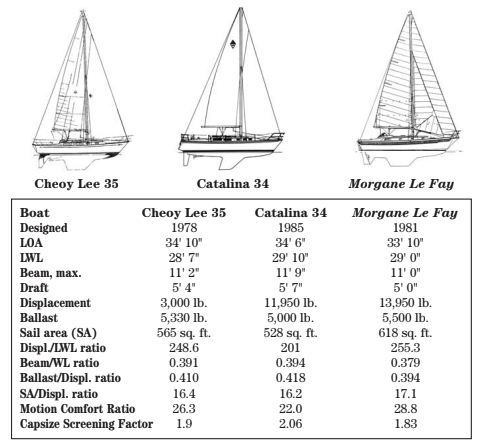
Bob Perry told me that when he designed the Cheoy Lee 35 in 1978 he styled her after the Luders 33 and similar classic CCA-type cruiser/racers. He succeeded admirably. With her nicely balanced ends and sweet sheerline, she would have looked right at home in any gathering of Luders, Rhodes, Sparkman & Stephens, and other fine auxiliary yachts in the 1960s. The only above-water sign of her birth date is the tall rig, as her mainsail’s 3.5:1 luff/boom ratio is definitely extreme compared to the under 3:1 ratios of the old CCA standards.
It was a bit difficult to dig up sufficient information on comparable designs, as I don’t like to do a write-up unless I have all the pertinent information, plus drawings of the sailplan and underbody. I looked at the Tartan 33, but she is hardly comparable because of her shoal and chunky Scheel keel and fractional rig. I came up with the Catalina 34, but she is a much newer design, of course. In desperation, I decided to include one of my old custom designs, Morgane Le Fay, which is of similar size, designed for the same purposes, and designed within three years of the Cheoy Lee 35.
In my own defense, I have to say that the Morgane Le Fay was a custom design, so her maximum draft was, as is usual, dictated by the client. With only a 5-foot draft on a heavier hull, the boat’s fin simply cannot be as effective in taking her to weather as the fins on the other boats in this comparison. In reviewing their underbodies and the statistics, I have to believe that the Catalina 34 with her deeper, more efficient, fin and her spade rudder would have an edge to windward over the Cheoy Lee 35 and an even larger edge over my Morgane Le Fay. The latter could definitely use another 6 to 9 inches of draft.
However, cruising folk do not always sail to windward, and they often find themselves caught out in stormy seas. Under those conditions, the heavier displacement ratios of the Cheoy Lee 35 and the Morgane Le Fay will tend to pay off in greater motion comfort. To put it simply, the boats will rise more slowly as the seas pass under them, and this makes life a little easier for sailors with queasy tummies.
Understandably, the Catalina 34, with the longest waterline, widest beam, and lightest displacement of the three, has a very low Motion Comfort Ratio, lower than that of several 30-footers, and even some 28-footers I’ve written up for this series. She will tend to be corky in a seaway. Her light displacement and generous beam also gives her a relatively high Capsize Screening Factor, slightly over the desirable 2.0. This is not a major problem as she has a generous ballast ratio and, in any case, was not intended as a Cape Horner. The 34 was designed more as a fast and roomy coastal cruiser with the potential of voyages to the Caribbean in season, and that job she does well.
The Cheoy Lee 35 and the Morgane Le Fay, though quite different in many respects, were both designed as bluewater cruisers and are well suited to extended voyaging. Is one better than the other? That’s difficult to say, as much comes down to personal choice, but I will point out one thing: a custom-designed and custom-built boat, such as the Morgane Le Fay, is only for those with very deep pockets these days. A Cheoy Lee 35, in good basic condition and with some money spent on upgrading the sails, rigging, and any other problem areas, will seem like an incredible bargain in comparison.
Thank you to Sailrite Enterprises, Inc., for providing free access to back issues of Good Old Boat through intellectual property rights. Sailrite.com