They’re designed to be perfect yachts for ocean voyaging
Issue 28 : Jan/Feb 2003
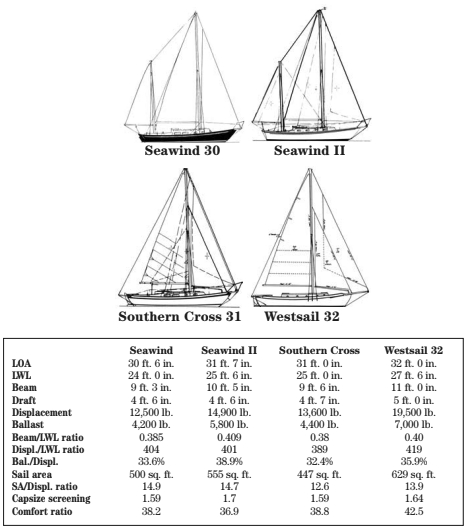
In the 1960s the Tom Gilmer-designed, Allied-built, Seawind ketch became the first fiberglass yacht to circumnavigate the globe, a notable feat that opened a lot of cruising sailors’ eyes to the capabilities of husky small craft. Then, in 1970, the Westsail 32 came out and was touted as being a modern version of Billy Atkins’ famed Colin Archer-type, Eric, and therefore the perfect yacht for ocean voyaging. She caught the eye of numerous would-be small-boat circumnavigators and became a commercial success.
Inevitably, other manufacturers decided to produce their own versions of Walter Mitty’s South Sea Islands dreamboat. Interestingly, two of these — the Ryder-built Southern Cross and the Allied Seawind II — were also Gillmer designs. There is no doubt that Tom Gillmer had the touch for designing able and attractive offshore types, and his beautiful little Blue Moon, a true classic, has always been one of my very favorite designs.
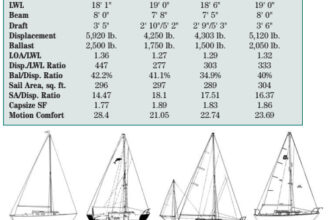
A glance at the numbers seems to indicate that the Southern Cross is very much undercanvassed but, being a cutter, she should be able to keep up with her ketch-rigged sisters under most conditions. In any case, given their extremely high displacements and modest sail areas, none of the four was designed to win races. Couple that with their full-keel underbodies and relatively high wetted surfaces, and you have yachts that are not going to set the world on fire in light air either. One point in their favor is that once they get moving, all that weight provides considerable momentum. The result is that the heavy boat continues to glide through the dead spots that seem to occur so often in the soft, fluky summer breezes, while lighter yachts slow to a crawl in the lulls between the puffs.
Less weatherly
Weatherliness will not be these boats’ strong point either, as the heavy displacement and moderate draft mean that there is not a great deal of useful lateral plane below the canoe hull. Also, the long, shallow keel will not be as effective at generating lift as would a higher-aspect-ratio shape. Still, any of the three will work to windward sufficiently to claw their way off a lee shore in a blow. However, the ballast ratios of the Seawind and Southern Cross are quite low, and their hull shape will not provide a great deal of form stability. For serious offshore work I would tend to add about 500 to 700 pounds of ballast. This would help them stand up better to a stiff breeze and that, in turn, will enhance their windward performance.
Motion comfort is rarely a strong point in yachts of this size, but all four of this group will prove to be very easy-riding in a blow. Their husky displacement produces motion-comfort figures that are incredibly high for 31- to 32-foot yachts and, indeed, they compare favorably with many 40-foot and even larger craft in that regard. (The Motion Comfort Ratio of the Block Island 40 is 35!) The one problem might be that the yachts scend so slowly on a steep sea that they are likely to be wet in extreme conditions. This is particularly true of the Westsail 32, with its deck-level cockpit offering little shelter from the wind and spray.
That same generous displacement also results in unusually low Capsize Screening Factors, so it is unlikely that any of the three would stay inverted for any great length of time if they did happen to be rolled in heavy seas. Their relatively shallow lateral plane will be a help in this regard also as they should tend to slide sideways on a steep, breaking sea and not be as prone to being tripped and capsized as a deeper-draft model would be.
It is obvious from the figures that all of these vessels were originally designed with serious ocean cruising in mind and, for that reason, may not be as well suited to coastal cruising as many a lighter, swifter, and more weatherly yacht. Still, the proud skippers of any of these boats can take comfort in knowing that, when the South Seas beckon or the gale winds blow, their seaworthy little ships will take them wherever they want to go and bring them home again, safely and comfortably.
Thank you to Sailrite Enterprises, Inc., for providing free access to back issues of Good Old Boat through intellectual property rights. Sailrite.com