A little attention takes your trailer a long way
Issue 29 : Mar/Apr 2003
One of the biggest advantages of trailersailing is that you are not limited to one sailing area in a single sailing season; you can experience a cornucopia of sailing destinations, thanks to our extensive highway system.
While much attention is spent on selecting, outfitting, and maintaining a seaworthy trailerable craft, less attention is paid to the contraption that allows trailersailors to achieve this enviable versatility . . . the trailer.
A trailer’s systems are few and relatively simple. However, if neglected they can be a continual source of unwelcome distractions. With care and understanding, you can make the trailering portion of every trip uneventful and the sailing eventful.
Tires and wheel bearings
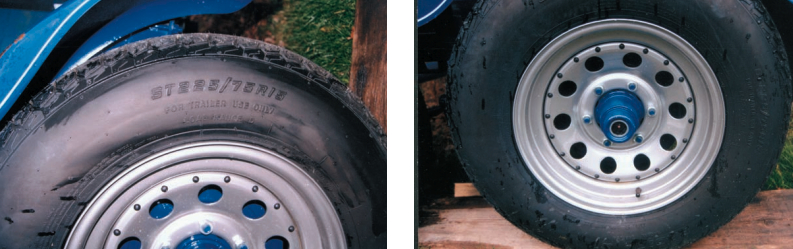
Tires and wheel bearings are the most critical items on your trailer and require special attention throughout the season. Make sure they’re rated for trailer service and that they’re the correct size and type. Don’t mix radials with bias-ply tires. Unlike passenger-car tires, trailer tires are subject to greater flex, weight, and heat stresses.
While they do not appear to be different from passenger-vehicle tires, trailer tires possess a much higher load-range rating, typically a load-range rating of C or D, approximately 1,000 to 2,500 pounds. Compare this with A or B, rated at 850 pounds or less. This increase in load range is mostly due to the increased number of plies used in the construction of the tire, especially in its sidewalls. Typical passenger-vehicle tires generally have two-ply sidewalls, whereas trailer tires often have as many as eight plies and usually no less than six.
While trailer tires are still available in bias- and radial-ply configurations, the overwhelming trend is toward radial-ply tires. Bias-ply tires have plies that crisscross the tire diagonally from bead to bead. They are less expensive than radials and are therefore the typical choice for lighter loads. The ply of radial tires run at a 90-degree angle from bead to bead. Radials dissipate heat better than bias-ply tires and are the tires of choice for long-distance travel or heavier loads.
You shouldn’t mix radials with bias-ply tires because they exhibit very different handling characteristics, which will result in severe sway and tracking problems. Also, never use a tube in either of these tubeless tires. A tube increases heat development and retards heat dissipation.
Check tire pressure often and make sure they are properly inflated. Follow the manufacturer’s recommendations. Proper tire pressure reduces damage caused by overheating.
In the off-season, when storing your trailer with your boat on it, use blocks to get the load off the tires. This also takes the load off the springs, axles, and wheel bearings.
Shade the tires from sunlight, since UV rays dry out the oil in the tires’ rubber. Watch for cracking on the sidewalls. This sign of old age indicates it’s time to replace the tires.
In the normal course of launching and retrieving your boat, the trailer’s tires and wheel bearings are immersed in water. If the bearings are cool and the hubs are filled with grease, this is not too much of a problem. However, when traveling down the highway, even well lubricated bearings can get hot. Then, when they are immersed in cold water, a vacuum is created and water is drawn into the wheel hubs. This condition can cause the bearings to seize up, rendering them useless. Salt water aggravates this condition. To protect your wheel bearings, try to keep your hubs out of the water when launching and retrieving your boat. If this is not possible, install bearing protectors on each wheel hub.
These are spring-loaded devices that maintain a slight pressure on the grease packing in the hub, which helps prevent water intrusion when the trailer wheels are submerged. Since bearing protectors incorporate a zerk (grease) fitting, they make lubricating wheel hubs dramatically easier.
On an annual basis, inspect and repack your wheel bearings, making sure to fill the wheel hub completely with marine-grade wheel-bearing grease. Unlike standard wheel-bearing grease used on passenger vehicles, this grease is formulated for the marine environment. In addition to its lubricating properties, marine-grade wheel-bearing grease is water-insoluble and contains corrosion inhibitors and antioxidants. It affords corrosion protection against moist or wet conditions, especially the highly corrosive saltwater environment. Marine-grade wheel bearing grease won’t soften, break down, or wash out in water. It maintains its stability and lubricity under the heat resulting from pressure and high speed.
Brakes
Depending upon the gross weight the trailer is designed for and/or the state in which it is registered, trailer brakes may be required.
There are two types of legal braking systems: electric and surge (hydraulic). Electric brakes function by sending a voltage to the trailer via an electric brake controller in the tow vehicle. This voltage activates the trailer’s brakes when the tow vehicle’s brakes are applied.
Surge brakes work from the trailer’s inertia. When the tow vehicle’s brakes are applied, inertia causes the trailer to continue forward and apply its brakes through a closed hydraulic system. Most modern boat trailers use surge-braking systems.
Trailer brakes are designed to activate in conjunction with the tow vehicle’s brakes and should continue to operate even if the trailer is accidentally separated. Be sure that the brake cable leading from the trailer to the tow vehicle is shorter than the safety chains. This cable sets the brakes if the trailer breaks loose.
After immersion, the brakes temporarily lose a significant portion of their braking power. Allow them to drain before heading out. If you have electrical brakes, you can also maintain slight pressure on the brake pedal for the first quarter mile or so to generate some heat. This will help dry out the brakes.
As with most metallic components, immersion in water can result in corrosion, and salt water corrodes most aggressively. While repacking the wheel bearings, inspect the condition of your brakes. If you suspect anything is amiss, have a qualified brake technician take a closer look.
Lights
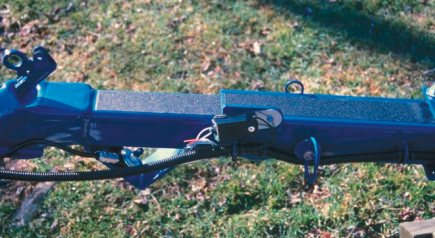
Lights on boat trailers experience rougher treatment than lights on passenger vehicles. No lighting system can tolerate repeated immersion, not even those rated “water-proof.” Salt water is especially corrosive. Having the trailer lights removable or mounted high enough so they don’t get immersed, goes a long way in reducing premature lighting failures. If this cannot be done, unplug them from the tow vehicle prior to backing down the launch ramp. Hot bulbs can crack when touched by cold water, so allow the bulbs enough time to cool before they are immersed.
If the lights do not operate, and the bulbs appear to be good, you may need to polish the bulb terminals with fine sandpaper or steel wool. Even a small amount of corrosion will keep them from making good electrical contact. Corrosion on the electrical connector between the tow vehicle and trailer can also be removed by sanding. The most frequent cause of trailer light failure is a faulty ground, which creates an open or poor circuit. The ground is normally identified as a white wire. Make sure it is bonded to the trailer frame and the tow vehicle.
Lastly, you may want to consider adding additional lights or reflectors beyond those required by law, especially to the trailer’s sides. This substantially increases night safety. Install a heavy-duty flasher in the tow vehicle to handle the increased lighting load, and routinely check the operation of all trailer lights before heading out.
The hitch
Trailer hitches, or more correctly, those portions permanently attached to the tow vehicles, are classified by gross trailer weight (GTW) and tongue weight (TW). GTW is the combined weight of the trailer, boat, and gear, while TW is the weight the loaded trailer places on the towing hitch. Here are the classifications:
Too much tongue weight results in “tail dragging” of the tow vehicle. Too little causes the trailer to sway excessively while being towed. Unfortunately, there are no guidelines or relationships between the tow vehicle and trailer. The manufacturer of the tow vehicle has the first and last word in setting the towing specifications. Check the owner’s manual before hitching up. Assuming that the tow vehicle can adequately handle the load, match the hitch to the load. When in doubt, move up to the next higher rated hitch.
There are two types of trailer hitches used with boat trailers: weight-carrying and weight-distributing. Both are bolted to the tow vehicle’s frame. Weight-carrying hitches come in all classes and, as the name implies, bear the entire trailer’s tongue weight. They are most commonly used in Class 1, 2, and 3 configurations. Rather than supporting the tongue weight, weight-distributing hitches apply leverage between the tow vehicle and trailer by means of a spring bar or bars. This causes the tongue weight to be borne by all axles of the tow vehicle and trailer. Typically, weight-distributing hitches are used with heavier loads (Class 4 and larger).
In connecting the tow vehicle to the trailer, the coupler on the trailer’s tongue is attached to the ball on the tow vehicle’s hitch. These balls come in several sizes. Be sure to use the correct size ball for your coupler. A ball that is too small can cause the coupler to come loose; one that’s too large will bind, and the trailer will not track the tow vehicle correctly.
Before connecting the trailer to the tow vehicle, grease the ball slightly. This makes for smoother movement of the hitch.
Trailer couplings can be screw-type or latch-type. Secure one that is latch type with a pin or lock to keep it from coming loose.
Associated with the hitch are safety chains that are permanently attached to the trailer’s tongue and secured to the tow vehicle with a hook or shackle. Don’t allow the chains to drag on the road surface. They only need to be long enough to allow free turning of the hitch. When connecting them to the tow vehicle, cross the chains under the hitch, forming a cradle. If the coupling fails, the cradle will prevent the trailer tongue from hitting the pavement and digging in.
Winch and tie-downs
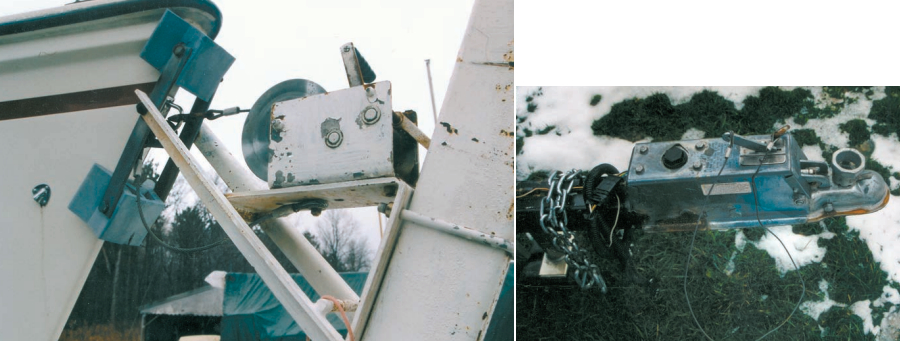
The primary point of attachment of a sailboat to the trailer is the bow eye, to which the trailer winch is connected. The winch line is usually a steel cable or a polypropylene rope or strapping. While cable may rust over time and eventually need to be replaced, synthetics will deteriorate more rapidly due to the UV rays in sunlight. Inspect the winch line annually and replace a synthetic line or cable if you suspect degradation. Do not use nylon; it stretches too much.
Be sure the winch has an antireverse lock in working order, but don’t rely on it totally. Use a short length of cable or chain to secure the bow eye to the base of the winch. Fasten a cable from the bow eye to the tongue of the trailer as well. This prevents the boat from sliding forward if you need to stop abruptly.
The boat should be firmly secured to the trailer. While the bow is held in place by means of the winch cable, tie-downs should be fastened at or near the stern of the boat. A gunwale tie-down stretching across the boat and hooked to either side of the trailer or transom tie-downs connected to lifting rings and to the trailer will accomplish this. A larger boat requires larger and more tie-downs.
Remember, should you need to stop in a hurry, you want your boat to stay on the trailer and stop when you do!
Launching
If there is but one thing that you do before launching, it is to make sure that the water at the launch ramp is deep enough. Some ramps are marked. If not, check with the marina, ramp operator, or other sailors. If all else fails, get wet!
If you determine that adequate water depth requires that your trailer be extended far out, you may need to employ a tongue extender. Many sailboat trailers incorporate them as part of their design. Some marina and launch ramps have them available for use, either free or for a fee. If you can’t use an extender, you’ll need to locate a deeper ramp. Under no circumstances should you allow the rear wheels of the tow vehicle to go past the water’s edge.
The following is a list of other items to consider when launching your sailboat, before backing down the ramp:
- Remove all tie-downs, but do not disconnect the winch line from the bow eye.
- Raise and lock anything that may snag on the trailer or in shallow water. This includes the outboard motor, rudder, and centerboard or swing keel.
- Insert drain plug(s), if so equipped.
- Attach bow and stern lines to maintain control of the boat and to help ease it off the trailer.
- If you can remain in the tow vehicle, leave the engine on, keep your foot on the brake, and the transmission in park (if automatic) or first gear (if manual).
- If you must get out of the tow vehicle to assist, turn off the engine, set the parking brake, put the transmission in park (if automatic) or first gear (if manual), and chock both rear wheels.
Legal considerations
One of the few absolutes in trailering a boat is its width. The widest boat you can legally tow on most state roads is 8 feet. Anything wider requires a special permit.
On interstates, some access roads, and on federally funded highways having 12-foot-wide lanes, the maximum width is 8 feet, 6 inches. These widths include the boat and the trailer.
Regulations are continually changing and differ from state to state, so consult your state police and your bureau of motor vehicles to obtain the most current ones.
Trailer gear
Regardless of how diligent you are in maintaining your trailer, sooner or later a breakdown will occur. Make the following items part of your trailer gear inventory:
- Mounted spare trailer tire inflated to the proper pressure.
- Trailer jack or scissors-jack and handle.
- Lug wrench sized to fit the trailer’s lug nuts.
- Spare wheel bearings and wheel-bearing grease.
- Spare light bulbs.
- Tools to replace wheel bearings and make minor repairs.
With the above items, the majority of trailer breakdowns can be easily and quickly remedied. This is especially important on those hot Sunday afternoons when you are driving through the middle of nowhere.
Thank you to Sailrite Enterprises, Inc., for providing free access to back issues of Good Old Boat through intellectual property rights. Sailrite.com