Ten lessons one woman singlehander learned during 20 years of offshore cruising
Issue 29 : Mar/Apr 2003
A singular disadvantage of the sea lies in the fact that having successfully surmounted one wave, you discover that there is another behind it.”
When he made that observation in The Open Boat, Stephen Crane meant to express humorous resignation. From another point of view he is illuminating one major reason we never tire of the sea: the lessons come one behind another. As in literature, our own voyages inevitably turn out to be journeys of exploration and discovery, almost always of spiritual as well as practical dimensions. The sea and our boats are tireless coaches.
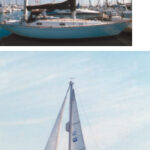
My old gaff cutter, Cooee, has been coming up with new lessons for me for nearly 20 years now. For the first five of those years I sailed with her previous owner, Peter. Then he set her up for me to singlehand. Imagining yourself as a singlehander when setting up a cruising boat is not a bad idea even if you are certain you will never venture out to sea alone. Most cruising boats have only two people aboard, so sailing and maintenance jobs are usually done by one person anyway.
Both alone and as a part of a cruising couple, I learned many things from Cooee and the sea the hard way. My experience was gained from longterm, long-distance cruising, which creates a particular set of conditions, demands, and rewards. But most of what I learned applies to any sort of messing about in boats. Here are some of the most important lessons I’ve learned:
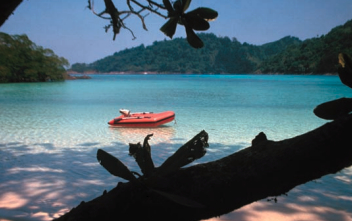
1. Simple is beautiful
Bernard Moitessier, writing of his 1968 round-the-world voyage, tells how he chose to carry his “old, quiet friend, the slingshot” rather than a radio; “so much better to shift for yourself, with the two hands God gave you and a pair of elastic bands.” Readers of his book will recall how, with the three great capes behind him, he fired his legendary message onto the bridge of a ship anchored outside Cape Town: “I am continuing non-stop toward the Pacific Islands [instead of finishing the first singlehanded round-the-world race] because I am happy at sea and perhaps also to save my soul.” Moitessier’s choice of a slingshot may seem a little extreme in these days of relatively tiny and inexpensive radios, but the principle holds: part of what cruising is about is self-sufficiency, paring down, and simplifying.
There is a practical corollary to this. When you’re cruising, you spend a lot less time sailing than you spend on maintenance. The year I crossed the Indian Ocean, I spent 10 weeks at sea and it felt as though I was always on the move — preparing, sailing, or arriving. The year I left the Virgin Islands in the Caribbean was the same year I arrived back in Australia — 11 weeks on passage, plus local daysailing — another big sailing year. The cruising life is, in reality, the life of boat maintenance, albeit in some spectacular settings.
Even though Cooee was and is very simple, with her laced-on mainsail, no halyard winches, no shower, a sink I empty over the side, no fridge, and few electronics, maintenance is a large part of life aboard when she and I are actively cruising. With little boat maintenance experience, this was initially a problem for me (see Good Old Boat, November 2002). First, I thought taking a lot of money with me would be a good solution. No matter how remote the port, I was usually able to find willing help. But it often turned out that no one knew much more than I did. And there were times when things broke at sea and I had to rely on myself anyhow.
My solution, which evolved over time, was to grow to love boat jobs. I even came to love intimidating bits of equipment. Two of my favorite things on this lovely old classic cutter are my engine and my anchor winch. After a while, they became less malignant, quite fun really. If you do not enjoy maintaining and repairing things, it is worth considering what you can do without.
2. Small is beautiful
For a singlehander, small is good. I have an inflatable dinghy I can carry, an outboard I can lift onto the boat, jerry cans and gas bottles I can handle when they are full, an inboard engine I can winch out on my own, using blocks and tackle and the boom. I haven’t tried launching the life raft; I can lift it and trust in adrenaline for the rest.
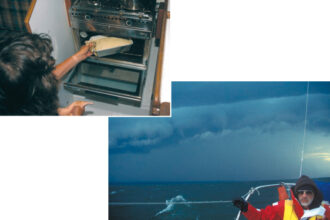
Small is beautiful in heavy weather, as is practice. Once I had worked out how Cooee hove to under a manageable sail plan, I practiced this fromtime to time in order to have a rest or to manage severe weather. In winds approaching or passing storm force, Cooee sits nicely under just the storm trysail with the helm lashed down; I would not like to be playing with the gaff main on my own in that situation. In headwinds around gale force, she will jog along at a couple of knots under the trysail and staysail, both small sails. I would lash the helm down, though I could probably use the Aries windvane for the same effect. I haven’t tried that.
This leads me to self-steering.
3. Self-steering is very beautiful
We take many of the great inventions for granted — the magnetic compass, the sextant, the chronometer, and electronic navigation aids. We are similarly blasé these days about the single most important development that allows us to sail singlehanded or shorthanded: self-steering.
This was my first and biggest problem as a singlehander and the one that took the longest to sort out. It may have taken so long because I set out to cross the Indian Ocean (not many chandleries there) before I understood fully how important it was not to be tied to the tiller. Carrying three Autohelm 2000s, I crossed to South Africa. Cooee is very heavy on the helm and, while the Autohelms were marvelous, they were not up to all conditions. Through necessity I became expert at repairing them — swapping motors, brushes, and control boxes, and improvising pins. In South Africa, I exchanged my bike for a secondhand Aries windvane and never looked back. The combination, including the ability to put the Autohelm on the Aries, means I never have to steer unless I want to.
4. Even engines can be beautiful
Cooee’s engine stopped running almost immediately after I took over its care. She was exiting a reefy pass off Palawan in the western Philippines, a remote and sparsely populated area at that time undiscovered by cruising boats. The only thing I knew how to do on the engine was bleed the fuel system. I put more fuel in the tank and bled the lines. This made no difference. A faint breeze took us back into Bacuit Bay where I anchored on a shallow shelf of reef. Later I went to bed still trying to persuade myself that this was a sailing boat, and it did not really matter if the engine did not run.
That night Cooee was blown out of her anchorage, and I was forced to flee to better shelter in a bay lined with palm trees and a few bamboo houses above the beach. The radio said we were on the edge of Typhoon Nelson. I was a very inexperienced sailor in charge of a precious old boat. Having a reliable engine really did matter. For the first time ever, I opened the Bukh shop manual.
The manual was very detailed but difficult to follow because the terminology was foreign to me. Even where there were diagrams, I could rarely recognize the part described since I had never looked — really looked — at an engine before. I reminded myself that I was at least as smart as the average person and that a lot of average people were out there fixing diesel engines.
The fuel system seemed the most comprehensible part so I decided to concentrate on that. I found where the fuel left the tank, followed it through its ups and downs, ins and outs, until it reached the injector pump. Plenty of fuel was reaching the pump but almost none was coming out. Dismounting the pump sounded easy on paper, so I began. Then I lost my nerve, reconnected the pipes and reconsidered. What if I got it dismounted? Even if the problem was obvious, then what? Among these remote islands there was little to be done.
All were beaten
In time, I made the acquaintance of local people with a knowledge of engines. One man after another took up the challenge, but all went away greasy and beaten. The saga continued over about six weeks, complicated, after Typhoon Nelson, by threats from Odessa, Pat, Ruby, Skip, and Tess. The upside of the experience was that I went through an unavoidable crash course in diesel mechanics as, manual in hand, I lived through it all. Slowly, I came to understand that none of these men had seen an engine like mine before. They could not read English, so they got no help from the manual. They had undoubtedly fixed a lot of engines, but the main advantage they had over me, I decided, was one of attitude. They were not intimidated by the task. They began with the belief that the engine could be made to go and that it would take only time, commonsense and, in these isolated parts, some improvisation. Through no fault of Bukh, the engine never ran again, but I learned much of importance during those weeks.
I sailed for Borneo and further lessons in diesel mechanics and then for Singapore. There I replaced the engine with a new one and from then on did all the maintenance and repairs myself. I am grateful now for the fact that I was sailing mainly in third-world countries where I did not speak the language. Doing the work myself was the path of least resistance, and I came to find satisfaction and even pleasure in it. In different circumstances, with expert assistance a phone call away, I doubt that I would have learned a thing.
I am still no engine mechanic, but even though I currently have access to experts, I make a point of doing the maintenance myself. It keeps my familiarity and confidence levels up. Given time to fiddle and find my way out of a few dead-ends, I can usually manage.
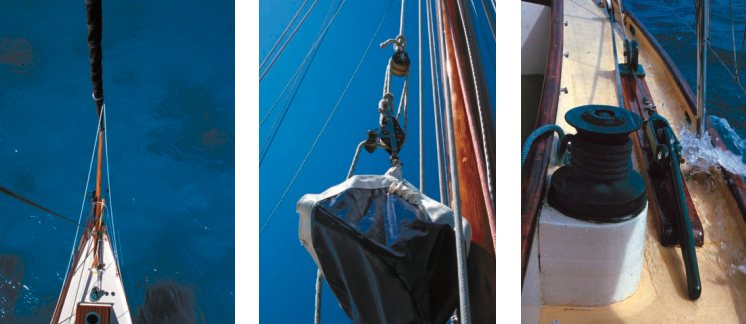
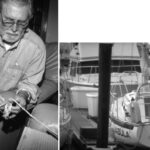
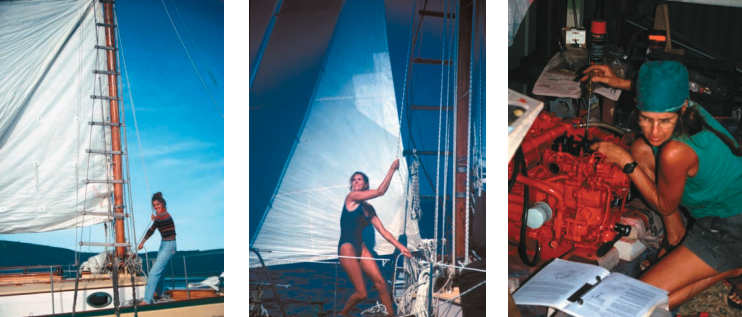
Center, Jill uses the same arrangement of blocks on the bosun’s chair and on the mainsheet. She says hauling herself up the mast with this purchase is not difficult.
At right, Cooee has two bronze winches for the jib sheets. Bronze Highfield levers simplify the running backstay work.
5. One is often easier than two
When people see I’m singlehanding, they ask, “Aren’t you scared?” and “How do you manage in a storm?” Then they often add, “I couldn’t do it — I’d be too lonely.”
When I went cruising alone, more — not less — of my time was spent socializing. It is a very social activity. No matter where you sail, the occupants of the little group of anchored yachts comprise your tribe. You may never have seen any of them before, but welcome and friendship, however transient, can be assumed. Outside the self-sufficient capsule of coupledom lie almost unlimited social possibilities as long as one does not require continuity.
As for solitary time at sea, I can think of nothing more wonderful. One is very alone on the ocean; it is difficult to imagine anywhere else of equal solitude.
When I first sailed alone, I set all the sails as Peter and I had done — full main, topsail, hanked-on jib, and staysail. The mainsail throat and peak halyards had three-to-one purchases, so raising the main was easy even without winches (all of Cooee’s halyards run to a pinrail at the foot of the mast). The sail and gaff were contained within lazy-jacks for controlled reefing or dropping.
Speed was not something I presumed to have an opinion about when Peter was skipper, and it took me some time to understand that I preferred sailing slowly to going fast. At sea, under a billow of white cloth, I felt euphoric, but always on edge and alert for potential problems. More often than not when I arrived at a destination, I wondered why I had hurried. This feeling usually wore off as I explored the new place, but when I slowed the boat down I began to discover profound pleasure in our passages.
With two reefs in the main, the self-steering systems could manage, and the boat maintained a more comfortable angle of heel. Cooee is easily driven; she moves along with just a fraction of her canvas up. These days, when conditions are squally or when I am tired, a storm trysail replaces the main; I adjust the sail area with the headsails, which are easier to manage, especially now that I have a roller furler on the jib. The topsail, a small, easily managed, and effective sail, can still fly above the reefed main.
Up the mast solo
Apart from the sailing itself, most boat jobs can be tackled by one person. I pull myself up the mast with a block and tackle on a masthead halyard after hoisting the bosun’s chair to the spreaders (up to which Cooee has ratlines); it is not at all difficult. The head of a bolt which is on deck can usually be jammed with Vise-Grips while the nut is tightened belowdecks. Aligning the engine takes longer, but there is only one person swearing.
Apart from two fine old bronze sheet winches for the jib, the only winch on Cooee is a beefy electric anchor winch.
Another advantage to being alone on a boat is that there is no one to impress or feel a fool for. Often I prepare to enter a pass through a reef, to approach a dock, or even to anchor, long before I need to. With someone else on board, however, I would like to appear more nonchalant. I am not unaware of the delights of two close people on a sailing boat, but sailing alone has rewards I cannot imagine relinquishing. Without Fletcher, my cat, and the BBC World Service, however, I am sure I would feel just a little lonely.
6. The money is never enough
Regarding money, I learned that it does not matter whether you have very little or a lot. Whatever you have, it’s always almost enough.
People often ask what it costs to live aboard and cruise. In summary, cruising takes what you have plus just a little more. Interestingly enough, the same seems to apply to boat accommodation space, and neither has much to do with satisfaction or pleasure.
7. Travel light
The year my mother moved from her home, Peter and I were boatbuilding in China. Everything I owned that was not aboard Cooee was stored in a room under her house: furniture, household appliances, business and evening clothes, leather briefcases. I flew home for Christmas and gave it all away. Flying back to China, I felt exquisitely light. By the time I returned to Australia again with Cooee, 10 years later, I felt even lighter: I had managed to spend all my money, too.
Recently I heard an author in a radio interview regretting the fact that while impotence was acceptable in the modern world, indigence was not. I know what he means, but I disagree. Acquisition is not all there is, but if you’re reading Good Old Boat, you already know that.
8. Focus on the voyage itself
A voyage is a natural vehicle for reflection, and it is difficult to ignore it as a metaphor for life’s journey. For many of us, the coastal aspect of cruising makes another nice metaphor for life on the fringes. The vastness of the ocean — and the image of our trustful selves and our little ships adrift in it — means that even the most resolutely practical among us engages in a certain amount of metaphysical brooding.
That goals and their timeframes no longer have control of our lives is an unavoidable conclusion. We sometimes take an hour, or even 24, to cover five miles. It doesn’t matter. There are fish to be caught, flags to be sewn, worn lines to be turned into baggywrinkle. Arriving is not so much the goal as another step in the process.
9. Wood is beautiful
Wooden boats exude history and romance; they feel like boats, sound like boats, smell like boats. They are a joy to live and sail and work in. John Ruskin, in The Harbours of England, 1856, said:
“The boat’s bow is naively perfect: complete without an effort. The man who made it knew not that he was making anything beautiful, as he bent its planks into those mysterious, ever-changing curves. It grows under his hand into the image of a sea-shell; the seal, as it were, of the flowing of the great tides and streams of ocean stamped on its delicate rounding. He leaves it when all is done, without a boast. It is simple work, but it will keep out water. And every plank thenceforward is a Fate and has men’s lives wreathed in the knots of it . . . ”
Could a metal or plastic boat have inspired this kind of ecstasy? I hear you cry, “Of course it could!” and that leads me to my final point.
10. Lessons are personal things
Hearing about the experiences of others is a fine and useful thing. Learning one’s own lessons, even if they are the same lessons, is an entirely different thing. That is what makes cruising (and life) worth doing.
The waves keep on coming, and we are grateful.
Thank you to Sailrite Enterprises, Inc., for providing free access to back issues of Good Old Boat through intellectual property rights. Sailrite.com