Twins are good, says noted yacht designer. Just don’t call them keels
Issue 29 : Mar/Apr 2003
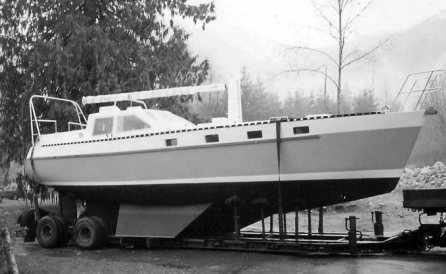
First, I’d like to clear up the terms I use. Every dictionary I’ve seen agrees that the maritime “keel” is the structural backbone of the vessel. So, to my way of thinking, there is no such thing as a fin-keel yacht any more than a shark is a “fin-backbone fish.” The boat is a fin yacht. Similarly, with apologies to Craig Anderson, editor of the very informative and interesting Twin-Keeler newsletter, I prefer to call the boats “twin-fin” and “bilge-fin” yachts.
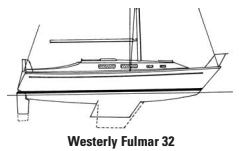
The bilge-fin yacht carries its main ballast in a central fin, which may be full length, as in a full-keel yacht, or carried in a shorter fin. However, the vessel’s main lateral plane is provided by an unballasted or lightly ballasted fin on each side of the central fin. In effect, she really has three fins! I feel this form is best suited to heavier displacement vessels of the motorsailer type, where minimal draft is essential since wetted surface is increased substantially and performance hampered by the added resistance.
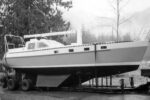
The true twin-fin yacht, on the other hand, has no central ballast fin, and the ballast is carried in the fins with perhaps a small amount of trim ballast in the canoe hull itself. Thus, wetted surface is kept reasonable and, with good design, the yacht’s performance can be as good as, or better than, that of a full-keel yacht of the same draft.
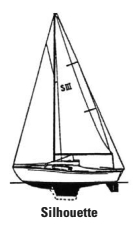
My introduction to twin-fin yachts came in the late 1950s when a U.S. firm was heavily touting the Robert Tucker-designed Silhouette, a 17-foot, V-bottom, plywood cruiser built in England. The importer ran big ads in all the yachting magazines . . . ads replete with greatly exaggerated blurbs about the advantages of the twin-fin design, with the result that several thousand of the little yachts were sold in only a few years.
Could not resist
I was working in Canada at the time, and bringing an English boat up from the U.S. was simply not practical. But in 1958 I ran across an ad in a British yachting journal for the V-bottom Caprice, an 18-foot 4-inch Tucker design, also built of marine plywood. The price was right (I could just barely afford it) at about $1,450 delivered to Toronto, Canada, complete with a very temperamental Vincent two-stroke inboard motor of about two Shetland-pony-power. I could not resist it and quickly placed my order.
The new boat, which I named Phialle (Greek: a small drinking vessel), arrived in the spring of 1959 and looked very attractive in the dockyard, her bright red hull sitting upright on her twin fins with no need for a cradle. We cleared her through customs, launched her, stepped the mast, unpacked the sails, and were away and sailing inside of two days. Unfortunately, we soon found that, having been designed for the blustery winds of the English Channel, she was woefully undercanvassed for the light summer breezes of Lake Ontario. So Phialle was sold when I moved to Connecticut to work for Bill Luders in 1960.
In defense of Robert Tucker designs, I must add that Shane Acton and his Caprice, Super Shrimp, eventually circumnavigated the globe, and Tristan Jones cruised his Tucker-designed 21-foot, bilge-fin Debutante, Sea Dart, across oceans and up the Amazon. Tucker designs were simple, but able, small yachts with a deserved reputation for seaworthiness. Other British designers were working on twin-fin yachts in the late 1960s also, resulting in a raft of small cruisers and a number of larger ones. Many of these craft were built in fiberglass and exported to North America. One 20-foot Vivacity, Mini, was sailed from the West Coast to Hawaii in 1992, despite 40-knot winds and 35-foot seas . . . solid proof of the ability of these mini-yachts.
Bigger boats
Larger twin-fin designs were not ignored and, in the 1960s and ’70s, Macwester Marine produced a series in sizes 26, 28, and 32 feet, while Kingfisher offered a line of 22-, 26-, and 30-footers. According to Kingfisher, one of their 26-footers placed second overall in the Round Great Britain Race and later won the Singlehanded Transatlantic Race Monohull Handicap, being the first boat under 30 feet to finish; definitely an enviable record for any boat whether single-fin or twin.
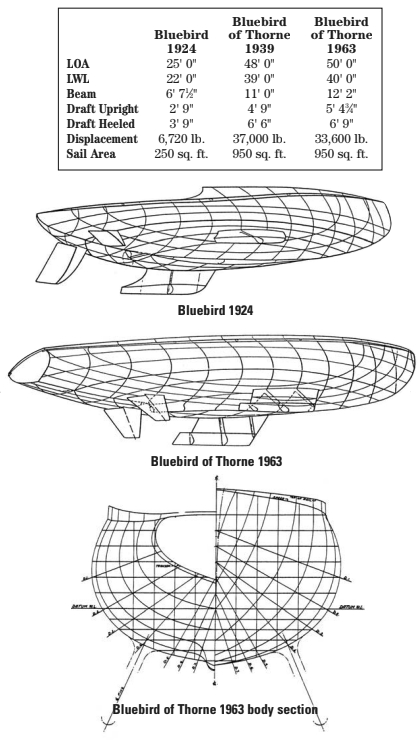
Twin-fin yachts are not exactly new; the history of the type began about 80 years ago in 1923 when Lord Riverdale performed towing tests, upright and heeled, along with free-sailing tests, on 25-inch-long models. Eventually this resulted in a design for a 25-foot double-ended, twin-fin, twin-rudder cruiser, Bluebird, which he built himself in 1923 and ’24. She was, as he admitted, a bit extreme with her symmetrical fins and rudders angled outboard at 30 degrees, but she was definitely successful and was still sailing more than 45 years after her launching when I checked.
In 1939, Lord Riverdale tested and designed a larger vessel, the 48-foot Bluebird of Thorne, an unusual twin-fin yacht with a central ballast “pod” and with the twin fins angled 25 degrees from the vertical and connected to her twin rudders. He sailed her some 40,000 miles in the years up to 1961 and claimed she had good seakeeping and balance qualities but was slow in light winds. He admitted that she was a step backward with her central ballast pod. It is significant that, on his last yacht, Lord Riverdale returned to the twin-fin design with no central ballast.
True twin-fin
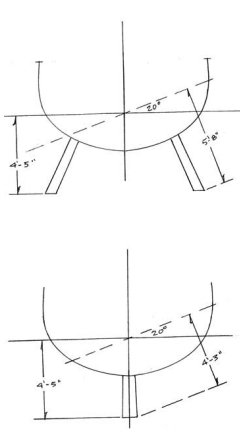
His final twin-finner, the 50-foot Bluebird of Thorne, was designed by the well-known British designer Arthur Robb, in collaboration with Lord Riverdale, and launched in 1963. This was a true twin-fin hull and perhaps the first to have asymmetrical fins, fitted at 24 degrees from the vertical, along with twin symmetrical rudders of unusually small area. The table shows some data on the three Bluebirds, and the reader will note the great difference in heeled and upright draft. Unfortunately, Lord Riverdale did not indicate the heel angle but, on the lines of the 1963 boat, I roughly worked out the 6-foot 9-inch draft to be with the fin vertical at a 24- degree heel.
I think this is a bit extreme as, when heeled that far, the weather fin will be at the surface, creating added wave resistance. I feel that 20 degrees would be a more realistic maximum heel and would result in a heeled draft of about 6 feet 6 inches. That is still quite impressive when you consider the draft of a similar single-fin hull would be reduced to about 5 feet 2 inches at 20 degrees of heel. The much deeper twin-fin will make a substantial difference in reduced leeway.
Based on his experience with the 1963 design, Arthur Robb claimed several major advantages for twin-fin craft:
- Elimination of the complexity of the centerboard (no doubt about that!).
- Lateral-plane efficiency increases with heel angle, rather than decreasing as it does on a single-fin yacht.
- The vertical center of gravity is equal to that of a single-fin or keel/centerboard yacht of equal draft; thus stability is not impaired.
- The weather fin produces downward lift that increases heeled stability.
- The fins provide some lift at speed when the hull is upright.
- Directional stability is enhanced.
- Improved efficiency under power and better control in reverse.
- The ability to ground out upright in tidal waters.
- Smaller rudder area is possible if twin rudders are fitted, as the lee rudder is nearly vertical and in the accelerated flow from the fin.
I used single centerline rudders on my twin-fin designs so I cannot comment on the last claim. The complexity and extra cost of twin rudders seems to outweigh their benefits, and most twin-fin boats I’ve seen use a single rudder.
The twin-fin design improves efficiency under power since the propeller can work in clean water, undisturbed by the wake of a central fin. Then, if a folding propeller is fitted, the drag under sail will be absolutely minimal. Arthur Robb also claimed higher speeds under sail for the twin-fin than for “an orthodox cruising yacht.” By “orthodox,” I believe he meant a typical full-keel auxiliary of that era. Robb may well be right in this respect as the twin-fin yacht can have less wetted area than a full-keel vessel. This is not necessarily true of the modern deep draft, single-fin cruiser which, I feel, still has a performance edge over a well-designed twin-fin craft, particularly at lesser heel angles.
Ratio changes
However, as heel angle increases, the effective aspect ratio of the single fin decreases, while the aspect ratio of the twin fin increases up to the point where it becomes vertical to the surface due to heel angle. Thus, there may be some angle of heel at which the twin-fin equals or outperforms the single-fin even if the latter yacht is of slightly deeper draft when at rest.
Ed Dubois, a well known English designer, points out that the extra wetted surface of the twin-fin yacht is only significant at low speeds, where surface friction is the major component of resistance. Wave-making is the prime source of drag at more usual sailing speeds, and surface friction is only a small portion of the total resistance. Thus the performance of twin- and single-fin yachts tends to even out as speeds increase. Dubois also claims the twin-fin yacht to be steadier on the helm in a seaway, while Patrick Bray, a Canadian designer, believes that the twin-fin yacht has superior performance in heavy weather due to the damping action of the fins reducing roll and pitch.
Bray also states that properly designed and placed twin fins alter the wave pattern, reducing the midship wave trough and flattening the stern wave. He feels that this can increase the maximum hull speed by as much as 15 to 20 percent. Although he has tank tested a model of a 38-foot motorsailer, I have to admit to being skeptical about such a huge performance increase. Still, it would be fascinating to tank test a complete series of twin versus single fins; shoal fins, deep narrow fins, single vs. twin rudders, and so on. Would any reader care to donate several hundred thousand dollars for science?
Increased angle
Lord Riverdale, and many other designers, commonly toed in the twin fins at a 1- to 2-degree angle to the hull centerline in order to increase the angle of attack and so increase lift. This would seem to be advantageous if the fins were symmetrical foils. However I used asymmetrical foils on my twin-fin designs and set them parallel to the centerline as I felt that the asymmetrical foil would develop adequate lift while toeing-in would simply increase resistance when running free or under power. Again, only a complete tank testing program could determine which is the best route to go and, even then, it might vary with hull and fin type.
On my own twin-fin designs, a 54-foot ketch, a 60-foot ketch, and a 60-foot schooner, I set the fins at a 15-degree angle to the vertical as I felt the modern, beamy boats would heel to a lesser degree than Lord Riverdale’s narrower Bluebirds. On studying things further I’d be tempted to set the fins at a 20-degree angle today as there would seem to be some advantage to having the fin angled slightly to leeward even when the boat is sailing at a good angle of heel. Patrick Bray has noted that if the fin is still angled outboard 5 degrees or so when the boat is heeled, there is less tendency for crossflow beneath the fin with its resultant vortex-forming drag. I have used wide “foot plates,” protruding 5 to 6 inches outboard of the fin, to reduce crossflow, and they also help keep the boat from sinking too deeply into the muck when dried on an outgoing tide.
There’s still much to learn about the capability of twin-fin yachts. It is quite possible that the type would form the majority of cruising yachts today if half as much experimenting and tank-testing had been done on twin-fin as has been done on full-keel and single-fin sailing craft. The real potential of the type is still largely unexplored. I hope future designers will approach the twin-fin yacht with an open mind and give it the chance it deserves.
Thank you to Sailrite Enterprises, Inc., for providing free access to back issues of Good Old Boat through intellectual property rights. Sailrite.com