A quick look at the complicated business of finding the right propeller
Issue 29 : Mar/Apr 2003
Nearly all cruising and most racing sailboats have an auxiliary engine and an associated propeller. Apart from the inescapable technical factors that determine propeller dimensions, there are quite a few options offering different compromises between efficient propulsion under engine and minimizing drag under sail.
Propulsion basics
We won’t delve into the technology of propeller design or selection for particular boats here; there are books, Internet sites, and firms specializing in this business. Even so, one can’t escape a few technical terms.
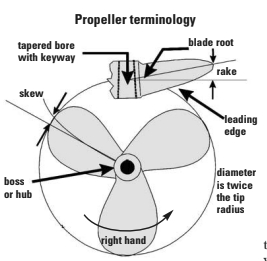
At the most basic level, a propeller is described by its diameter, pitch, and number of blades. In theory, propellers are selected for a particular power, design boat speed, and shaft speed. The total blade area must be large enough to convert the available power into thrust and is, therefore, linked to the number and shape of the blades and their diameter.
Pitch may be thought of as the distance the propeller would, in theory, screw itself forward in one revolution through a solid material. The pitch is selected so that at the design speed of revolution and boat speed, the theoretical advance speed of the propeller (pitch times revolutions per minute) is somewhat faster than the boat speed. The difference is termed “slip” and is necessary to produce an angle of attack between the blades and the water.
Propellers produce thrust over a wide range of slippage, but there is an optimum value that maximizes thrust per horsepower. The number of shaft revolutions per minute (rpm) is not usually the same as the engine’s rpm, because most yachts have a reduction gearbox that can also reverse the shaft rotation direction so the boat can go astern.
The gearbox reduction ratio is another variable in propeller selection — greater reduction leads to larger, slower, and more efficient propellers, but there are practical limits on this. These include cost, mounting space, and especially, drag under sail.
Engines and propellers
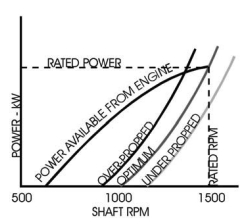
The diagram at left shows representative curves for the power output of a typical diesel engine and the power required by three propellers at varying propeller-shaft speeds. In theory, to be able to make full use of all the power available, the propeller curve should intersect the engine curve where the engine is producing its maximum rated power. If the propeller had greater (coarser) pitch or larger blade area, it would require more power at lower rpm, and the engine would begin blowing black smoke as the governor supplied excess fuel in a vain attempt to reach its rated speed.
In this case, the boat is said to be over-propped, and the engine is showing signs of overloading. If, on the other hand, the propeller has less (finer) pitch or smaller blade area, the engine will run up easily to full speed without blowing smoke but will not be using as much fuel, nor producing as much power, as it is rated to do. In this case, the boat is under-propped.
In real life, few yacht owners routinely run their engines at full power, but most expect it to reach its rated revs when they want it to and not to blow black smoke. The propeller could be selected for any lesser boat speed but, given a sufficiently large engine, most are chosen so the boat can achieve pretty close to displacement hull speed in calm water.
This is a reasonable basis for selection, but it means that the propeller pitch is inefficiently coarse if full engine speed is called for when conditions prevent the boat from moving at hull speed. The engine might even be overloaded. Head seas, a headwind, a fouled hull, or the need to tow another yacht can all have this effect. Furthermore, there is definite merit in choosing a finer-pitched propeller (for lesser boat speed) so full power can be efficiently applied when really needed.
There are also inefficiencies in the other direction — yachts that are motorsailing generally run their engines in supplementary mode at moderate or low engine speeds, and then the pitch of their propellers is inefficiently fine.
Some propeller options address these pitch/efficiency problems, and the possibility of maximum thrust under adverse conditions is worth considering. Sailors are less inclined than motorboat owners to be greatly concerned by fuel efficiency but are very likely to be interested in minimizing propeller drag under sail.
Sailing drag
When the engine is not supplying power, a propeller creates drag that increases rapidly with boat speed. At low speeds or at high speeds when there is plenty of wind, propeller drag is not of much consequence for a displacement yacht, but in between these two extremes it can slow the boat significantly. The difference between a folding and fixed propeller may be half a knot or more in your sailing speed.
At some speeds, the drag of a fixed-blade propeller may be reduced by allowing it to freewheel, but at others it may even increase. This might be worth experimenting with (the speed log or GPS should reveal any significant benefit).
For cruising boats, however, the additional noise and wear count against this, especially since some gearboxes don’t have an oil supply to their thrust bearing unless the engine is also rotating. The usual practice is to lock propellers when sailing by engaging reverse gear, although in some cases a disk brake is fitted, acting on a disk at the gearbox/shaft coupling.
Fixed blades
So far we have been considering the situation as it exists for the conventional fixed-blade propeller. The main advantages of fixed blades are that they are strong, relatively cheap, and built with a twist in the blades so the whole blade has the same angle of attack on the water. A blade experiences a relative water flow that is a combination of the boat’s forward motion plus a much larger tangential component due to rotation. The tangential component increases with radius, so the blade angle needs to reduce toward the tips. The resulting twisted blade produces maximum efficiency but only under the specific conditions for which it was selected, including an assumed speed through the water.
Over-propping can be counteracted by reducing the diameter in a lathe, and in some cases it is possible to take a fixed-blade prop to a propeller shop for slight changes of pitch, but such experimentation is expensive. Other possibilities become available with propellers that have articulated, rather than fixed, blades.
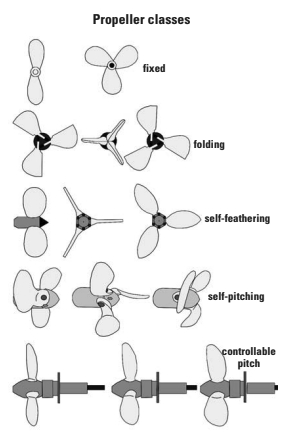
Folding props
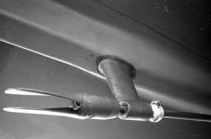
Folding propellers remain a common choice on racing yachts. The two-bladed versions have a longer history and are mechanically simpler. The basic type has just a single pivot about which the blades can swing independently. More recent patterns with separ- ate pivots link the blade movements by meshing gears at the base of each blade, ensuring that both open by the same amount. The propeller pitch is fixed during manufacture.
When rotated by the engine, the blades fly open under centrifugal force, and in forward gear are also forced forward against stops by the lift forces on the blades. When the boat is sailing and the engine is not engaged, the passing water pushes the blades backward. Two-bladed versions can nest the blades compactly back to back, while three-bladed versions rest the trailing edges together or slightly separated. Either type presents a greatly reduced resistance to the flow and, compared with all other options, is the least likely to catch seaweed or ropes when sailing.
Some versions claim additional features, such as the Gori overdrive, in which the three blades can open either way, depending on which way the shaft initially rotates from the folded position, presenting the same leading edge in forward or reverse. If they are opened in reverse and the engine is given a good squirt, the resulting water flow can hold the blades open long enough for forward gear to be engaged. In this orientation the blades have greater pitch, which better suits motorsailing.
Folding propellers are available in a wide range of sizes and can be quite satisfactory for auxiliary power, but are heir to several problems. The most significant is their poor and sometimes unreliable performance in reverse. In this mode, centrifugal force attempts to open the blades, but blade lift tends to close them.
To maximize their opening, operators need to run them at high rpm, which maximizes centrifugal force but creates massive cavitation, destroying thrust. The problem is worst during emergency stops because the yacht’s forward motion also tends to fold the blades.
Another common problem with single-pivot, twin-blade folding propellers is that gravity may partly open the lower blade if the pivot is horizontal. Locking the shaft with the pin vertical may minimize this, but before a race many crews put an elastic band around both blades (which breaks or dislodges when the engine is engaged).
Self-feathering props
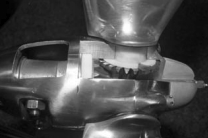
Self-feathering props are also available in two- or three-bladed versions. The blades are mounted into a hollow hub on spigots that are able to rotate between stops. The blades are without any twist and are shaped such that their center of lift (and drag) is behind their pivot. This tends to make them self-align with the water flow.
When the shaft is stationary, the blades are edge-on to the passing water and present a small cross-section. When the shaft is rotated by the engine in forward or reverse, the blades attempt to align themselves with the relative water flow but are prevented from completely doing so by stops which hold them at some pre-set maximum angle.
A useful characteristic of these systems is that their blades also reverse to face the flow when going astern, which gives them unusually good performance in this mode. This compares favorably with fixed-bladed and some controllable-pitch propellers whose blades are designed to operate efficiently in forward gear and are significantly less effective when operated in the reverse direction.
In most cases, the blades of self-feathering props are linked by gears or other mechanisms within the hub so they open simultaneously by the same amount. Most incorporate adjustments that allow the owner to alter the pitch stops. In some cases this can be done by a diver without having to dismantle anything. This can be very useful when you’re trying to match the propeller to the boat and engine, and it allows the investment to be transferred to another boat or another engine.
Being able to adjust forward and reverse pitch stops independently is another useful feature, allowing experimentation in reverse settings, for example, to maximize thrust or reduce prop-walk.
Disadvantages may be the need for occasional lubrication of the hub (which must have little friction if the blades are to self-align under sail), usually from a grease gun. There is also an increased vulnerability to mechanical damage. A blade is replaceable and a spare might even be carried, but it should really be factory-balanced to match the original.
The lack of blade twist means that self-feathering propellers are not quite as efficient as propellers with twist when operated under design conditions. However, most yacht motoring and motorsailing takes place under quite different conditions, and most owners would rate reduction in drag under sail as more important than peak efficiencies anyway. Feathering propellers are made by many firms and have such useful advantages — less drag and the ability to alter pitch — that price is probably the only consideration preventing them from completely supplanting fixed-blade propellers in sailing boats. While most are made from bronze or stainless steel, composite engineering plastics are starting to be used for some components.
Self-pitching props
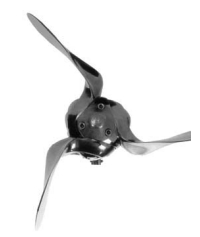
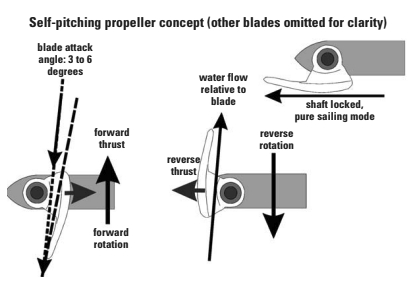
Self-pitching propellers are a quite different approach to the pitch-selection problem. Each blade is independently mounted on a radially pivoted crank arm so that it is essentially free to align itself with the passing water. When rotated by the shaft, centrifugal force tries to swing the blades square to the shaft, but the blade sections are slightly asymmetric and shaped so they naturally adopt the correct angle of attack to the water flow. They therefore develop lift, much like a cambered wing. When the yacht is sailing, the blade wings point nearly straight ahead, but if the engine is engaged and the propeller as a whole rotates, they automatically pivot to maintain their angle of attack to the water.
Compared with a fixed-blade propeller, this is a great improvement, increasing the effectiveness of the propeller when operated away from the assumed design boat speed. The practical results bear this out, with people I’ve spoken to agreeing with the manufacturers’ claims for increased boat speed at maximum and intermediate rpm, and noticeable fuel savings.
These propellers also self-feather under sail, but the asymmetric blades tend to rotate the shaft, so locking is still advised. Self-pitching propellers may have slightly more sailing drag than ordinary self-feathering types, but the difference is probably too small to notice.
The arrangement works in forward and reverse gears, and the only drawbacks seem to be price, damage vulnerability (probably similar to feathering props in this regard), and perhaps the greater axial space needed to accommodate the blades, which are in different positions in forward and reverse.
Most boatowners could never justify the extra cost of a self-pitching propeller on the basis of fuel saved, but the ability to get extra thrust when the boat is already sailing fast under sail or to effectively use full power against a headwind or sea are more tangible benefits. The ability of these props to extend the range yielded by a given fuel load may also justify their cost to some cruisers who need a long motoring range. They seem destined to become more common, particularly on motorsailers where they may be seen as a reasonable alternative to our last propeller option, which is very expensive.
Controllable-pitch propellers
Controllable-pitch propellers are widely used in commercial vessels and might be more common in yachts if it weren’t for their price and installation requirements. All the previously considered options can be designed to mount on a conventional propeller shaft, with a standard shaft taper, keyway, locknuts, split pins, and so forth and can usually be retrofitted easily. But controllable-pitch propellers use a hollow propeller shaft through which control tubes or rods move forward or backward to simultaneously change the pitch of all the blades. In some cases, the propeller and shaft actually move forward and aft, too.
The hollow shaft, control system and, in some cases, the shaft tube and bearings are supplied as a unit. The gearbox may also be an integral part of the installation. Several levels of control sophistication are possible, but essentially a controllable-pitch propeller can be adjusted to absorb as much power as the engine is able to supply at any combination of shaft rpm and boat speed. Diesels operate more efficiently when well loaded. An adjustable-pitch propeller can be thought of as being the equivalent of a whole range of different propellers (with the same diameters) selectable at the push of a button or lever.
Some systems are fully reversible and don’t need a reversing gearbox, but these types may not be able to align the blades fore-and-aft for minimum drag under sail.
There also is, or was, a cheaper version that could only adjust the pitch when the shaft was stationary, but the main brands can be adjusted under power. Finding the sweet point for a given situation may involve a little trial and error, but the exhaust gas temperature is sometimes monitored to avoid overloading the engine, and a speed log in combination with a fuel-flow monitor can also be useful in revealing efficiency changes.
As with feathering propellers, the blades of adjustable-pitch propellers are not twisted. Therefore the actual blade angle of attack is different at different diameters, so the overall result is an average and is, as a result, less efficient than a fixed-blade propeller operated under its design conditions. For sailing yachts, this is not a significant issue compared with the reduced drag under sail and an ability to adjust pitch to suit actual conditions.
The Atomic 4 problem
The use of the Atomic 4 engine in smaller boats caused special problems. The engine is rated at 30 horsepower when turning at 3,500 rpm. It was fitted to many smaller boats that did not require even half this horsepower. These small-boat applications used a direct-drive transmission and a fairly small-diameter prop. The final drive ratio of 1:1 allowed the prop to turn reasonably fast at a low engine speed. At that low engine speed the Atomic 4 was able to develop about half of its rated horsepower, but that was all the horsepower that was needed.
The engine and prop were reasonably effective in the original form, but some boatowners complained of poor performance in reverse, and there were serious problems when these boats were retrofitted with diesel engines. In both cases, the small prop was the cause of the problem. This was further aggravated by the A4’s planetary transmission, which had a very low gear ratio in reverse.
Retrofit diesels that are used to replace the Atomic 4 will typically have about a 2:1 reduction gear in their transmissions. This means the prop will be turning at half the speed that it would be turning with a direct drive. The diesels tend to be rated at about half the horsepower at 3,000 or even 3,600 rpm and so need to be able to run very close to maximum rated speed to do the job.
The 2:1 reduction gear would allow this, but at half speed the original props are not able to deliver the power to the water. The solution is to select a much larger-diameter prop, but the physical arrangements of the hulls often do not allow these larger props the space they need. Apertures are too small, and the shaft and strut layout on fin-keel boats does not allow adequate clearance between the prop and the hull.
These problems cause people installing diesels to choose three-bladed props where two-blades had been used with the A4. This compromised solution is not always as effective as a larger two-bladed prop would be.
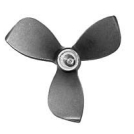
There are two special propeller designs on the market that target these problems. Indigo Electronics offers a nickel-aluminum-bronze alloy, three-bladed propeller with a shape that is very wide near the ends of the blades. This allows the three-bladed prop to deliver the necessary power with only a 10-inch diameter. The blades have winglets to reduce the noise generated by vortices coming off the tips and striking the hull. These same winglets will increase the lift of the short blades.
The prop has better than normal performance using the Atomic 4 engine in the original application. It allows more engine speed to develop, and allows the engine to deliver the required horsepower at a higher rpm with less lugging.
The CDI Extendo prop attacks the diesel conversion problem. This prop has a 6-inch-long hub forward of the blades that allows the blades to be positioned farther aft. In the case of most fin-keeled boats, the hull is sloping up in the vicinity of the prop, and the shaft is angled down. Additional clearance is gained by moving the blade disk further aft. This can allow the application of a 15- or 16-inch prop where only a 13- or 14-inch prop could be used before. The added overhung loading is mitigated to some extent by the prop being made of a lightweight urethane material. In addition to allowing clearance for a larger-diameter prop, the Extendo has the variable-pitch features of the PerfectPitch prop that is also offered by CDI.
Variable pitch
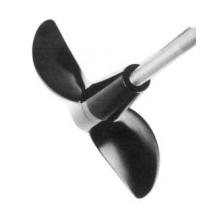
The CDI PerfectPitch prop achieves pitch variation by a controlled distortion and deflection of the blade as the load changes. The prop is made of a hard, high-strength urethane material engineered to change shape in response to loading and direction of rotation. In the forward direction under light load the prop is (by selection) slightly overpitched. This allows the engine to run at a reduced speed but still be well within its appropriate loading range so that it does not smoke or lug. As the loading increases in the forward direction because of higher speed and/or rougher seas, the prop depitches to allow the engine to reach full speed and still remain properly loaded.
The cross-sectional blade shape of the PerfectPitch prop is closer to a symmetrical foil so the prop will function better in reverse. In reverse the prop pitches up, instead of down, compensating for the lower gear ratio that marine transmissions have in reverse. This gives the prop better performance than a fixed prop when backing.
Two vs. three blades
Yacht propellers are generally two- or three-bladed, and most varieties are available in either form. In principle, two-bladed props can be more efficient and, if fixed, may also produce less sailing drag if the propeller can be locked vertically behind a keel. This advantage isn’t a possibility in modern short-keeled yachts, so the choice between two or three blades usually depends on other factors.
Three blades are likely to produce less vibration and may be more robust than an equivalent two-blade, but the deciding factor may well be the space available to swing the propeller, because three-bladed propellers can be smaller in diameter. The closer the blade tips pass by the hull, the more noise and increased vibration is likely to be felt within the boat.
The usual rule of thumb is to provide a tip/hull clearance of at least 20 percent of the propeller diameter. Another factor encouraging smaller diameter, three-bladed, rather than two-bladed, propellers is the need to keep the tips immersed as deeply as possible to minimize air entrainment and cavitation. However, a counteracting factor comes into play when considering propellers with articulated or adjustable blades because two-bladed systems may be cheaper or stronger.
A few last points
- Propellers with articulated blades are intrinsically more vulnerable to fouling, damage, and galvanic corrosion. They need good, but not excessive, cathodic protection, periodic lubrication, and inspection to remove barnacles or debris that may prevent articulation.
- Be critical when considering manufacturers’ claims — efficiency comparisons are sometimes misleading and, for most sailors, efficiency is a secondary consideration compared with reliability, prime cost, and sailing drag.
- Whatever sort of propeller you use routinely, it’s a good idea to carry a backup. Even if the backup is far from optimum — provided it has a compatible taper and keyway and you carry spare nuts, split pins, and a diving mask — you are prepared for something that probably won’t (but just might) happen.
Thank you to Sailrite Enterprises, Inc., for providing free access to back issues of Good Old Boat through intellectual property rights. Sailrite.com