How to stop a diesel that’s running amok
Issue 31 : Jul/Aug 2003
A runaway diesel engine can be a destructive, dangerous, and terrifying experience for people nearby. Although it happens infrequently, a runaway is possible if you overfill the crankcase with oil, are motorsailing at too much of an angle of heel, or have certain mechanical problems. Closing the throttle or turning off the fuel supply from the tank will have no effect because the engine is burning lubricating oil, not diesel fuel. I’ve only had a runaway engine once, about 20 years ago, but that was enough to make me take precautions in case it happens again.
A diesel engine that is running can only be stopped by eliminating the fuel source, the air source, or the compression. The fuel source — such as too much crankcase oil — cannot be easily shut off. If the engine is equipped with compression-release levers, the compression can be eliminated by raising these levers, which will stop the engine. Some engine manufacturers, however, warn that if the compression levers are lifted when the engine is operating at high speed, the pistons can hit the valves, causing severe internal engine damage. This leaves shutting off the air as the safest alternative.
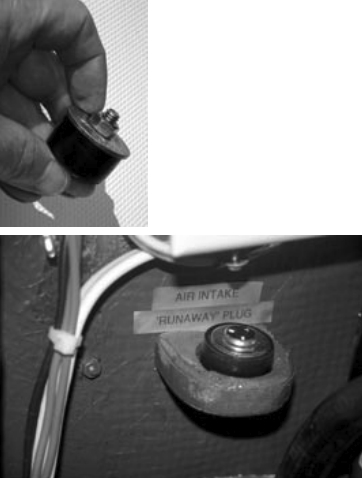
Just inside the engine-compartment door, within easy reach from inside the cabin, I have a small wooden rack that holds a rubber plug that fits snugly into the engine’s air intake. In case of a runaway, it can be rapidly and safely inserted in the air intake — before any engine damage can occur, I hope.
This rubber plug, which was purchased at a local hardware store, also serves a dual purpose. Most engine manufacturers recommend that rubber plugs be inserted in the engine’s air-intake and exhaust ports during the winter lay-up to prevent condensation from forming inside the engine due to cold, winter air — so my runaway plug also serves that purpose.
And just in case I forget to remove the rubber air-intake and exhaust plugs during spring commissioning, I have a sign in front of the engine control panel to remind me.
Thank you to Sailrite Enterprises, Inc., for providing free access to back issues of Good Old Boat through intellectual property rights. Sailrite.com