How a mysterious mechanical malady was finally cured
Issue 32 : Sept/Oct 2003
The other day we were out sailing and headed home when the wind died. We turned on the engine and motored back to the harbor. The engine ran fine for about the first hour. After that it ran, but it would vary its speed without my moving the throttle. It was as if it was hunting, up and down, up and down. It would go from 2,200 rpm to 2,600 and back to 2,200, wait a little while and then do it again.
We had had this condition last year, and I couldn’t figure out what it was or find anyone who actually knew about it. This year I was determined to fix the problem once and for all because we were planning a Florida cruise and did not want to have questionable engine control.
After calling around to several people, most of whom did not have a clue what the answer was (like me), I found a fellow who said, “Oh yeah, that’s air inhalation.”
“Air inhalation?” I thought, “When the engine increases in rpm?”
The answer was yes, it does that. It is a known phenomenon and yes, it is caused by air inhalation affecting the governor. The advice I got was to check the filters and check the suction tube to be sure that there was a free flow of fuel to the engine and that air is not entering the line at some point. The air disrupts the governor control of the speed of the diesel and allows it to speed up momentarily. He said when we had a free flow of fuel to the engine and found the air leak, the problem would go away.
Unbeknownst to him, fuel filters had been on my mind since they hadn’t been changed in a while. As a matter of fact, I had bought a brand-new Racor filter and new filter elements only to put them in the spare parts locker thinking I would get to it one of these days. Now “one of these days” had arrived! In addition to the filter changes, I had to look for an intermittent air leak as well.
Impossible to reach
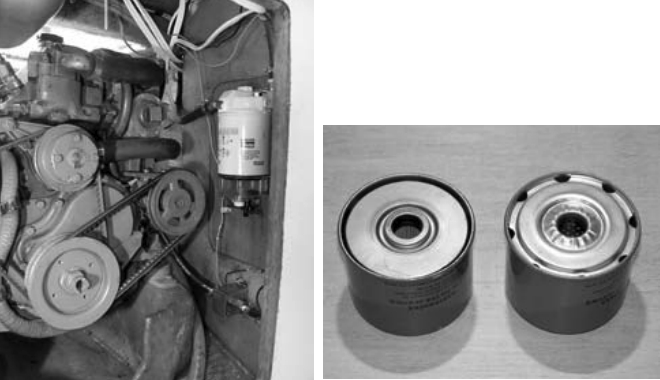
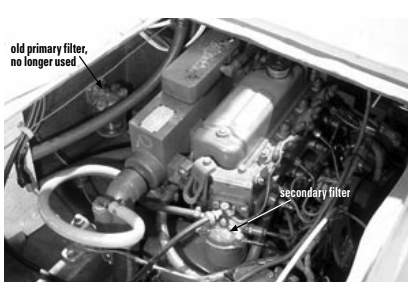
The reason I was reluctant to change the filters was that the primary filter (the one off the engine) was mounted alongside the engine underneath the water hoses, underneath the bilge pump hose, and screwed to the bulkhead. It was impossible to reach (see photo on Page 68). There was no way I could check it, clean it, and put it back. Even lying on top of the engine, it was a one-handed proposition if I could get to it at all. I decided it was necessary to redo the entire fuel system, start from scratch, rip all the old stuff out, and replace it with new.
Easier said than done. The old primary filter was extremely difficult to loosen from its lines and didn’t want to come out at all. The lines actually draped down into the bilge and had obviously been spliced at some point into two or three sections. This was very unsatisfactory as far as I was concerned and might, in fact, be where the air leak was located.
After much ado, the original primary filter came out with its attendant fuel lines. It was filled with an incredible amount of water and black goo. I don’t know how the engine ran at all. I took the secondary filter canister off the engine so that everything was removed.
The only problem I had was the fuel supply to the secondary filter from the mechanical fuel pump underneath the manifold on the port side was totally inaccessible. I could feel the fitting, but I couldn’t see it. There was no way I could reach it. I decided the better part of common sense in this case was to cut the line and splice it because it was otherwise impossible. I cut this and took all the lines off the boat.
Better access
The next day I decided where to put the new filter to improve access. Up forward in the engine compartment on the port side is a piece of bulkhead with nothing on it. It is accessible by removing the companionway steps. I thought this was a perfect place for a filter (see photo on opposite page). I could get at it and under it. I could drain it, put a new element on it, and do anything I needed to with it. The new filter was installed in that location and new lines, selected especially for their fire resistance, were run from the tank to the filter. I added a new gadget called a filter gauge that measures the pressure drop through the filter. At a pre-determined reading, it is time to change the filter cartridge. I mounted this gauge on the bulkhead adjacent to the galley so it would be easy to see and easy to read.
After running all the new lines, I filled the primary and secondary filters. I thought I had bled the system. Well, I hadn’t. I started the engine; it ran for 10 seconds and shut down. So much for that! I had to bleed the system . . . a real pain considering I have to lie on top of the engine to get at the injection pump to bleed it. I followed the manual exactly, but no matter what I did the engine would not start. I gave up and called a qualified diesel mechanic for help.
He arrived and could not start the engine either. Two hours later, we were no better off than when we started. He recommended changing the old mechanical fuel pump for a new electric model, thinking the air problem might be coming from the 25-year-old mechanical pump. It would also make future fuel filter changes a lot easier, as all I would have to do was flip a switch, and fuel would be pumped through the system. No more lying on the engine and physically pumping the mechanical pump under the manifold.
Never be sure
I agreed to the work, and we set a day aside to do the changeover. I was sure this would solve the starting problem once and for all. But you can never be sure of anything when working with an engine!
We did all of the work and installed the new pump under the new primary fuel filter. We had to completely isolate the old mechanical pump by removing the fuel lines but left the pump body in place, as it connected to the oil gallery where it was driven by a lobe on the camshaft. If we removed it, we would have been left with a hole in the block. Anyway, there was no way to get at it without removing the engine from the boat.
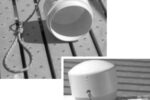
The new electric fuel pump worked fine, except we could not get it to prime the engine. Back to the drawing board. I decided to remove the secondary filter as we had proved we had lots of fuel to that point. When I looked at the new secondary filter I realized the fuel was supposed to exit the filter at the rim. This path was being blocked by the gasket that is supposed to prevent leakage. What to do? The filter was full of fuel that could not get out to prime the system. The filter I had removed, the old one, had a series of half-moon holes around its perimeter to let the fuel out. The new one, bought with the same part number as the old one, did not have these holes (see photo). In an attempt to remedy the problem I took an ice pick and carefully punched a ring of holes in the top of the secondary filter just like the old contaminated filter had, reinstalled the secondary filter, primed the system per the manual, and the engine started. Problem solved!
Roundabout cure
This was a really roundabout way to solve my mysterious diesel problem, but it is finally solved. Two people spent two days trying every trick they knew.
The moral of this story is that fuel filters and an air-tight fuel supply are vitally important to the health of your diesel engine. This is not to slight gasoline engines because filters are important there, too. I replaced the old filters on the gas engine in my Pearson Ariel and put the new ones in an accessible spot. Every few months when I checked the filters, any water that had accumulated could be drained.
The filter could also be easily topped off so that the engine did not have much of an air bubble to contend with. But gasoline engines are more tolerant and can digest a little air now and then. A diesel cannot stand any air at all. My current engine is 25 years old and was not the self-bleeding type. It can now self-prime with the electric fuel pump.
I called the engine manufacturer and explained my problem with the secondary filter. They sent me a new secondary filter, free of charge. It had a set of half-moon holes just like the original filter. Two different filters with the same part number? Yes, but now I know which one to use.
The total bill for all of this work was about $600. One cannot buy a new engine for $600, so it was worth it. Not only that, but now I have confidence in my fuel system and engine for the trip I have planned.
If there is any question about access to your fuel filters or fuel pump, take the time (it will probably take you about a week, working part time) to find and remove the old filters. Run the new lines, install new filters, install a new electric fuel pump, and bleed the system back. Be sure the replacement parts look exactly like the ones you are replacing (except for the new fuel pump, of course) lest you have my problem.
It is unusual in today’s quality-conscious manufacturing environment but mistakes still happen. I have proof of that.
Cheap insurance
Clean filters and an electric fuel pump are cheap insurance for the trouble-free use of your boat. The new electric fuel pump is definitely an improvement. I did not know you could add one so easily. It costs a couple of hundred bucks, but I think it’s worth it.
Now that I think of it, the old gasoline Atomic 4 had an electric fuel pump added at some point before I bought the boat.
As a final thought on another engine auxiliary part, the external voltage regulator for the alternator on my engine quit this spring and could not be removed easily. I found that I could buy a regulator that mounts on the side of the alternator in place of the old one and it is easily rewired. At the rate I am going, nothing will be original on this engine except the block. That’s OK as long as it keeps running. Sometimes after-market products make life easier. They certainly improved mine.
Thank you to Sailrite Enterprises, Inc., for providing free access to back issues of Good Old Boat through intellectual property rights. Sailrite.com