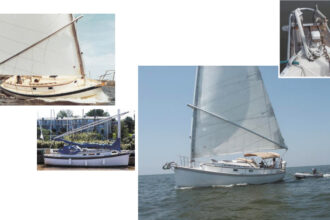
The Com-Pac 23 is a trailerable pocket cruiser with sturdy, traditional lines
Issue 32 : Sept/Oct 2003
Florida resident Jim Lennox seems to have figured things out pretty well. He’s the antithesis of retirees who become so bored that they take jobs flipping burgers in fast-food restaurants or as greeters in department stores just to have something to do. Not Jim. “I try to go sailing almost every day,” he says, “and I don’t miss many opportunities.” Who says it’s possible to have too much fun?
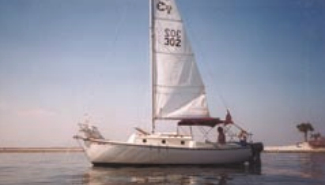
Jim earns my vote as having his priorities in order. He has his Com-Pac 23, Wonderful One, tied up within footsteps of his home. From there, it’s a five-minute sail to the Intracoastal Waterway near Clearwater. And he isn’t a slave to a large lawn or landscaping chores.
Not only does he have the right attitude and environment to pursue his hobby as avidly as he chooses, but Jim is the skipper of a boat that’s well suited to his taste and temperament. The Com-Pac 23 is a tremendously versatile, low-maintenance sloop suitable for daysailing and for Jim’s annual voyage from northern Florida to Key West, a trip he usually makes as a singlehander.
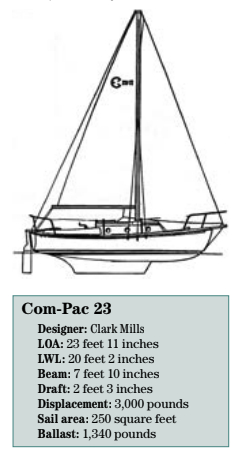
Sailing in skinny water is no problem. With depths in the Florida Keys ranging from deep to less than 2 feet, his boat’s 2-foot 3-inch draft is a plus. “If I run aground, I step overboard, push off, and we’re back in business. I can also cruise shallow water and coves other boats can’t get into,” Jim says.
Com-Pac Yachts has been in continuous operation since it was founded in 1957 by W. L. (“Hutch”) Hutchins, Sr., an entrepreneurial tool and die maker who operated a metal-stamping fabrication shop in St. Louis . . . which, if you check a map, isn’t exactly the sailing capital of the United States. Prior to his transformation to boatbuilder, Hutch was credited with the invention of many automobile accessories.
Ship in box
In 1970, he commissioned Clark Mills to design the company’s first boat, a 16-footer, and added a unique twist: he wanted to be able to ship the boat in a box. His goal was to “build a small but highly efficient sailboat that could easily be trailered behind a car.” Clark Mills, by the way, is renowned as the designer of the Windmill and Optimist prams.
In 1974, Hutch formed a partnership with Buc Thomas, a Florida boatbuilder, to begin producing the boat, initiating a tradition of building conservative, durable sailboats.
These days, the company thrives under the direction of Hutch’s sons, Rich and Gerry. Rich, who began working for his dad as a child in St. Louis and now lives aboard a Com-Pac 35, is Mr. Outside. Gerry, a graduate engineer who began his career at Gulfstar, is Mr. Inside. The company produces 16- to 20-foot catboats and daysailers, as well as 27- to 35-foot cruisers designed by Bob Johnson and Charley Morgan comparable to those coming off the production lines of the largest sailboat manufacturers in operation.
The firm operates in an inconspicuous building on a side street in Clearwater that camouflages a 15,000- square-foot compound where 20 full-time employees spend their days. Com-Pac typically produces 100 boats annually.
Traditional mini-cruisers
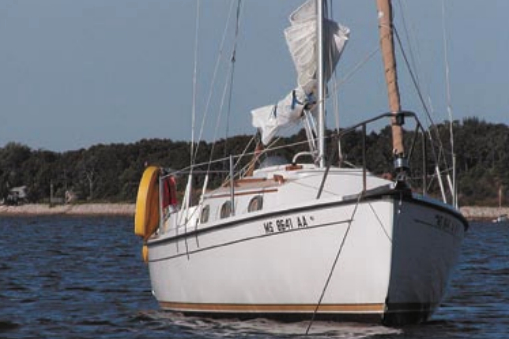
Hutch envisioned producing boats designed to look like traditional mini-cruisers in the style of the 1970s and 1980s. They were characterized by a rounded entry, traditional stern and sheer, and cabintops that produce space belowdecks. They bear no resemblance to the plumb bows, flat decks, and reverse sterns of modern yachts.
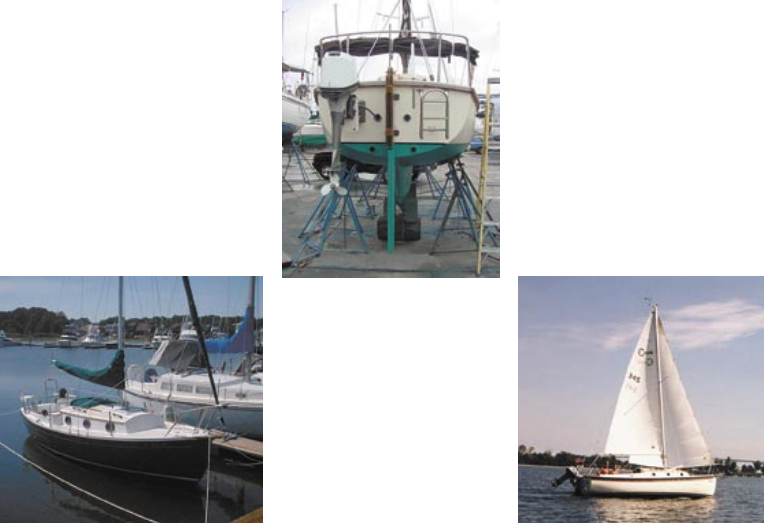
The Com-Pac 23 is typical of the breed, though she suffers in appearance from a tallish cabintop, the result of an attempt to increase living space in a short boat. She also has bow and stern pulpits that are disproportionately high when viewed from abeam. The first of the line suffered from excessive weather helm. As a result, she was redesigned, and the Mark II was introduced with a bowsprit that changed the center of effort of the sailplan. Coupled with upward-sloping backrests in the cockpit, the ’sprit actually improves her profile, and adds a bit of sail area. Many describe the boat as being old fashioned; I say she’s appropriately traditional.
The 23-footer was introduced in 1981 with a sticker price in the low $20,000 range, including sails but without outboard or trailer.
No delamination
Though Com-Pac boats were designed primarily for use on lakes and relatively protected water, the company hasn’t taken a cost-cutting approach to construction. Older boats that have been well maintained, as Jim’s has been, are in seaworthy condition without the delamination problems encountered by the low-priced alternative. At 3,000 pounds, the 23 is heavy compared to many of her contemporaries, but weight may produce a more comfortable ride in a blow.
As with other boats the company builds, including the 35-footer, the construction of hulls and decks is farmed out to a local fiberglass shop with excellent results.
“We are not interested in being in the glass business because it is so specialized and requires a huge commitment for space,” Rich says. “However, we dictate lamination schedules and are diligent about the storage and maintenance of the molds.” This allows the fabricator to produce consistently smooth finishes when hulls and decks are popped from the molds. Since the construction of spars and rigging also is farmed out, the company could be considered an assembler as much as a builder.
Hulls are molded of solid fiberglass, a mixture of mat, roving, and multi-directional cloths. Typical of smaller trailerable boats, the interior is constructed of plywood sections tabbed to the hull, rather than being formed as a one-piece liner that is then dropped into the space and bonded with putty. Either technique provides hull stiffening.
Screwed bulkhead
The forward bulkhead provides support for the deck-stepped mast, in lieu of a compression post that would reduce living space. The bulkhead is secured to the hull and deck with a number of screws, rather than being taped around its entire edge. That’s not a construction method you’d want to employ with an oceangoing vessel but for her anticipated use, the construction is adequate.
The deck is a fiberglass section cored to provide stiffness and sound deadening. The hull-to-deck joint is an outward-turned flange onto which the deck is laid, bonded with 3M 5200 and bolted. A rubrail conceals the exterior joint and the interior is caulked, so leaks are uncommon.
Since she’s designed for gunkholing, her 2-foot 3-inch draft is created by constructing a long, shoal-draft keel ballasted by a mix of lead and concrete poured into the keel sump. The process may not sound scientific, but it works. The head of her kick-up rudder is cast aluminum. The rudder itself has a squared-edged, 3⁄8-inch section.
Jim boat’s was constructed in 1988, so she was fully mature when we sailed her. She’s sailed many miles, some in the open sea, and showed little sign of construction defects.
Simple layout
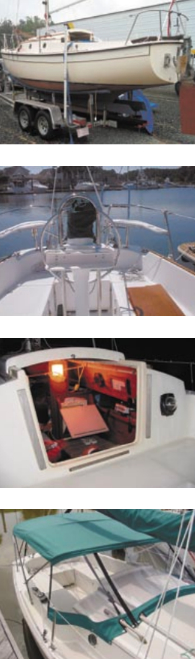
Her rig and deck layout are as simple as imaginable, as you would expect on a pocket cruiser. The deck-stepped mast is a straight section that looks almost brutish, and spreaders are tubes in sockets connected to a pair of lower shrouds with open-faced turnbuckles that facilitate tuning. The rig can be tweaked but won’t be tuned for race conditions.
The mainsheet is led from the end of the boom to the stern, creating an awkward, but typical, 45-degree angle that’s an impediment to producing good mainsail shape. That’s a minor concession to comfort, however, since a mainsheet traveler located in the aft section of a 23-footer would make about as much sense as adding a hot tub belowdecks. A vang adds the ability to improve sail shape at little expense.
The cockpit is seven feet long, and comfortable for three full-sized adults, as I discovered on our test sail. And there’s adequate space for a fourth. Seatbacks are high enough to be comfortable, and the tiller is long enough to facilitate steering from either rail without being excessively intrusive. Winches are single-speed Lewmars.
The two pulpits and a single lifeline will retard crewmembers’ attempts to escape overboard. When owners complained of stanchion bases breaking on early models, subsequent boats were fitted with stanchions that had beefier backing plates. Given that the sidedecks are wide enough for traffic and that two handrails are located on the cabintop, the overall arrangement produces a safe environment.
Illusion of space
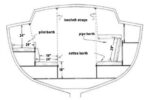
It would be a wild exaggeration to say that stepping below produces the impression that she’s 23 feet long outside and a 35-footer belowdecks. Nonetheless, the illusion of spaciousness is created by her beam, the height of her cabin, and sightlines forward. A six-footer can sit comfortably on the settees without fear of banging his head on the overhead. Areas amidships and forward are divided by a bulkhead with large cutouts that produce view corridors to the bow. The forepeak may be enclosed by a fabric door.
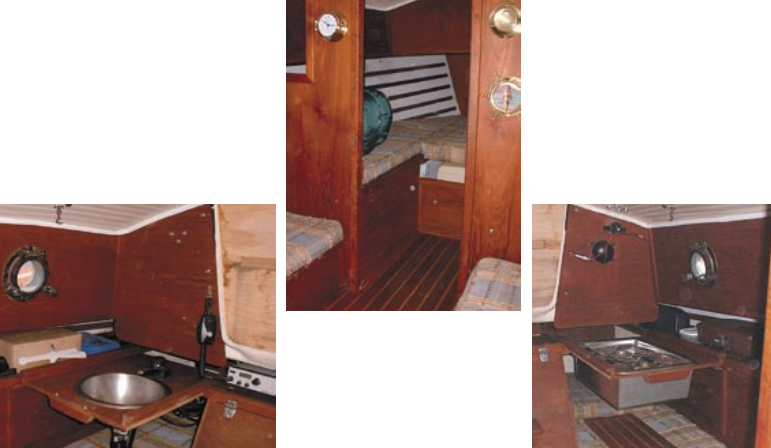
Interior joinery, even on an aging boat, is still-attractive teak-faced plywood, and hull sides are covered with teak battens fitted over shiny fiberglass. The gelcoat overhead is finished to resemble planking, and a teak-and-holly sole is underfoot. She gives the appearance of a proper yacht. Teak cabinets and storage shelves line both sides of the main saloon, accented by six bronze opening ports that add a salty touch. Settees will seat four to six crewmembers or sleep a six footer.
Among the first things I noticed about the test boat was that Jim has found space for a lot of extra gear. He’s mounted a liquor cabinet on the starboard bulkhead to store airplane-sized whiskey bottles, and he’s found spaces for clipboards, books, and navigational aids on the bulkhead and shelves lining the hull.
A stroke of genius is the layout of the galley in two sections that place the stove to port and the sink to starboard. Mounted on sliders, these sections disappear into quarterberths when not in use. Of course, that means passengers 5 and 6 will be sharing sleeping quarters with a coffeepot or faucet. Storage space for a cooler and a silverware drawer is under a lifting companionway step.
Saloon table
In another space-saving design element, the dining table is a wood section cut to fit in the space in the bulkhead, like a hatchboard in the companionway. It is supported by a post, so there’s no need for hinges or bungee cords.
The V-berth is more than 6 feet long, about right for most adults. Jim is 6 feet 4 inches tall and says it’s a comfortable berth. Unfortunately, the space allocated for a Porta Potti is under the berth’s pillow, which presents an interesting predicament. The anchor locker in the bow drains overboard, preventing the intrusion of water and the accumulation of odors from the ocean floor.
Jim, who lives just a stone’s throw from the ICW, replaced a 1981 Com-Pac 23 he sailed for several years with Wonderful One, a 1988 model. The PHRF rating, for a sailor interested in competition, is somewhere in the mid-200s. However, her displacement and outboard sheeting angles will present a performance challenge for a skipper racing in a light-air venue.
As I discovered during our sail, she performs best in 8-plus knots of breeze and is fastest and most responsive on a reach, when the sheeting angles produced by outboard shrouds may be an advantage. We sailed with a full mainsail and 110-percent jib and managed to coerce 4 to 5 knots of boatspeed beating to weather. She’s tender in a puff, heels quickly, but stiffens at 15 degrees of heel with her shoulder buried as she slides forward without burying the rail. Jim’s boat is equipped with a vang, which improves her pointing ability. She tacks through 100 degrees.
Tiller holder
Since he sails alone most days, Jim has attached a knob to the underside of the tiller with a line that runs to a cleat on the coaming. This arrangement holds the tiller where he wants it. With the main doused and the jib backwinded, he can enjoy a leisurely lunch or peruse a magazine.
To minimize weight, he leaves a 12-volt battery on the dock during daysails and uses handheld instruments — windspeed indicator, GPS, and VHF. These tools weigh less than fixed instruments, are always close at hand, and live comfortably and warmly indoors, just like the skipper.
An 8-hp Johnson outboard powered us into 10 knot winds at 4 to 5 knots.
There must be much that’s attractive about this boat because scads of Com-Pac 23 owners strap them onto single-axle trailers and head for distant shores.
Regardless of her portability, I’ve come to appreciate her sailing characteristics, comfort, and versatility. She won’t beat to weather as well as a Catalina or Santana 22, but she’s a long way from being sluggish. She’s fast and steady off the breeze, so easing sheets to sail 10 degrees lower is a good option. The cockpit and spaces belowdecks are well conceived, especially the galley arrangement. And I like being able to step overboard and shove a boat off a sandspit when I’ve neglected my navigational chores.
All things considered, including her price in the aftermarket, she qualifies as a good old boat.
Thank you to Sailrite Enterprises, Inc., for providing free access to back issues of Good Old Boat through intellectual property rights. Sailrite.com