Understanding and using your marine-band radio
Issue 32 : Sept/Oct 2003
The primary short-range radio-communication system for most small craft is the VHF-FM marine-band radio. It is the communications method of choice for the recreational boater, and a station license from the FCC is no longer required for use within the United States.
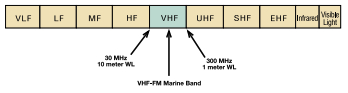
VHF stands for Very High Frequency — the band of frequencies between 30 and 300 megahertz (MHz), with wavelengths of 10 meters to 1 meter, respectively. The marine band, with frequencies between 156 and 163 MHz, is located in this broad VHF band, which is home to a variety of services, including FM radio, aviation, police, commercial uses such as trucks and taxis, garage-door openers, scientific and medical uses, cordless phones, amateur radio, radio control, and television channels 2 through 13.
Just like those television signals, this marine band is usually described as “line-of-sight,” which means that the higher the antenna is, the greater the range will be. Actually, VHF signals bend slightly, attempting to follow the contour of the earth. Infrequently, when special layers of the ionosphere form a reflective path, they can travel hundreds or thousands of miles.
FM stands for Frequency Modulation — the same type of signal that brings us our FM broadcast stations static-free, as well as the sound on our TV.
Although some people new to boating eschew the marine-band radio in favor of their cell phones, this is a bad idea. In an emergency situation, when you’re using the marine band, you can reach the Coast Guard directly, and other boaters nearby can also hear your Mayday call and come to your assistance. (Mayday is a phonetic way for the English-speaking world to say the French phrase, “Help Me.” This term was established in the early part of the last century, before English took over from French as the language of diplomacy and international travel).
Power limited
The power of a marine-band transmitter is limited to 25 watts, the amount of radio-frequency energy that goes into the antenna. It is also required that this power can be readily reduced to 1 watt for short-range communications.
Antennas for the marine band are vertically polarized. This means that the transmitting antenna element is vertical and, for optimum performance, receiving antennas should also be vertical. (TV antennas, as we have all observed, have horizontal polarization).
The “gain” of a marine-band antenna is a measurement of how much of the antenna’s transmitting and receiving power is concentrated in a desirable direction. Obviously, you don’t want to waste power transmitting toward the sky or toward the water, so the gain of the antenna is concentrated in a horizontal direction. For sailboats, a gain of three decibels (3 dB) is the norm, since any higher gain would concentrate the antenna’s transmitting and receiving power into an even narrower horizontal beam that could be counter-productive when a sailboat is heeled.
On many marine-band radios you will note that a selection can be made between “International” and “USA.” This is because on some channels there is a frequency difference between the two. Thus, for routine communications with the U. S. Coast Guard, you must tune to Channel 22 with the American frequency (which is easily remembered by the suffix “A”). Hence, the Coast Guard is listed as Channel 22A. If you were to transmit on the International frequency of Channel 22, the Coast Guard wouldn’t hear you.
Relatively simple
As originally conceived, the marine band was relatively simple and straightforward. Channels were allocated for distress, safety, and calling; the Coast Guard; commercial vessels; recreational boats; ship-to-ship calls; ship-to-shore calls; marine operators (who can connect you into the land-line telephone system); and weather forecasts.
But the marine band is no longer as simple as was originally envisioned. Digital Selective Calling (DSC) technology is now a part of new 25-watt marine-band radios. Although commercial vessels have had DSC since 1988, it has just recently become available to recreational boaters. With DSC, at the touch of a button, an automatic Mayday call can be transmitted that includes your Maritime Mobile Service Identification (MMSI) Number, which describes your vessel. Also, through an interface with your GPS or Loran, your latitude and longitude can be automatically transmitted, and these DSC-equipped radios can continue transmitting the emergency message even when the boat has been abandoned.
Unfortunately, in many parts of the country the Coast Guard is still a couple of years away from having DSC receiving equipment, but many towing companies and yacht clubs can monitor DSC Channel 70 and will relay emergency information to the Coast Guard. The Coast Guard is expected to be fully online with DSC by 2006.
DSC can also be used for making direct calls without going through the marine operator and ship-to-ship calls to other DSC-equipped vessels. As one way of relieving the congestion heard on channel 16 in some areas, the hailing part of these calls will not be heard by every other boat in the vicinity. Once the hail is completed and the radios are connected, however, the voice part of the call is conducted on ordinary analog VHF channels so anyone with a scanner or who happens to be tuned in to that channel can hear the conversation.
Big asset
DSC capability is still being installed at MariTel’s marine-operator shore stations, and although the system is not a duplex system (where you can simultaneously talk and listen) this new system can be a big asset when you are out of range of a cell-phone tower.
A DSC-equipped radio must be registered with the FCC, which can be easily done through BoatU.S. The MMSI number of each of these radios is similar to a telephone number, so when making a DSC ship-to-ship call, you must know the MMSI number of the other party.
Hand-helds
Hand-held VHF radios have decreased in size and increased in reliability. Many are now submersible, which makes them great for your abandon-ship bag. Since most sailboats have their 25-watt, fixed-mount VHF radio in the cabin, a handheld can be a great asset in the cockpit, especially when entering a strange marina and receiving directions from the dockmaster or when talking to a drawbridge operator. But for newer cabin-installed radios there is an alternative: remote microphones that allow channel-selection, entire LCD displays, and a speaker, all in the palm of your hand.
New battery technology has also given longer life to hand-helds, with the new nickel-metal-hydride batteries providing twice as long a time between chargings as the old nickel-cadmium rechargeable batteries. But it’s still a good idea to keep alkaline batteries in your abandon-ship bag, since they have a shelf life of more than five years, whereas a rechargeable battery can self-discharge in a few months.
Thank you to Sailrite Enterprises, Inc., for providing free access to back issues of Good Old Boat through intellectual property rights. Sailrite.com