A determined sojourner ends a long search for the right boat
Issue 32 : Sept/Oct 2003
It was the way the sails seemed more like wings than cloth that held me transfixed that summer morning as I stood looking out over the open sea. In my fancy I saw the two billowing white pinions carrying off the boat and its privileged occupants to some other, perhaps more perfect, world than the one my fellow mortals and I lived and walked in … a world infinitely freer, less subject to the demands of time and place.
Only recently retired, I was strolling the beach at Long Beach Island on the New Jersey coast (to the best of my awareness a contented man) when I saw it. The sleek, 30-something-foot yawl shone like a jewel in the sun, and something within me stirred. Was it the memory of the small daysailer I had sailed on Barnegat Bay back in my college days? I had named her Israfel after the angel in Poe’s poem. Was it the memory of feeling close to the heart of things, of trusting to the wind and the tide, and of having the solid wooden hull beneath me?
Whatever it was, that morning as I stood watching the yawl make her slow majestic way south toward Cape May, I could not prevent from passing in front of me all the many years that had come between then and now: marriage, children, a divorce, a second marriage only years later, and throughout it all a long and satisfying career as a professor. There had been the usual dreams, of course, some fulfilled and others forgotten, that had been lost to the daily give-and-take of a man’s life. But all in all, it had been a good run. Yet here I was picturing myself at the helm of a fine sailing vessel far out at sea, following a star whose name I had yet to learn.
I bought a magazine . . . a book . . . another book. I walked the docks of yacht clubs and marinas, went to boat shows in Atlantic City and Annapolis, read a brochure.
One week to learn
“Achieve your sailing dreams in just one week,” the Bay Island Sailing School in Rockland, Maine, promised me, and I wanted to believe them. There I learned a jibe from a tack, how to read telltales, and what to do if someone fell overboard. At the end of the week I was presented with a certificate of proficiency and told the world was my oyster . . . the sailing world at least. All that remained for me to do was narrow my list of preferred boats and make a final choice.
Three years and many sailing experiences later — a charter in Florida, several in Maine, cruises on friends’ boats from Bar Harbor to the Chesapeake — I set out to find my boat. Due to finances and aesthetics, it was to be a good ol’ boat. It was to be sloop-rigged, big enough to cruise in but not so big I couldn’t handle it alone. There was a vintage Pearson 28 in Port Clyde, Maine, whose solid hull, narrow beam, and moderately long overhangs satisfied my longing for the traditional; an Alberg 30 whose combination of rugged stability and seakindliness made her an excellent bluewater cruiser; most notably a Cape Dory 26D with its classic full keel, bronze portholes, and enough interior teak and brass to make an old sea captain envious.
But as difficult as the right choice of boat could be, there were other, sometimes even more pressing considerations: the limited finances of a fixed income, unsolicited advice from family and friends warning me about the “two best days in a boatowner’s life,” the decision whether to keep the boat in Barnegat, New Jersey, near our home in Pennsylvania, or in Port Clyde, where we summered in Maine.
Without a doubt the most challenging of concerns was fear . . . fear of being inadequate to the task . . . fear that, as the fantasy of owning my own boat was fast turning into reality, I would not measure up to the demands of so arcane an art and science as seamanship. It was that part of me that ever since childhood had driven me to do better than my best and to compare myself to others no matter how experienced and expert they might be. And yet, along with the fear came the realization that if I did not pursue my dream, if I did not at least try to “follow my bliss,” I would come up feeling empty, depleted, less than the man I wanted to be. So I pushed on.
Experienced friend
Fortunately, I had the help of a friend who, while much younger than I, was vastly more experienced and knowledgeable in the ways of sailing and boat ownership. He was Brad Wildauer, a former student and successful businessman who sailed his Catalina 25 off the New Jersey coast. He had been sailing since he was a boy, had owned three boats, each successively bigger, and next to sailing itself enjoyed introducing others to its manifold mysteries and satisfactions. It was he who, in a generous expenditure of time and in an ironic reversal of student-teacher roles, went with me, no matter where, to look at boats — the Chesapeake, Maine, Long Island. It was he who encouraged me to go on looking when I felt overwhelmed by the mounting collection of statistics, the exorbitant prices some owners asked for their boats, the growing sensation that the ideal boat I so ardently coveted simply did not exist.
It was also he who, when necessary, served to moderate my impatience. The temptation to finish up with the search, have my own boat, and set forth at last on life’s newest adventure would at times overpower both reason and the constraints of budget.
I found myself, more often than I’d like to remember, overlooking a boat’s shortcomings, allowing aesthetic considerations to outweigh structural problems, wanting a boat so badly that, if left to my own desires, I would discount cracks at the chainplate, lack of good ventilation, corroded keel bolts.
“Are you sure?” Brad would caution. “Why don’t you go home and sleep on it? The boat’ll be here tomorrow.” The next morning I would awake boatless but grateful.
There was also the question of a name. I would, of course, be satisfied with nothing but the most appropriately nautical — a sign or witness to whoever cared to notice that this was, indeed, a serious boat … that while sailing was fun, it was also about connecting with life’s elemental forces: with the wind, with the sea and tides, with oneself.
Nowhere too sacred
And so I found myself, while reading at night, at dinner parties, at church — no place was too sacred — probing mind and spirit for a suitable name, choosing one only to replace it a moment later with another just as perfect. “Avoid the word ‘wind,’” some counseled. “Nothing too pretentious,” others insinuated. “No more than two or three syllables,” several old salts cautioned. Thus was I forced to abandon Deo Volente as too Latin and too long; the French Aile de mer — who could pronounce it? — Southern Lady, in honor of a wife who wasn’t even remotely interested in a boat or what I called her.
In the end, frustrated and still at a loss for the perfect name, I turned the decision over . . . though to what or to whom I’m not quite certain. Either the boat’s original name would claim my fancy — wasn’t there an old superstition about changing the name of a boat? — or the right one would magically present itself when first I saw her.
And then one fine fall day, when all I could think of was sailing a boat I did not yet own, I found her.
“I have something you might be interested in,” Bryan Winter of Winter’s Sailing Center in Riverside, New Jersey, had informed me that morning by phone. “It’s along the lines you’ve been looking for: traditional, seaworthy, all in all a good old boat.” My spirits rose only to fall just as quickly on arriving at the yard and seeing the Bristol 27. She lay in her slip, much too tired and disheveled-looking for a lady her age. When I expressed my disappointment that it had a gas, rather than a diesel, engine, Bryan came to the rescue. “There’s another boat that might fit your needs,” he said, “although it’s a bit more money.”
Fitting name
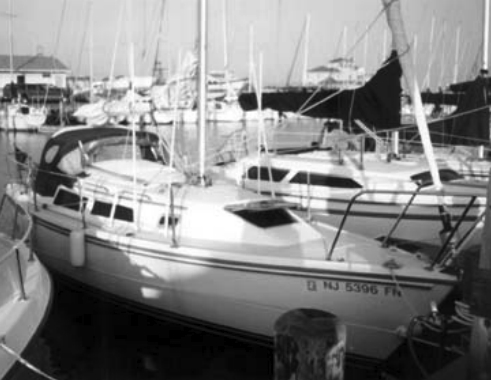
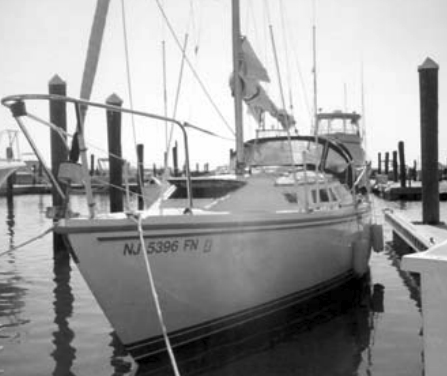
It was the proverbial love at first sight, a 1990 Catalina named At Last — how fitting a name it seemed at the moment! — whose single owner and meticulous captain had been forced after much resistance to surrender his boat to time and age. For me the Catalina now seemed suddenly the most logical of choices, its shallow 2-foot, 10-inch draft appropriate for Barnegat Bay, its solid hull and dependable Universal 12 diesel more than enough to handle coastal cruising north to Long Island or south to the Chesapeake.
There was more than just logic to her appeal. I liked the apparent yet pleasing contradiction that, while a relatively new production boat, the hull retained some of the older classic lines; that the cabin’s antiseptic white fiberglass interior was softened by an abundance of teak and brass; above all that I felt at home at the tiller.
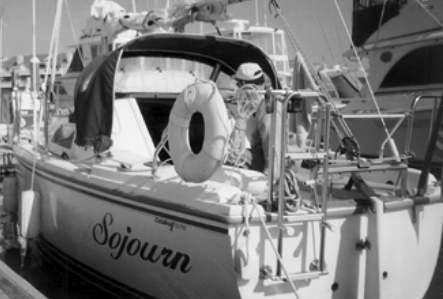
Much like the younger man I once was who, when it came time to marry, prepared a long list of preferred attributes in a partner only to fall hopelessly in love with someone totally different, so was I now with my Catalina 25. And yet love her I did! There was a sea trial, negotiations, the thrill — I’ve never until now admitted this to anyone, least of all to my wife — of paying my first bill for a slip, and the changing of the name.
Sojourn was to wait for spring at Winter’s boatyard on the Delaware where she would be recommissioned in early May for her first voyage, a 200-mile trip to her permanent home in Mariner’s Marina in Barnegat, New Jersey. It would take three days and two nights, allowing for stopovers at Cape May and Atlantic City, to sail down the river and through the bay, around the cape and up the coast to Barnegat. We would leave the dock at midnight, the tide in our favor, would snake our way out the narrow channel with its blinking red and green lights, onto the deep, dark rolling waters of the river, a river destined to take us, at last, on that first voyage, that first sojourn.
For each of us the adventure is different, the challenge unique. Some set out across an ocean, others a bay. There are the few — a Robin Knox-Johnston, a Bernard Moitessier — whose dreams are grander, more daunting, but it is, nonetheless, for all of us the same call to freedom, the same need to follow one’s bliss, to find fulfillment on a boat out on the water, a particular boat … our boat, no matter how modest.
We love our boats as men love their wives, their sweethearts. We see in them what only we can see, the quiet beauty of a line that eludes others, the perfection of a dream meeting reality. In the end it is the journey that counts, not the destination or how impressive the vessel. It is the awe-filled sense of achievement, of allowing ourselves to be who we truly are, men and women at sea, on a sojourn.
Thank you to Sailrite Enterprises, Inc., for providing free access to back issues of Good Old Boat through intellectual property rights. Sailrite.com