One of Bill’s pupils reminisces as the one-time mentor turns 85
Issue 32 : Sept/Oct 2003
Dear Editor: You want me to write a piece on Bill Garden including background biographical information to be published … along with photos of Bill? I’m not sure I can do this. Bill enjoys his privacy like few other people. He once spent 10 minutes explaining to me his philosophy behind avoiding having his picture published. How about I just give you a stream of personal impressions of Bill based upon the time I spent with him when I was a kid?
I was 15 years old in 1960. I was in love with boats. I began buying and collecting boating magazines. I studied the various designs. There was just something about boat designs that intrigued me, especially one powerboat that looked like it was a close cousin to a fishing boat. The design article was titled “Garden Cruiser.” Now what the heck is a “garden cruiser?” It can’t be a 40-foot boat you cruise around your garden. Eventually I figured it out. Garden designs were a very regular feature in all the magazine design sections. Bill was prolific. I wanted to be a yacht designer, too.
One day I was walking through Seattle’s Shilshole Bay Marina, back before they put locks on the gates. I had my sketchbook. I was sketching design and rigging details. I came to a long, light greenish/gray sloop with the name Oceanus on the stern. I was struck dumb. This boat was really different! There was nothing about this boat that I could relate to the other boats on the dock. It had a long, exaggerated canoe stern. It had an almost featureless, molded-looking cabin trunk that morphed into a pilothouse with a “baseball cap bill” over the windows. There was an aft overhang on the pilothouse that curved exactly the opposite way from what you would expect.
But damn, the entire thing worked together to present a marvelous picture of a sailing yacht, a unique sailing yacht. I’m reminded of that scene in Close Encounters of the Third Kind in which Richard Dreyfus looks at the immense pile of mashed potatoes mounded on his plate and mutters, “This is important.” When I looked at Oceanus, I thought, “This is important.”
Incredibly jealous
I told Jay Spearman, my sailing friend at school, about Oceanus. “Oh, that’s Bill Garden’s boat,” he said. “He’s a friend of my dad’s.” I was incredibly jealous that he knew Bill Garden; a family friend, no less.
I kept drawing boats. I kept studying the designs of Bill Garden. I practiced writing in Bill’s lettering style. I filled pages with Garden “R’s.” I could draw little Garden men with carrot noses with my eyes closed. I practiced writing my name with Bill’s address. Bill’s drafting style became my drafting style, or at least I did the best I could to emulate it while combining it with other styles that I admired. Bill’s style was so incredibly strong that it was impossible for me to try to lift techniques from it without being overcome with the guilt of copying.
I told Don Miller, my English teacher and the Corinthian Junior Yacht Club sailing instructor, about my admiration for Bill’s designs. Always supportive of my efforts, he said, “Why don’t you call him and arrange a visit?” I did. It was arranged for a Saturday morning. My dad drove me out to the Seattle locks and dropped me off. This might be hard to believe, but I truly expected Bill Garden to be seated at a drafting table elevated in the middle of a room surrounded by other drafting tables. My 15-year-old imagination had literally put Garden on a pedestal. At that time, Bill must have been 42 years old. He turned 85 this summer. I marvel at the fact that I am older now than Bill was when we met.
Small footbridge
Bill’s office in the 1960s was located on Commodore Way, perched on a steep bank on the south side of the Hiram Chittenden locks in Seattle. You walked across a small wooden footbridge to enter the offi ce. The styling of the building was modern and clean. I’m certain Bill designed it. There was a sail loft on the floor beneath Bill’s level and a boatyard on the waterfront level. I knocked and was called into the office. There was no one in the tidy reception area. I peeked through the next door. There he was: alone, standing over a drafting table, drawing. He was kind of short and skinny, certainly several inches shorter than I was.
The office was very neat with rolls of drawings here and there and a lot of drawers to hold drawings under the endless drafting table that ringed the room. There were photos of Bill Garden boats lining the wall, all reproduced in a similar size and arranged in a straight line. Picture windows looked out over Lock Haven Marina and the locks. I had found heaven. I noticed that Bill was not using a T-square. Every drafter used a T-square I thought. I asked him how he drew without a T-square. He said, “If I don’t know 90 degrees by now, I might as well quit.”
I fumbled with words to express my admiration and gratitude at being able to meet him. His response was gruff and to the point, and while I can’t remember his exact words, it was something to the effect of, “I hate flattery.” Hurt, I’m sure I blushed. But I was young, and I healed quickly.
He then said, “Call me Bill,” and gave me a copy of his spiral-bound design catalog, 100 Yacht and Vessel Designs. I still have it. It’s right here. Always. He was an accommodating and friendly guy. While obviously totally absorbed in his own pursuits, he always had time for me.
Searched the files
I spent that Saturday morning deliriously happy. Bill said I could rummage through his files. I rummaged with a vengeance. I must have taken him some of my own drawings, but for some odd reason I have absolutely no recollection of Bill Garden ever critiquing my work. He stopped working long enough to put together a great roll of extra prints for me to take home. I felt like I had found buried treasure. I even had the framing plan for a small steel ferryboat. Yes!
Bill’s general treatment of me became my model for how I tried to relate to the many youngsters who came to visit my office over the years.
That morning Bill asked me if I would like lunch. Are you kidding? Of course! We drove to the diner in Bill’s plain Ford sedan. I had bus fare home, 35 cents in my pocket. I held my breath but there it was at the bottom of the first page of the menu, “French Fries . . . . . 35¢.”
“I’ll have the French fries, please. Yep, that’s all I eat, French fries.” Bill picked up the tab, and I felt stupid and still hungry.
I was soon visiting Bill fairly often on Saturday mornings, hoping to be chosen as his summertime helper. Unfortunately, he had chosen Steve Seaton for several summers in a row. By the time he chose me, I was forced to turn the job down as he didn’t pay anything, and I needed to make money for college. I’m baffled now that I did that. I think I was afraid to expose my own meager design skills. I’d look at the sketches Steve had done in Bill’s office, and I was convinced I could never do as well. Bill remained elevated in my eyes. (I had originally written “godlike.”)
Crewing on Oceanus
I crewed for Bill on his 60-foot Oceanus, beginning when I was 16. We raced fairly regularly, always with a bunch of clients and cronies on board. Bill needed some young guys to do the hard work. He seemed to have an extremely loyal and eclectic group of friends. They always had a great time enjoying warm friendships. There was Carl Harper, the sailing cowboy, who wore cowboy boots while sailing; and, Ellis Provine, a gentle, kind man with a Scottish tam. There was a covey of salty characters. While Bill steered Oceanus standing on a box designed to get his eye level over the top of the pilothouse, his pals would line up on the bench in the back of the deep cockpit, smoke cigars, and pass the flask.
I had no foulweather gear. I was cold and wet all the time but without a doubt the happiest kid in Seattle. I finally splurged and bought navy-blue canvas Sperry Topsiders. I was proud of my yachting shoes.
I walked down to Oceanus and climbed aboard for the race. Bill took one look at my shoes and said, “Don’t wear those shoes on board. They pick up rocks and scratch the paint.” He seemed to wear what I would call après ski boots for sailing. His clothes were almost Eddie Bauer-like in style, but on his gaunt frame they appeared to be two sizes too large. I continued to wear my new shoes. Bill never mentioned them again.
I loved Oceanus. It was far from a rocket by today’s standards, but in Seattle in its day, we generally had the ability to out-waterline the competition. We regularly had boat-for-boat races with an old 8-Meter. Bill’s sails were awful. Still, it was Bill’s boat and an aesthetic marvel. One morning I showed up at Vic Frank’s boatyard where Oceanus was and gave the boat a thorough scrubbing. All 60 feet of it. Bill fussed about with things below as we prepared to motor out to go racing. Ellis Provine said the boat had not been that clean since it was a “puppy.” I beamed. Bill said nothing.
Get Skene’s
My incessant design questions were usually answered with, “Get a copy of Skenes.” Skene’s Elements of Yacht Design was the ancient textbook for yacht designers. I did manage, however, to get a few gems of advice out of Bill over the years. In preparation for writing this article, I pulled the load of correspondence we have shared since then and reread most of the letters. His letters to me were always handwritten in a loose scrawl. These gems were full of life and soft, subtle, sage advice.
I asked Bill, “How much lead I should give a sailplan to insure correct helm balance?”
He answered, “Lots. How many boats have you ever sailed with weather helm?”
“Most of them.” I answered.
“How many boats have you ever sailed with lee helm?” he asked.
“None, yet,” I answered.
“See?” he said.
While scrubbing Oceanus, I found a spare key. It was hidden, tucked behind a piece of molding on the cabin trunk back. If the Russians ever dropped the atomic bomb, I had a plan. I was going to hightail it down to the marina and steal Oceanus. I’m not kidding.
Bill on everything
I asked Bill one day, “What do I do about rudder flutter?” He responded, “If the rudder has a radiused trailing edge, flatten it. If the rudder has a flat trailing edge, radius it.”
One afternoon on his island he spent about two hours drinking tea and lecturing me about all the legal hassles he had experienced over the years. “Never guarantee performance in writing,” he told me. I’m not sure what his aim was that day. If he was trying to discourage me, it didn’t work.
In 1977 I got a letter from Bill dated “Advice Day 1977.” He advised me to “trim the whiskers to a good Van Dyke, and you won’t lose identity with the kooks; and you will relate better to the people who are spending the money. All unkempt geniuses die broke, plus the fact that they itch and eventually bore their wives.” He added, “Yacht designers are like violin players: all supply and no demand.”
Bill was very “real.” I’d sent him a drawing to look at. His letter finally addressed it: “Your ketch looks fine and is a nice drawing. I believe she will trim about 5 inches deep so caution them to keep the W.L. paint high, as shown. The first few years are hard, but you have a good eye and like to draw. So if you can keep from starving to death, the people will eventually come to you. You are in the period that wipes out the competition. Keep me posted.”
Other topics addressed in his letters:
“I’d love to have you back here to do all the work, but I’d be back in business then.
“As I see it, the design business will supplement clam digging in the near future. We are headed for a violent reappraisal that will make the 1930s tame.
“Eighty-two percent of everybody in the world are not competent at anything.
“Age 40 isn’t bad . . . 67 getting obsolete and ready for knackers. Dropped a piling on my big toe last week. Big hurt. Head cold this week. Mild fever which speeds up productivity.”
Hero worship
Bill’s letters were always accompanied by sketches and prints. Many of them were hand-colored. Needless to stay, I kept them all. Looking back at these sketches today, I am amazed at the amount of work he put into using the colored pencils to highlight the blueline prints. It takes immense effort to appear that cavalier.
As a kid I had a bad case of hero worship. That doesn’t bother me today. Bill Garden was a good hero to have. I spent hours studying the details of his designs. There has never, ever been a yacht designer who showed as full a grasp of aesthetics over such a wide variety of designs. From the minuscule Bug to a big fishing boat, to a high-speed powerboat, to a character yacht, Bill’s style is immediately recognizable. His drawings are rough, hairy, vague, exact, and expressive beyond words. Every line is exactly appropriate. Much of this drafting and design style came from H. C. Hansen, a Washington state yacht designer, but Bill surpassed Hansen’s efforts to such an extent that it’s impossible to see this style today as anyone else’s.
Bill and his work continue to be a huge influence on my own work, despite the fact that I have matured (I hope) into my own design style. Next to my workstation here today I have a cardboard tube in a drawer. In that tube is a drawing of Bill’s. I saw the drawing in his office years ago, and I wanted it. So I called him up.
“Send me that drawing,” I said. I was blunt.
“OK, I’ll send you a print.”
“I don’t want a print. I want the original.”
“OK. Do you want me to color it?”
“If you like.”
I got the drawing. It was carefully “colored in.” At the end of a long day, some buddies of mine will occasionally drop by and have a wee Scotch while beating old dead sailing horses and discussing perfect boats. “Hey,” I say, “I’ll show you something that’ll knock your socks off.” I pull out the tube, take the drawing out, and unroll it. “There.” We silently sip our Scotches and take that salty journey deep into the genius of Bill Garden.
No college degree
Bill was born in Portland but moved to Seattle and attended high school there. He was building boats from an early age. He spent time in the Army and was stationed in the Aleutians. He sketched a lot of boats while in the service. Bill did not go to college, but he managed to get “grandfathered in” for his naval-architect license. Bill drew every kind of boat imaginable.
Bill is about 5 feet 9 inches and very thin, with sharp, hawklike features. A client of mine and a high-school mate of Bill’s once told me, “Bill was working at looking like an old salt when he was 19 years old.” He has a look to him that tells you quickly he doesn’t abide fools or appreciate having his time wasted. Bill has a very distinctive walk with a spring to his step that gives the impression he’s always off to do something important.
I saw Bill about five years ago. We were launching a new 50-footer of mine, and Bill motored by in his launch. Disappointed that he didn’t stop, I waved. He waved. I felt bad. The boat needed a contrasting bootstripe, but the owner had opted not to do it. I hoped Bill would not think that was my idea. I so badly wanted him to be impressed with my new 50-footer. Everyone else was. But that didn’t matter to me.
Oh, well. I do have an envelope from him addressed to “Robert H. Perry, N.A.” That N.A. after my name, written in his hand, means more to me than any college degree.
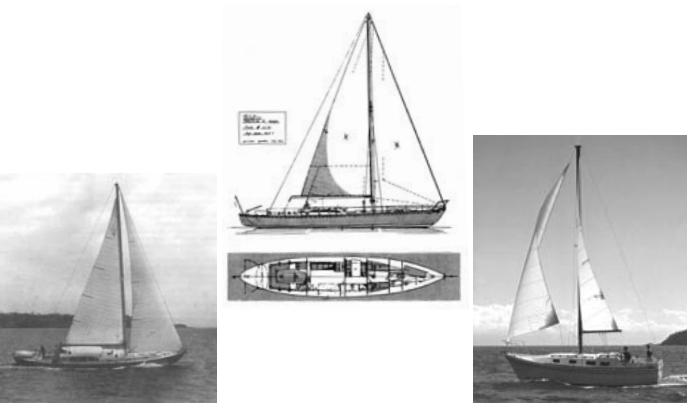
If we really want to know who Bill Garden is, I think we are better off looking hard at some of his designs and leaving the man to his privacy. His production designs include the Fast Passage 39, Rawson 30, Bayliner Buccaneer 305, Vagabond 47, Truant 33, and Gulf 32. But, as with most designers, his custom work is far more interesting.
Andy’s Boat
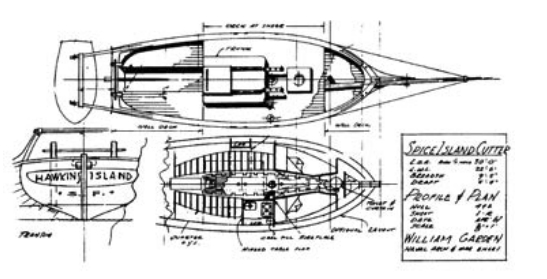
One design is called the Spice Island Cutter, but I know it as “Andy’s Boat.” I knew Andy, and I knew his boat. Andy’s Boat did not have the pulled-out clipper bow. Andy’s bow was almost plumb, and I liked it better than the clipper version. This design is a perfect example of how Bill could take a totally impractical type of boat and turn it into a boat you would drool over. It’s a dream machine. I cruised alongside Andy on several occasions, and I can assure you this boat was slow. Very slow. Still, it was handsome and made you long for a time when things were simpler and you didn’t smell polyester resin when you stepped aboard.
The sheerline is perfect. It’s strong and rises to a pugnacious bow when you build the plumb stem version. I find the clipper bow too exaggerated, but that’s what Bill was good at. While many designers would end their outboard rudders with graceful curves, Bill preferred over the years to keep the lines of the rudder blade straight. The hull form in plan view is almost “cod’s head and mackerel tail” with the max beam well forward. This is not the shape of speed. But at the waterline the DWL (designed waterline) in plan is sweet, with some slight concavity at both ends. The sections show a wineglass form with great hollow bilges. You could build your Spice Island Cutter with internal or external ballast. This boat is a true “full-keel” design. It’s hard to imagine more wetted surface for this DWL. The D/L (displacement/length ratio) of this design is 493. I don’t think I’ve ever seen a higher D/L.
I love the way the rig bends forward, seemingly under the pull of the headstay and its big Yankee jib. There is a “lizard” on the Yankee sheet, the block and tackle assist. There are no winches on this boat. You could rig the topsail to brail up to the mast when not needed. I think you would have to learn to fly your topsail on this boat.
Below, there is a head tucked between the berths forward. The coal-fired fireplace will keep you warm. And you will cook on what appears to be a kerosene stove.
Before sunset, in the harbor, you can pop your head out of the companionway of the Spice Island Cutter, look around the anchorage at the assembled large yachts, and breathe a sigh of relief that you can be satisfied with the simple life.
Seal
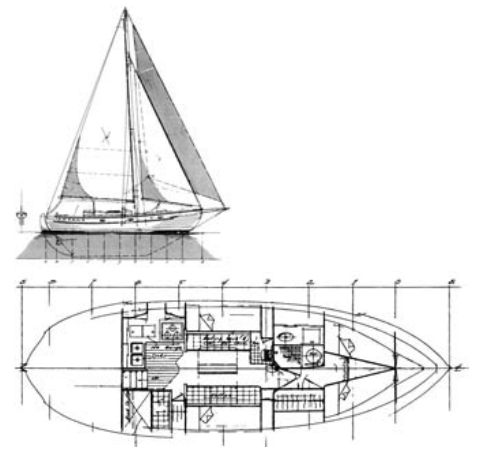
Seal was in my Garden design catalog. As a kid I would sit and stare at the drawings of Seal for hours on end. If things weren’t right at home or things weren’t right at school, they sure would be right if I just had a Garden Seal. You can see lots of Seal influence in my own double-enders — Tayana 37, Baba 30 — and so on. Seal was their step-grandpa.
This is a design based upon the Norwegian Colin Archer type. It’s a very heavy boat with lots of keel and not much rig. If Seal were a man, he would have really bushy eyebrows. Bill drew both ketch and cutter rigs. I preferred the ketch as a kid.
The hull lines show broad garboards, but the ballast is external iron. The waterlines show a very symmetrical shape. I think Seal would have been a plodder under sail. It’s too heavy and under-rigged for any speed. I just love the off-center bowsprit and the unique character of the deck structures.
You can have just as much fun losing yourself in the beauty of Bill’s structural drawings as you can the sailplan. His drawings for wooden spar fittings are marvelous and for years have provided a vivid model for my own drafting. Who says the drawing for a spreader bracket can’t be art? While they were fun to examine, some builders joked about these drawings, calling them “the funny papers.” I still find it hard to tear myself away from the drawings of Seal. Boy, if I had a Seal, then I’d be happy.
Oceanus
To me, there is no boat that says Bill Garden more than Oceanus. At 60 feet LOA and with a 12-foot beam, Oceanus is almost a canoe. There is nothing about the shape of this boat that I would call “normal.”
The bow is a knuckled thing and quite flared. The stern is a strange thing of beauty. I’ve never seen another stern quite like it. The extreme aft overhang develops out of sections with a high degree of deadrise that right at the last moment go concave at the tip of that stern profile knuckle. It’s exquisitely delicate and would have been hard to build in conventional planking.
But Oceanus was cold-molded with triple skins, and that was quite unusual for the time. The deep deadrise is carried right through Oceanus’ hull. In profile, the fore-and-aft rocker appears bizarre to my eye today. The deepest part of the hull is well forward, and the canoe-body profile goes hollow around station 8.5 to roll down into that lovely exaggerated stern overhang. The trick is not to try to justify the shape of Oceanus by today’s performance shape standards. Just sit back and wonder at the creative powers of Bill in 1953.
I never understood the rig of Oceanus. The mast is way forward, but so is the keel. I think in the early days there may have been a weather-helm issue because the mainsail foot appears to have been shortened. Note how much boom extends beyond the clew of the mainsail. The mainsheet was lead to a “Barney post” in the middle of the cockpit. Oceanus did not have a vang. In one blustery race, as we close-reached toward the finish, trying to hold off a gray 8-Meter, a couple of us youngsters clung to the boom like monkeys, trying to pull some of the twist out of the mainsail. With the rig that far forward, Bill pulled the backstay well inboard. That left the stern open to stow a hard dinghy.
I can’t be objective about this boat. On the one hand, it’s a wacky design. The keel and rudder configuration is unusual. But it’s 2003 and Bill drew Oceanus in 1953, so you have to look at what else was being built 50 years ago to get a true understanding of what he was doing with Oceanus. Bill produced great hand-drawn lines perspectives of Oceanus superimposed over the lines of a 12-Meter, probably Vim. The horse race would have gone Vim’s way, but Oceanus wins the prize for aesthetics. Leaving my objectivity aside today, I prefer to look at Oceanus through the eyes of a 16-year-old boy.
On reflection
Several things struck me as I went through my extensive collection of Garden designs for this article. The sheer volume of the work is impressive, even more so when you consider that Bill seldom employed draftsmen. The work you see is Bill’s. Don’t even dream that he ever used a computer.
Then there is the variety of the work. Bill excelled in every conceivable style of boat from craggy-looking workboats to pea-coated pocket cutters, to slicked-back fast power yachts. Each example is a unique vision of Bill’s that stands alone in the field.
I’m also impressed with the courage and imagination of Bill’s clients. Where are they today? Holed up in their plain white plastic sloops? Bill’s clients certainly were never wimpy about bold, soaring sheerlines or proud and prominent bows. Clearly, in many of these designs Bill and his client were far more concerned with the style of the boat than its performance.
There’s an old yachting word: “yare.” It means “right.” When everything about the boat is just perfect, the boat is yare. Bill’s boats are yare. Like a radical jazz musician, Bill may take you to the fringes of possibilities for any given key signature, but when he’s done, the entire piece is tied together perfectly. Now, juxtapose over this thought the fact that Bill designed the Bayliner Buccaneer 305 and several other boats that to my eye and knowledge of yacht design definitely poke out through the edges of the envelope. It’s an enigma. But I think it’s just Bill having fun while ignoring the key signature. I’ve never been able to listen to John Coltrane’s A Love Supreme all the way through either. Some great artists enjoy making you uncomfortable.
Don’t do it
When I told Bill that I had been asked to write this article he said, “No, don’t do it. Give the space to a youngster who needs the publicity.” I told Bill this wasn’t about publicity for him. It was about giving his admirers a better glimpse into his world of design. In short, this is about our needs, not Bill’s.
“OK,” he said. “If it will do you some good, then go ahead.” He still didn’t get it.
He’s a fascinating old bird.
Readers interested in seeing more Garden designs may wish to read Yacht Designs and Yacht Designs II, both by Bill Garden.
Thank you to Sailrite Enterprises, Inc., for providing free access to back issues of Good Old Boat through intellectual property rights. Sailrite.com