Faux teak deck is a winner after three years in service

Issue 33 : Nov/Dec 2003
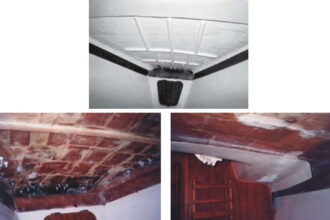
In the January 2001 issue of Good Old Boat, I published an article about the new deck I made for my Pearson Triton, All Ways. At the time of publication, the deck was a year old. Since then we have enjoyed three seasons of sailing and three winters on the hard. The deck still looks as good as new and has required zero maintenance.
To recap briefly, I bought All Ways with delaminated decks. I used a combination of techniques to fix the delaminated core problem. When I was done with the structural repairs, I was faced with the issue of the cosmetic appearance and the issue of non-skid. For aesthetic reasons, I decided to create a laid deck with gracefully curved strips of teak sprung to match the shear, nibs at the cabin, and a kingboard in the center. For practical reasons, I decided to use Trex instead of teak.
Trex is a synthetic wood made of approximately equal parts sawdust and recycled milk jugs (polyethylene). It is produced by Mobil, is certifi ed to meet non-skid requirements, and is guaranteed (in usual applications such as for a deck around swimming pools) for 25 years. It starts life as a beige color but quickly fades to a silvery grey very much the color of untreated teak. (Trex also comes in a brown version, but its fading characteristics are considerably less predictable.)
Since I did my deck, many similar products have come on the market — one I noticed uses only cedar for wood and might have some advantages, but I have not pursued the issue since I don’t anticipate repeating this project anytime soon!
The Trex comes in nominal 2 x 6 planks which, when sawn on edge, yield 1 1⁄2-inch strips for laying a deck. See the original article for all the details. This is definitely a labor-intensive project, but the results have been worth it.
Daily compliments
Since her restoration has been completed, All Ways receives compliments almost daily. Even in our slip (where we have been for four years), people often stop by to say how much they admire our boat. Nearly everyone comments on her deck. It is beautiful.
No one has ever recognized that it is not teak, and even when told they usually express disbelief. When I tell them the story and show them the deck up close, they are usually amazed. I have had two or three claim they are going to do the same on a boat they are restoring, but I have yet to see any results.
When sailing, the deck functions as well as it looks. Even when taking green water over the bow, it is never slippery. The light color keeps it relatively cool to walk and sit on, and it is much more comfortable than any traditional non-skid when it comes to sitting or lying. There are no splinters or slivers. Dropped winch handles and so forth don’t faze it. I have yet to put a real ding in it, and it has seen some serious abuse. Even more amazing: sunscreen doesn’t stain it — nor does barbecue sauce.
Maintenance of the deck is virtually non-existent. After each sail, I hose it off with fresh water. I once washed it with a commercial deck soap. That was a mistake. The soap made the Trex incredibly slippery and took what seemed to be forever to rinse off. Since then, I just use a freshwater rinse. Even rings from coffee cups vanish with a quick spray.
Speaking of coffee, mornings on deck are great. As soon as the sun hits the deck, it is dry — a real plus for morning coffee in the cockpit.
Any downside?
There really have been very few problems. I had one spot which I sanded too vigorously when laying the deck and broke through. I patched it with a mixture of epoxy and Trex sawdust. Initially it looked great and was invisible from more than a few feet. Unfortunately, the epoxy reacted with the UV and has yellowed, leaving an obvious patch. It is still functional, just ugly. The solution will be to cut it out and replace it with a plug of actual Trex; I just haven’t gotten to it yet.
The only other problem is that some of the screw holes have reappeared. In the initial laying of the deck, the strips are held in place by thousands of screws. These are removed and the holes (along with the entire gap between strips) are filled with epoxy and carbon. (The carbon does protect the epoxy from UV; no problem here.) My assumption is that the thickened epoxy did not actually fill some of the holes; it trapped an air bubble and just left a thin coating, which has now broken down.
Using a thinner epoxy mix would have avoided this, and filling the holes with thin epoxy/carbon mix from a syringe will fix those that have appeared. Since the screws did not penetrate the core, there is no cause for alarm anyway. It is just cosmetic.
No other problems to report. My wife and I are thoroughly pleased with the deck. Would I do it again? That’s a harder question. The cost was reasonable (much less than teak!), but it did take an incredible amount of time (most of one summer after work). Faced with the same problems (delaminated deck, worn out non-skid, and cosmetic issues), I think I would do it again. The results really are worth the effort.
Thank you to Sailrite Enterprises, Inc., for providing free access to back issues of Good Old Boat through intellectual property rights. Sailrite.com