It was love at first sight — then the hard labor began
Issue 35 : Mar/Apr 2004
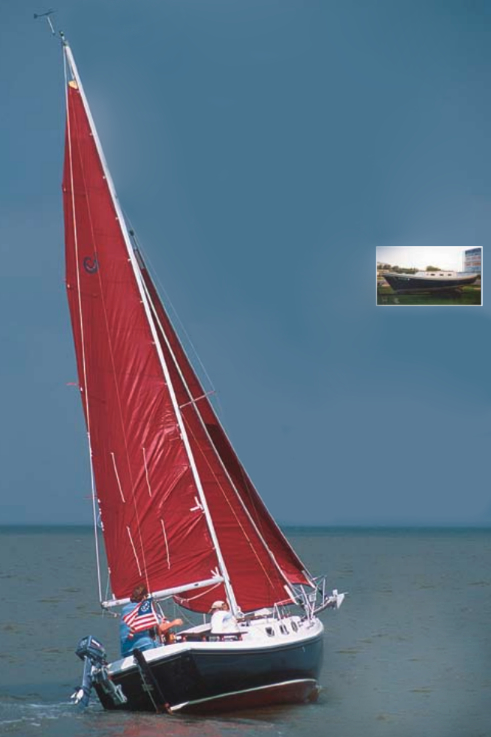
The first time I saw one of these boats, I asked the owner who built it and whether his was for sale. This was a most unusual craft: only 23 feet long, with a cutter rig, bowsprit, wooden taffrail, and beautiful classic hull and deck shape. The problem was that it was yellow. Very, very yellow. This was a problem I knew could be solved with some carefully chosen paint but, sadly, the boat was not for sale. Looking beyond the yellow, I could see that this could be a beautiful boat.
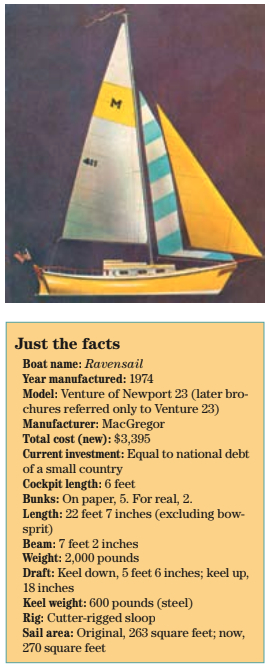
The boat was a Venture of Newport 23, built by MacGregor in the 1970s. Ah, the ’70s. No wonder it was yellow. This is the same era that brought us the Ford Pinto with the flowered vinyl top, harvest-gold appliances, and shag carpet. Since they only built about 2,000 of these boats over several years, I assumed my chances of finding one worth having would be very slim. My assumption proved to be right.
These boats also came in blue and red, I learned. The original sales brochure stated that the Venture 23 “is a modern replica of the famous English and American pilot cutters of the late 1800s. Fleets of these swift little ships sailed from the seaports of England and North America to meet incoming transatlantic sailing ships. On the outbound trip, the fastest cutters carried the pilots who would guide the square-riggers into the crowded harbors. On the return trip, the cutters carried priority passengers and light cargo to avoid the many hours, and often days, required to bring the big ships the last miles into port.”
Over the next few years, I kept my eye out for the funky little boats, finding only a few for sale, generally in a very sad state of neglect and disrepair. Those that had been “restored” or “upgraded” were often not much better. It seemed that many of the boats had simply evolved, gradually turning into something less and less resembling the original craft. All appeared to be projects so large and costly I knew they would probably never be finished. This did not diminish my desire to own one of these elusive boats.
Monumental project
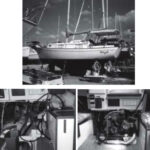
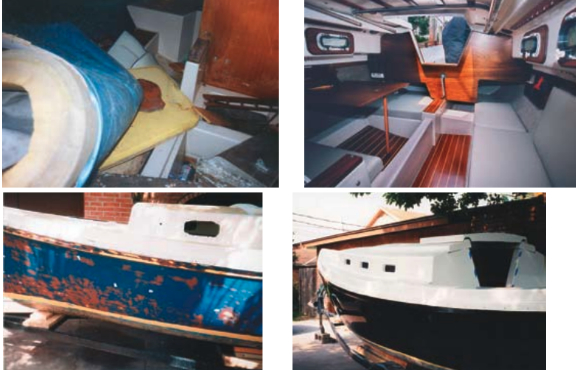
In 1999, a derelict Venture of Newport appeared in the storage yard near my house. She was for sale for $500 with a mostly useless, patched-together trailer. This was a project boat of monumental proportions. We would be buying a stripped hull, a deck, and a mast. There were only a few pieces of usable wood or hardware inside or out and an interior full of trash, broken wood, and rotting cushions, not to mention many gallons of stagnant water.
But the hull, deck, and keel appeared to be sound. My friend, Bryan O’Neal, and I formed a partnership to breathe life into this hulk. We gleefully hauled our new project to my house, parked it in the driveway, and prepared to work our magic. Our work was cut out for us.
You know you’ve really bitten off a lot when your neighbors all stop to ask you about your “project” with knowing smirks. Comments like, “Do you think you’ll ever finish it?” fell on deaf ears. Bryan and I, along with Veronica Veerkamp, my partner, were on a mission. This boat would sail and would be beautiful, one way or the other!
The first order of business was to completely strip the hull and deck of everything. Every screw, nut, and bolt was placed in a plastic bag and marked for later identification. All the hardware and usable wood was also marked. It’s too easy to forget where something went, especially if you pile it all up in the garage and then move it a few times. Although a good theory, this would later prove to be somewhat less useful than I had hoped.
After the obvious cleaning inside and out, including the removal of rotting gold shag carpet from the inside of the hull and hatch cover, we set about repairing fiberglass. Every nick and crack was filled, sanded, and faired with epoxy. With only three holes of any real size to repair, this process took us less than a week. The hard part, we would soon discover, was yet to come. Sanding the hull down to the old gelcoat seemed like a good idea at the start. This was not an easy task; it turned out to be all but impossible. Beneath the topcoat of blue paint were various coats of red and more blue, each one tougher than the last. We considered using chemical paint removers, but tests proved them to be all but useless. To do the entire job, we would have ended up with a toxic spill reminiscent of the Exxon Valdez. Common sense took hold. We agreed that, since it sure wasn’t going to come off anyway, it was unnecessary to do more than sand the old paint smooth.
Sanded and primed
Our next painting task was the interior. Veronica and Bryan sanded and primed with Interlux Brightside Primer. They then brush-painted it with two coats of off-white Interlux single-part polyurethane. We decided that the original finish on the cabin liner (seats and floor) was in good enough shape to leave without repainting. We would be covering all the horizontal surfaces with new cushions and teak-and-holly flooring anyway.
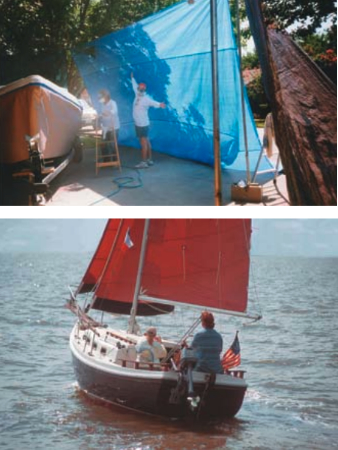
The most difficult painting job was the deck. The biggest problem was that with no scaffolding we had a difficult time reaching some of the areas in the cockpit and in the middle of the deck without walking on fresh paint. This was generally solved with ladders and extra hands handling the air hose. Spraying the finish seemed mandatory. In spite of what Interlux tells you about the ease of brushing, all the complex curves and the amount of surface area make spraying a preferred method. True, there is the cleanup factor of the spray gun, but the quality of the finished paint job is well worth the extra effort. After priming and sanding, one full coat of offwhite Interlux two-part polyurethane was applied to the entire deck.
While applying the second coat, we painted everything except the nonskid surfaces, allowing as much overspray onto them as possible. This left a slightly rough surface on the non-skid areas. After the deck paint was sufficiently dry, we taped off the nonskid areas, then rolled on an additional coat of paint mixed with Interlux flattening agent. This left a very even, ever-so-slightly-textured nonskid. The matte finish contrasted nicely with the glossy deck, giving it a very subtle visual difference. The combination of the original texture and the overspray worked great. The nonskid functions properly and is still easy to clean. We chose not to use sand additives. They are difficult to apply evenly, retain dirt, wear away quickly (taking paint with them), and are not very “skin friendly.” We are pleased with the results and with ourselves for being so clever.
Dramatic change
Painting the hull had to be the most dramatic and rewarding change in the overall look of the boat. After priming and sanding, we applied two coats of black Interlux two-part polyurethane down to the waterline. Last, we applied a couple of coats of red bottom paint.
Now the neighbors were stopping again but this time to congratulate us on our beautiful boat. We patted ourselves on the back and admired our handiwork. All fine and dandy, but many tedious tasks still lay ahead.
Now it was time to put the boat back together. One minor error in judgment had been to remove the aluminum rubrail without re-bolting the deck and hull together. Having the rail off had made painting easier, but when we began reassembly, the deck and hull had shifted sufficiently to make inserting the new bolts more difficult than it really needed to be. It was an annoyance that could have been avoided.
Then we got another unpleasant surprise. Remember all those carefully bagged and labeled nuts and bolts? Unfortunately, the only reusable bolts turned out to be the ones used to attach the chainplates and the bowsprit. Seems that, at the Mac-Gregor factory they used long bolts almost everywhere, and then cut off the excess length as necessary with bolt cutters. Anyone who’s ever tried to screw a nut back onto a cut bolt will tell you there’s no practical way. Granted, we now knew how long each new bolt should be and how many to get, but almost every screw and bolt on the boat had to be replaced. The upside to this is being able to use new Philips-head bolts instead of the old slotted ones.
All-synthetic carpet
While the paint cured, we got to work finishing the interior. To cover the inside of the hull, we chose an all-synthetic marine carpet. The original plan was to use padded marine grade vinyl, but the interior hull was so rough, we were concerned about the unwanted texture showing through. After some discussion and research, we determined that the vinyl would be better suited to cushions and that the carpet would offer more insulation, sound-proofing, and durability, not to mention being much easier to install.
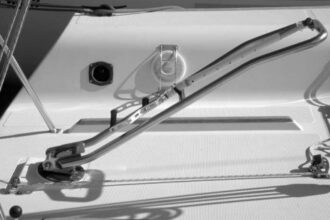
Over the next few months, we methodically fabricated each piece of wood for the taffrail, bowsprit, and all interior bulkheads out of mahogany. Veronica turned the spindles for the taffrail on a small lathe, and we redesigned the bowsprit to accommodate an anchor roller and to better match the width of the bow pulpit. We also cut teak-and-holly plywood for the cabin floor and for lids to be used on the molded-in storage areas.
All three interior bulkheads and the dinette table were cut from 5⁄8-inch mahogany plywood. The forward bulkhead was redesigned to be shorter than the original, helping make the small interior seem a bit more open and roomy. The dinette table was designed to drop into place between the seats, forming a berth. The removable table leg and two pop-top stanchions store in 1-inch clips on the underside of the table. We finished all the interior wood with Minwax satin urethane. We custommade every piece of wood except the grabrails, which we ordered through our local MacGregor dealer.
We got to know Frank Grizzaffi of Sail Venture Yachts quite well. Among other things, he helped us locate and order a new keel winch, sails, roller furling, and stanchions. He also made new standing rigging. His years of experience as a MacGregor dealer were invaluable, as were his frequent words of encouragement. He even gave us an original sales brochure for the boat.
Fresh mounting holes
Slowly each component of the running and standing rigging was installed, each one requiring fresh mounting holes, careful alignment, and a bit of engineering. With the mast stepped, one last bit of business was installing new tanbark sails. We chose sails by Hong Kong Sailmakers. Their quality was superb.
New winches, running lights, Windex, stereo, interior lighting, and wiring all had to be installed as well. Routing the wiring proved to be a challenge, but we finally accomplished that with the help of some flexible conduit. Switch panels and a bilge pump also had to be installed, and we fabricated a battery compartment out of the way under the starboard seat. A friend who was replacing interior lights in his Pacific Seacraft Orion donated all of his old fixtures to our project.
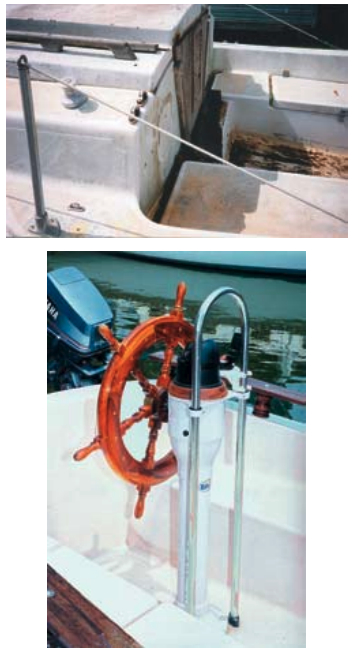
All that remained now was steering. Since the boat had had two wheel steering systems installed previously, we decided to go all-out and put in a new Edson Small Boat Steering system. This is a redesigned push/pull system that works like a dream. It’s also the only one that would fit into such a small boat. We installed the system in a couple of days without very much trouble. We located a great little classic-style wooden wheel, adapted it with some carefully crafted spacers (the Edson shaft was a little long for this wheel), and were ready for a test sail. This would be our finest hour.
Lost all power
Ideally, on an inaugural sail, you motor out, carefully set the sails one at a time, check to see that everything is working, then slip away into the distance with a huge smile on your face. Unfortunately, just as we motored into the mouth of our busy channel, we lost all forward power. Visions of hidden pilings, jagged rocks, scraped paint, sunken boats, and the general indignity of such occurrences raced through our heads. Without panic, but with a sense of extreme urgency, we did a “rapid sail deployment.”
As luck would have it, everything functioned properly, the wind was just right, and we were able to sail quietly away, keeping ourselves off the rocks and pilings. Turns out we had snagged a large plastic bag on the prop. After removing the offending plastic bag, the rest of the sail went off without a hitch, smiles and all.
Although some old boats, and even some newer ones, might seem better suited to life as a dive site or restaurant sign, it was evident to me from the beginning that the Venture of Newport 23 is not one of them. There is a lot of satisfaction in saving a deserving old boat, especially one with as much character and potential as this one. This is a prime example of an over-improved boat. But it’s not about the money. You only have to go sailing to make it all worthwhile. The bonus is to have other boaters chase you down to tell you what a beautiful boat you have. In fact, the only time I really think about how much work we all put into her is when I consider doing it again.
Thank you to Sailrite Enterprises, Inc., for providing free access to back issues of Good Old Boat through intellectual property rights. Sailrite.com