Try this simple substitute for flopper-stoppers
Issue 37 : Jul/Aug 2004
Have you ever anchored in an apparently protected harbor only to find a surge running into it? The boat starts rocking and rolling, things slide around on the counters, locker contents jangle, and crew members tumble out of their bunks. Just moving about becomes a chore.
It doesn’t take much of a surge to set up an uncomfortable motion aboard ship, and a big swell can make a harbor downright untenable. However, there’s an easy way to overcome the effects of surge in an anchorage, even a fairly big surge, by employing a springline to the anchor rode. I call this technique “springing the rode.”
To understand how this concept works, consider the conditions that would warrant using the technique. Suppose you’re anchored in a harbor where the wind is blowing from the north. As long as there is no current tugging at her keel, the anchored boat will point north into the wind. Now picture a surge rolling into the harbor from the west. It could be a residual ground swell generated by some distant storm or the remnant of seas outside the harbor bending around the headland. Whatever the source, waves from the west will strike your boat on the port beam, causing her to roll.
Now imagine the effect of turning the vessel 90 degrees to port so that her bow is facing into the waves rather than into the wind. The rolling would cease, replaced by a more gentle fore-and-aft pitching motion. In moderate conditions it would hardly be noticeable. The obvious question, then, is what is the easiest, safest way to point the boat into the surge, broadside to the wind?
Second anchor
Most sailors would probably think of setting a second anchor from the boat’s stern. In this example of a north wind and a westerly surge, the stern anchor would be set well out to the northeast. Then by hauling in on the stern anchor rode, and perhaps feeding out some on the bow’s anchor rode, the boat can be made to face west. This isn’t a bad solution except that it’s a lot of work to carry out and later retrieve the stern anchor. It also means the boat will no longer swing with other boats nearby that are lying to only one anchor, so if the wind shifts you could find yourself bumping against your neighbor.
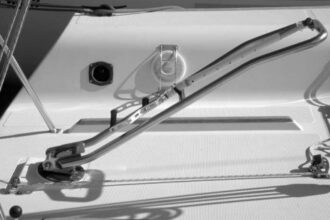
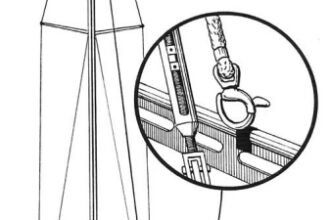
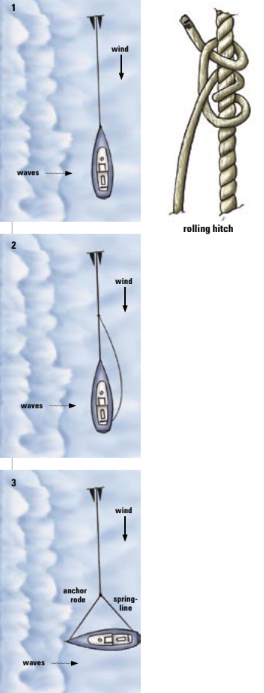
There is a much easier, more efficient solution to the surge dilemma using only the bow anchor that is already set. All you have to do is add a springline to the forward anchor rode. Just tie a long dockline to the anchor’s rode or chain at the bow of your boat. A rolling hitch works well for this. Then lead the slack line aft alongside the hull to (in the case I’ve described) the starboard cockpit sheet winch. Be sure it runs outboard of the bow pulpit, stanchions, and shrouds. On a center-cockpit boat it may be best to pass the line through a (starboard) stern-quarter turning block before leading it to the winch.
Next, pay out the anchor rode about half a boat length. Finally, take up on the springline by cranking on the sheet winch until there’s roughly equal pull on the rode and the springline and the two lines are forming a V-shaped bridle to windward. The boat will swing broadside to the wind and will face the swell. It’s as easy as one-two-three! (See diagrams on Page 81.)
In my example the waves are running 90 degrees to the wind, but you can adjust the vessel’s heading for other angles of wind and seas. If the surge is coming from forward of the beam, feed out less of the rode and/or take in less on the springline. If the waves are from abaft the beam, pay out more anchor rode and/or haul in some more on the spring. With a little experimentation you’ll soon master this simple, useful technique.
Here are a few other pointers:
- If the waves are abaft the beam, it may be equally comfortable to face the boat’s stern into them rather than the bow. This will require less line adjust ment than swinging the bow all the way around.
- Remember that to turn the bow to starboard, you must run the springline to the port quarter. To turn to port, use a starboard-quarter springline.
- If the wind picks up, and you feel uneasy about the strain your boat’s beam-on position is putting on the anchor, you can instantly return to the normal anchor mode, bow to the wind, by releasing the springline. The boat will quickly swing to the breeze. The springline can be recovered by shortening the anchor rode’s scope, or it can be left attached to the rode until you weigh anchor.
- If the wind shifts you’ll have to readjust the boat’s angle by adjusting the length of the spring or the rode.
- If the breeze dies altogether, deploying a stern anchor may be the only way to hold your boat end-on to the waves.
When a surge has your boat rocking and rolling at anchor, give your boat, your crew, and yourself a break. Spring the rode!
Thank you to Sailrite Enterprises, Inc., for providing free access to back issues of Good Old Boat through intellectual property rights. Sailrite.com