A tinge of fear heightens autumn’s sensations of delight
Issue 38 : Sept/Oct 2004
Marjorie and I rowed out to the boat around noon, just the two of us and the dog. The last day of September was magnificent — bright warm sunlight, a cloudless sky, only the gentlest of winds. We raised the mainsail and the boomed forestaysail, known to the old schoonermen as the jumbo. I dropped the heavy mooring line overboard, leaving our scarlet rowboat behind. My pulse quickened, as it always does when the boat lets go its tether to the land.
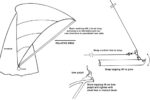
Marjorie steered for the harbor mouth. Silversark slipped between the red and green buoys, the water chuckling at her forefoot. We had no destination, no purpose, no objective. My only agenda was to see how my improvements to the jumbo rigging would work and to try out a temporary windvane. Silversark was built for one, but I’ve never managed to get it working.
We reached out into Lennox Passage and began tacking up into the westerly wind — across to the green bulge of Ouetique Island, back to Bernard Island. There is a unique, saturated depth to the colors in the fall — not just the flaming leaves, but also the gun-barrel blue of the water, the dusky green of the spruce trees, the vivid strength of the blue sky overhead. The density of the air makes the autumn atmosphere poignant: the last warmth of summer, the sharp edge of the winter to come.
I found myself thinking about Joshua Slocum and about fear. I never leave the mooring without at least a twinge of apprehension, but Slocum seems almost fearless, and the ocean he describes is a friendly and welcoming place. Certainly he was an infinitely greater seaman than I could ever be. Yet he admits in his letters that he experienced a good deal more fear than he describes in Sailing Alone Around the World.
Was Slocum a liar? Maybe not. In An Intimate History of Humanity, Theodore Zeldin maintains that fearfulness is the normal human situation. Most of us fear many things — disease, rejection, bankruptcy, human violence, accident, and much else. And we love fear. As Zeldin notes, “when religion stopped frightening people, they invented new fears to frighten themselves, as though they valued fear as a necessary part of the sensation of being alive.”
Greatest enemy
In its milder forms, fear may be useful, intensifying experience and making one feel alive — but fear is also the greatest enemy of freedom, and if we did not conquer it we would be utterly immobilized. Moreover, most of our fears are pointless. Most of the things we fear will never happen. And if they did, we would survive them.
The most powerful antidote to fear, says Zeldin, is curiosity, our ability to become so absorbed in what we are experiencing that we forget to be afraid. Marco Polo, for instance, “has such curiosity that he forgets fear. The diversity of human beings amuses rather than terrifies him, even though he does not get rid of all the darkness — no one ever has — there is always the puzzle that cannot be understood, the shapeless specter that automatically makes hair stand on end.”
“In every life,” says Zeldin, “there is an element of victory over fear.” And then I read about an Inuit shaman who told Joseph Campbell that the voice of the universe says one basic thing, and that is: “Be not afraid of the universe.”
Be not afraid of the universe: that is exactly the understanding that Slocum’s great book exhales. And it echoes my own small experience. I begin a voyage fearful of the sea, of the boat, and of my own limitations. As I sail, however, the fears disappear. Challenges arise, and I deal with them. I am absorbed by the experience of sailing, and the living world I inhabit. The longer my voyage, the less fearful I become. Eventually I become downright exultant.
It seems absolutely perverse that going to sea should tend to purge one of fear. But perhaps this is the emotional arc of every little cruise, the addiction of sailing — fearfulness experienced, confronted, and discarded.
Across to Cascarette Island, back to Poulamon Bay, and up into Knife Inlet. The jumbo works fi ne, but the windvane needs refinements. Off Indian Island we bear away for the downwind run to D’Escousse. The slanting sunlight on the ruffled water makes, says Marjorie, “a million diamonds on the water.” Cormorants stand black on the Goillon Reef, terns circle and hover off Bernard Island. We may not sail again this year, but the day is etched in our memory, and we feel at ease in the world.
Thank you to Sailrite Enterprises, Inc., for providing free access to back issues of Good Old Boat through intellectual property rights. Sailrite.com