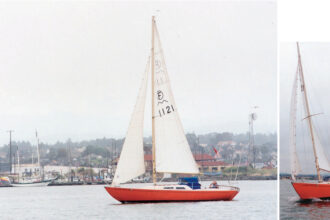
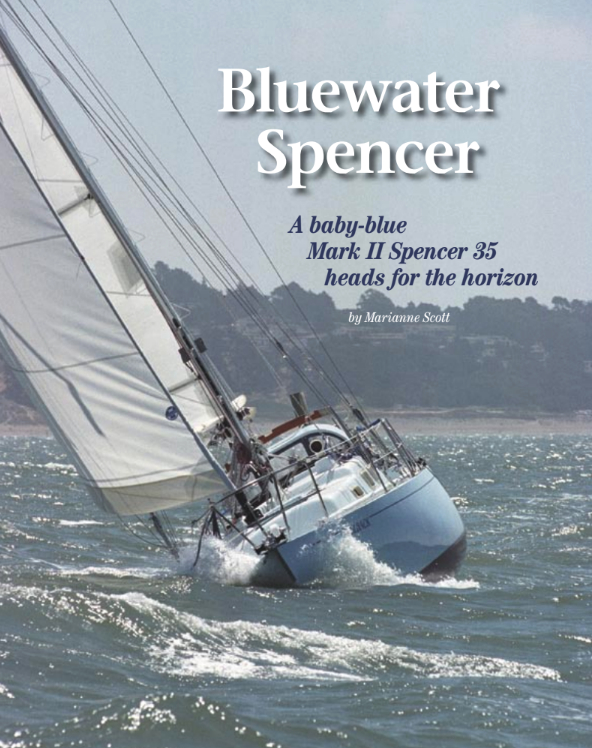
A baby-blue Mark II Spencer 35 heads for the horizon
Issue 38 : Sept/Oct 2004
In 2002, Jim Kellam won the Singlehanded Transpac Race in his refurbished Spencer 35 Mk II. The Canadian from Vancouver won the race from San Francisco to Hanalei Bay, Kauai, on a corrected time of 10:10:48:11. This victory was a pleasant surprise; his goal wasn’t winning the race, he simply didn’t want to embarrass himself. But he found the Spencer was “easy to sail to its rating” (Pacific Cup Rating 231). “I averaged 90 percent of the boat’s hull speed,” he says. “We went around 5.8 knots or 140 nautical miles a day.”
This wasn’t Jim’s first round-trip voyage to Hawaii. Three years earlier, inspired by the books of Moitessier and Knox-Johnson, Jim had counted on his Thunderbird experience to solo-sail a Gulf Island 29 to Hawaii: the 24 days alone were a test of his grit against the expanse of the Pacific Ocean. The 2002 Transpac race challenged him again, this time against both the sea and a pack of boats designed for speed.
Love-struck by long-distance sailing, the trim, compact 52-year-old signed on again for last June’s 2004 Singlehanded Transpac Race. After that 2,120-nautical-mile voyage, he has plans for a 45,000-mile solo circumnavigation that will take about 27 months. He has persuaded his employer to give him a leave of absence. “Because I’m completely unimportant, the company is allowing me retirement on the installment plan,” he banters.
His future route is nebulous; he might go south from Hawaii, maybe to Tahiti or Rarotonga, or he might spend time in New Zealand. I ask how, alone on his boat, he’d enter some atoll whose coral heads require someone on the bow to point out dangers to the skipper.
“I’m not going to those islands,” he says with his gravelly voice flavored by nicotine. “You see, I’m not all that interested in places. I want to sail, be out on the water. I like the freedom and self-reliance. There are so few activities that allow that for ordinary people.”
Quit school early
Jim grew up on an Ontario farm and never saw water unless “it was in the trough that waters the cows.” He quit school at 16, moved west, and began logging in British Columbia’s abundant forests. In 1979, he joined Seaspan, one of Canada’s largest marine transportation companies, whose tugs and barges operate from Mexico to Alaska. Jim served as crane operator on self-dumping log barges but sailed whenever possible. In 2001, when he sought a “slightly larger sailing platform,” he opted for a fixer-upper boat to keep it affordable. He found the Spencer 35 Mk II, Atari. The original Spencer 35 was designed by John Brandlmayr in 1961; the Mark II about a decade later (see sidebar on Spencer Yachts, Page 10).
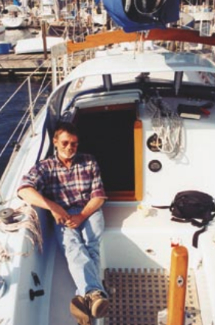
“She’s an old cruising boat with longish overhangs, full keel with a cutaway forefoot and keel-attached rudder,” he says, lounging back in his cockpit and stroking his neat, grizzled beard. “But she has nice easy motion in a seaway and, although she may not exactly gobble up the miles, we will get there eventually.” He bought the boat for $51,000 (about $35,000 U.S.), figuring upgrading it would double the initial investment. “She was basically sound and had a practically new 30-hp, three-cylinder Yanmar. I hauled the boat and spent about 1,500 hours over the next eight months on the refit.” As a reminder of his work, Jim rechristened the boat, Haulback, a British Columbian logging term.
Of course, there are refits and refits. You can upgrade a boat for the occasional weekend cruise and a bit of harbor hopping. Or you can meet the requirements of an offshore race. The Single-handed Transpac stipulates not only extensive sailing experience from the skipper, a well-found boat, and standard safety equipment, but also a long list of special gear, including a life raft, single-sideband radio, a masthead strobe light, EPIRB, extra GPSs, satellite voice communication . . . the costly inventory goes on and on.
Secured sponsorship
To help pay for all this, as well as the entry fee of $750, Jim approached Kyle Washington of the Washington Marine Group (which owns Seaspan) for sponsorship. Kyle liked the idea but decided it should be a company-wide adventure and invited Seaspan employees to participate. Jim’s colleagues enthusiastically endorsed the concept of backing their own offshore racer and the company-cum-staff contributed $30,000 (Canadian) toward equipping the Spencer.
Jim is pleased to have the Spencer 35 Mk II rather than the original Spencer 35. The later version was inspired by famous cruisers Hal and Margaret Roth, whose earlier Spencer 35, Whisper, added to the boat’s reputation. But the circumnavigating couple had complaints, which led to a redesign of the sloop. Grant Brandlmayr, John’s son, recalls the Roths’ visit to Vancouver (they’d rounded Cape Horn) to solve some of the problems.
“Leaks along the teak toerail were a nuisance, so Dad designed a new deck mold that integrated the toerail,”
he explains. “Dad also made the cabin longer and the cockpit shorter. A taller rig and squared-off rudder improved sailing ability as well. By the time we’d rebuilt Whisper, she’d become the Mark II.”
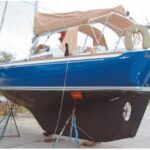
Except for the engine, Jim revamped his 12,000-pound Spencer from stem to stern. He believes in simple systems but likes strength and redundancy. His first task was to haul the boat and strip the bottom. He carefully opened blisters, drained them, then filled the voids with cold-cure epoxy and mini-fibers. For the next two and a half months, the boat remained inside a heated, insulated tent, which dried the hull. While the boat dried, Jim ground out loose fiber around the rudderstock and rebuilt the area with fiberglass mat and epoxy. He changed the through-hull fittings After fairing the hull, he applied three coats of Industrial Formulator S-1 sealer, followed by seven coats of Interprotect barrier coat and three coats of antifouling paint.
Shimmering blue
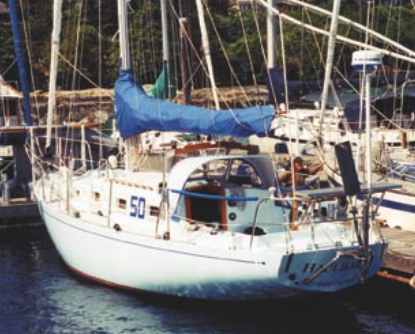
The hull above the waterline was also faired and primed, then it received a shimmering coat of baby-blue Endura polyurethane. He rolled gray Endura on the non-skid and embedded granules from International Paint to make the surface grippier. Large dark-blue numbers, advertising the hull’s number (50), are painted on the trunk cabin, which also sports a coat of shiny baby-blue.
Jim dismantled all deck hardware, stanchions, pushpit, and pulpit and made them leakproof. New lifelines will help keep him on board and supplement the harness, tether, and jackline he uses when going forward during his offshore journeys. To make sure his winches can take the load during prolonged heavy weather, he glassed-in heavier winch pedestals. A Fleming Global Major 401 windvane steers the boat. A dual anchor roller was installed on the bow with a two-speed, 1,200- pound Muir Windlass controlling the rodes, chain, and two anchors: a 35-pound CQR and a 44-pound Delta.
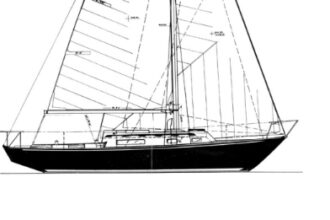
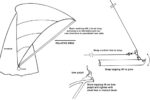
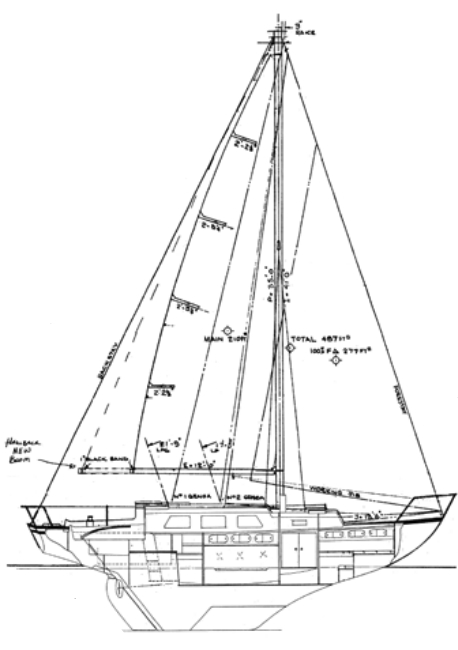
The Spencer comes with teak-and-stainless-steel gallows but is designed with a fairly short boom. Jim extended the boom from 12 feet 6 inches to 16 feet 9 inches (see illustration on Page 12) with mid-boom sheeting and slab reefing. Naturally, that led to a new, larger, fully-battened mainsail with two deep reefs. He renewed the standing rigging and can transform the sloop into a cutter during offshore voyages by attaching a forestay and running backstays. During his circumnavigation, he will carry a 115-percent genoa, three staysails, a trysail, and asymmetric and Code Zero spinnakers, as well as 1.5-ounce nylon headsails for “running dead downwind.” Finally, a cold-molded hard dodger with Lexan inserts is solid protection in big storms and tough enough to carry Jim’s weight. Everything looks tidy, secure, and cared for.
Singlehanded voyaging
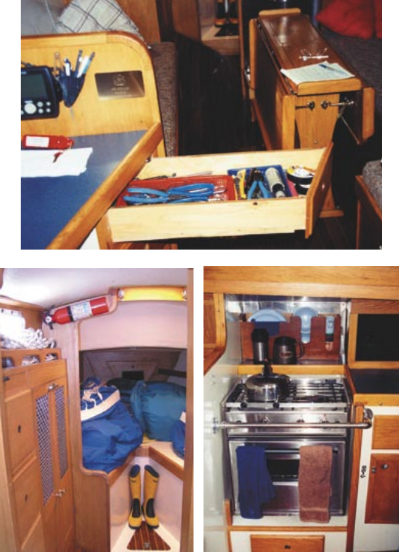
“You must understand,” Jim says before inviting me down through the off-center companionway, “that the interior renovation was designed for me and for singlehanded voyaging. The head, for example, was tiny, and the minuscule sink, walls, and door made me feel claustrophobic. So I ripped it all out and installed a Jabsco toilet in a more convenient location but left the space open to the corridor. No need for a door when I’m all alone.”
I note that Jim built storage shelves into the hull wide enough to hold cheerful plastic milk crates. Sturdy oak fiddles keep the boxes in place, but have extra protection from shock cord hooked into eye straps, with one cord doing double duty as a toilet-paper holder. The forepeak has been completely rebuilt, contains a new holding tank and serves as sail locker. Jim sleeps on the main cabin settee “on the low side” to avoid having to put up leecloths.
Stainless shields protect the main bulkhead against the high temperatures radiated by a Sigmar diesel heater, which gets its fuel from a 4-gallon day tank installed inside the head above the toilet. To freshen the interior’s look, Jim tore off the old vinyl liner covering the deckhead, ground off the old adhesive, and installed white fiberglass panels with acrylic coating. “Those panels are used for walls in commercial freezers,” he explains.
The rest of the cabin is lined with pale oak and oak-veneered plywood, making for a warm, clean look. The galley has been rearranged to hold a two-burner Seaward propane stove with dishes neatly stowed above it. He wrenched out the power-gulping fridge but rebuilt the icebox surrounding it with 6 to 8 inches of glassed-in polystyrene, which makes ice blocks last for a week. He also removed the scratched countertop covering and replaced it with merry blue Formica.
Sailing books
New cabin lights throughout will make it easy for Jim to read some of his favorite sailing tomes during his voyage — he also plans to take along a compact version of the collected works of Jack London and Robert Service. All four under-counter drawers were short, although the upper ones could have been made longer to take advantage of the wider hull, so Jim extended the drawers’ length to fit the hull shape and now stores his hand tools where they’re safe and accessible. He added shelving to the cabinets to extend storage space. Like everything else, the cabinets are carefully finished. Many a sailor would love to borrow Jim for refurbishing a boat. He’s a meticulous craftsman.
The same care has been lavished on the less visible, but equally important, furnishings. Jim cleaned the water tanks and fuel tanks carried in the boat’s belly above the keel. Certified propane hoses and fittings substituted for 20-year-old parts, and a new sniffer monitors the bilge. He replaced all the wiring, choosing multi-stranded, shielded copper wire, and put heat-shrink insulation over the connectors.
Power is supplied by a 120-amp Ample Power alternator with a three-stage regulator which also monitors the twin 8-D Davidson gel batteries and separate starting battery. Among the other new and updated equipment are bilge pumps, water pumps, Racor filter/water separators, fuel lines, plumbing, a new Norscot lubricated dripless stuffing box, and a Campbell Sailor fixed two-bladed propeller. Contemporary electronics include a Garmin 152 GPS, Furuno 1622 radar, Raytheon ST4000 autopilot, and ST40 wind instruments.
Sold their home
I connect with Jim just before he leaves for California to begin his race and circumnavigation. He and his wife, Martha, have just sold their large home and moved to a more manageable condo. “You know the old joke,” he quips, “Life begins when the kids leave and the dog dies.”
Martha plans to visit Jim in some exotic spots — when he figures out where those places are. The president and employees of Washington Marine Group, thrilled with their own blue-water sailing champion, again sponsored Jim and Haulback for the 2004 Singlehanded Transpac. He didn’t do anything too startling to the old girl this time around. “I added a Van Nav computer to support electronic charts and high-frequency email by SailMail. I also installed solar panels to keep those batteries topped up,” he says.
Mark Twain once wrote, “Twenty years from now you will be more disappointed by the things that you didn’t do than by the ones you did do. So throw off the bowlines. Sail away from the safe harbor. Catch the trade winds in your sails. Explore. Dream. Discover.” It’s as if Twain wrote those lines especially for Jim Kellam. If he suffers any disappointments, it won’t be because he feared the devil and the deep blue sea.
Thank you to Sailrite Enterprises, Inc., for providing free access to back issues of Good Old Boat through intellectual property rights. Sailrite.com