A third-generation performance cruiser
Issue 44: Sept/Oct 2005
AT THE 1959 NEW YORK BOAT SHOW, CLINT PEARSON AND his younger cousin, Everett, introduced their first sailboat, the Carl Alberg-designed, 28-foot Triton. The design was so appealing and well received that they returned to their Bristol, Rhode Island, plant with 17 orders in hand. Pearson Yachts was off and running. Over the next seven years, a total of 707, modified full-keel, 28-foot Tritons were built. Other sailboat models followed, and Pearson Yachts eventually became the largest sailboat manufacturer in the country.
The second-generation 28-foot Pearson appeared on the water in 1975. This time, the designer was Bill Shaw. The boat was fundamentally different from Alberg’s Triton, with increases in waterline length, sail area, and displacement, but only a slight drop in the sail area/displacement ratio. The full keel was replaced with a fi n keel, and the drop in the displacement/LWL ratio reflected a departure to a performance cruiser/racer design. This basic design, along with a few modifications in 1976, lasted until 1982.
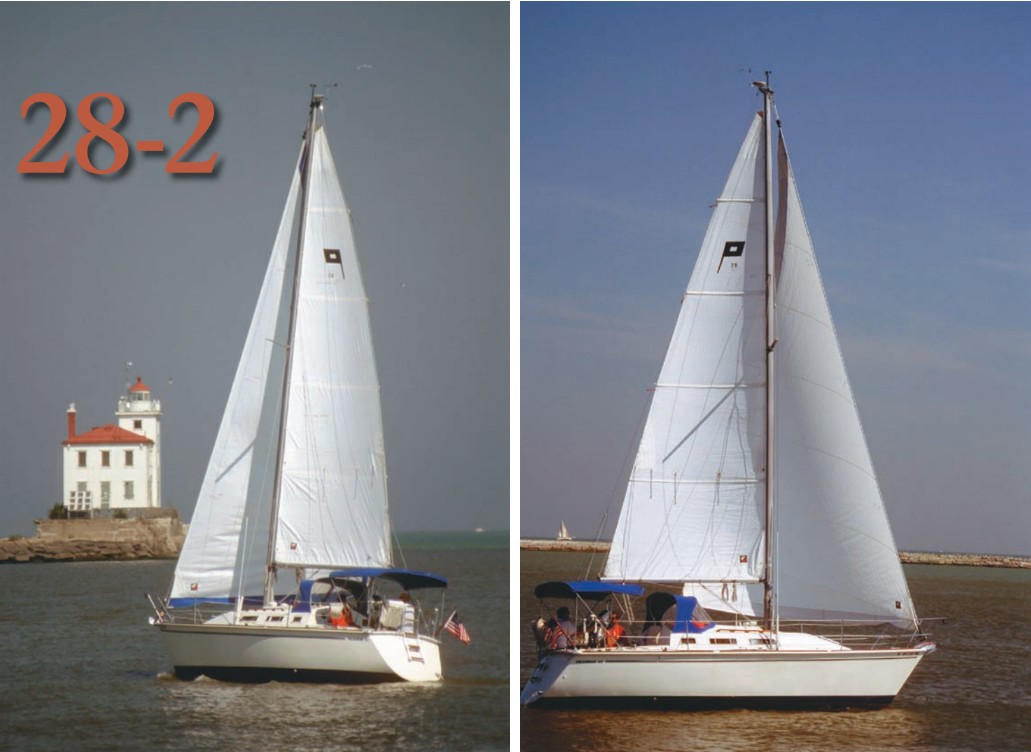
After a two-year hiatus, Pearson Yachts introduced its third and last 28-footer in 1985. This latest Bill Shaw design was as different from the second-generation Pearson 28 as the second was from the first-generation Triton. While the overall measurements of the 28-1 and 28-2 were essentially similar, a reduction in displacement resulted in an increase in sail area/displacement and a decrease in displacement/LWL ratio. The Pearson 28-2 was a higher performance cruiser/racer. The production of the 28-2, as well as Pearson Yachts, the company, lasted through 1989.
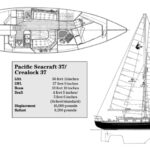
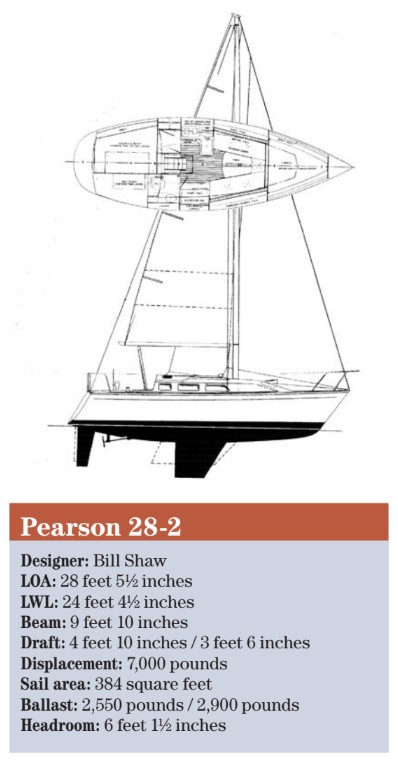
In addition to the increased performance of the 28-2, its accommodations, influenced by European designs, changed dramatically, adding style and increased cruising comfort and maximizing usable space. With an overall length of 28 feet 5 1⁄2 inches, a waterline length of 24 feet 4 1⁄2 inches, a beam of 9 feet 10 inches, and a displacement of 7,000 pounds with 2,550 pounds of ballast, the Pearson 28-2 is distinctively sleeker and more graceful than its predecessors.
Design and construction
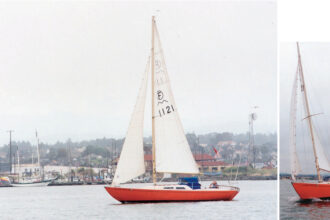
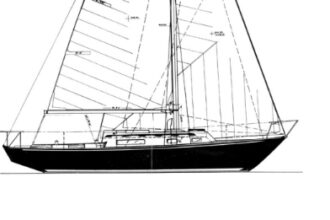
The profile of the Pearson 28-2 displays a flatter sheer, high freeboard, a fi ne entry, and a reverse transom. The coachroof is cambered and integrated into the deck, providing for increased headroom in the main cabin. The hull is a solid laminate of fiberglass cloth and resin, while the deck is a sandwich of two layers of fiberglass with an end-grain balsa core. This sandwiching provides additional strength and rigidity without a significant increase in weight. Everett Pearson was the pioneer in the use of end-grain balsa as a coring material.
The hull-to-deck joint is an outward flange that is bonded chemically and through-bolted on 4-inch centers. The joint is finished off with a two-piece vinyl rubrail and capped with a teak toerail. While this outward flange may add ease to manufacturing and is strong and secure, it is susceptible to damage from contact with docks and other things that boats occasionally bump into.
The Pearson 28-2 was available in two underwater configurations, a 4-foot 10-inch fin keel and a 3-foot 6-inch shoal keel, both with spade rudders. While the ballast of each is external, the fin keel contains 2,550 pounds of lead and the shoal keel 2,900 pounds of cast iron.
The deck hardware is of good quality and strength, and it is properly installed. Everything is through-bolted and secured to backing plates. All underwater through-hulls are bronze ball valves.
On deck
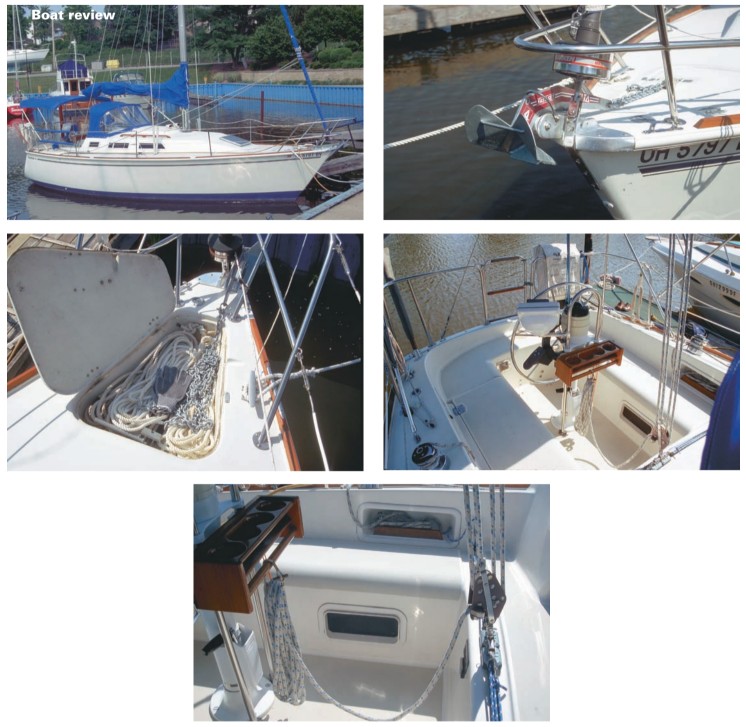
Located prominently on the stem is a substantial cast-aluminum stemhead fitting with integral anchor roller, a nice touch. A locking anchor well with overboard drain offers a generous capacity. It can house more than 300 feet of rope and chain rode plus a spare anchor — that is, if one takes a little time stowing it all. A pair of chocks and two open-throat cleats complete the forward anchoring/mooring hardware.
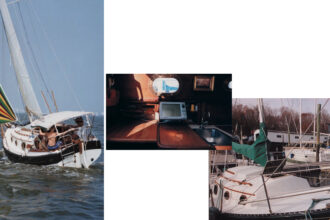
Except for the reinforced, smoked acrylic hatch, located on the forward slope of the coachroof, the foredeck is free of obstructions. For added safety, there’s a bow pulpit and dual lifelines. The molded non-skid deck is colored two-tone beige to reduce glare. The sidedecks are 18 inches wide and the shrouds are inboard. Along with the teak handrail, located on each side of the coachroof, this makes for ease of movement forward and aft. The cambered coachroof is also beige non-skid and incorporates a sea hood with a pair of integral Dorade vents that serve the main cabin.
Even though the cockpit measures 7 feet in length, the usable seating space is approximately 6 feet. The remaining foot is taken up by the impressive bridge deck. The seats are sloped outward for comfort and drainage. Two drains adequately remove water from the cockpit foot well and one scupper drains the seats. For stowage, there’s a cubbyhole in each coaming and a very large sail locker to starboard. The locker is also home to the water heater, Y-valve and holding tank, and emergency tiller. In addition, it provides some access to the steering mechanism.
To starboard, within easy reach of the helmsman, is the manual bilge pump. Completing the picture is an Edson radial drive steering system, a split stern pulpit with swim ladder, a pair of open-throat mooring cleats, and a teak flagpole.
Belowdecks
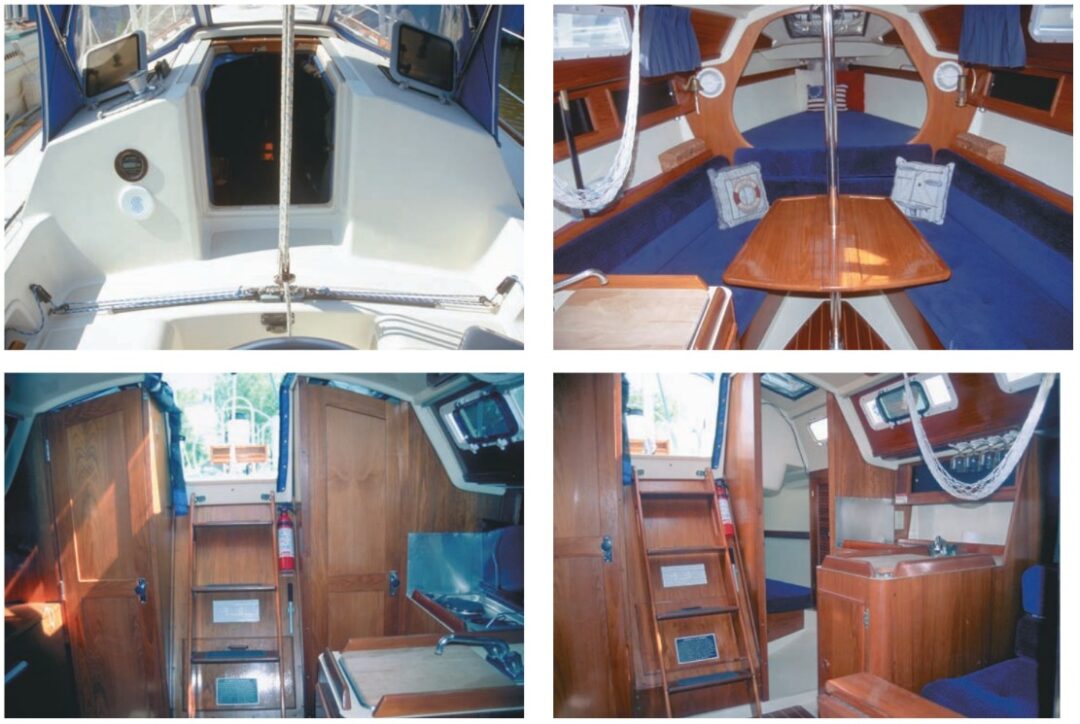
Access below is gained by removing the two solid teak hatchboards and sliding the smoked Plexiglas companionway hatch beneath the sea hood. The accommodations are a dramatic departure from the traditional, especially compared to those found on boats of 28 feet. The interior is open and airy, designed to make best use of space and to provide cruising comfort. Headroom is 6 feet 1 1⁄2 inches.
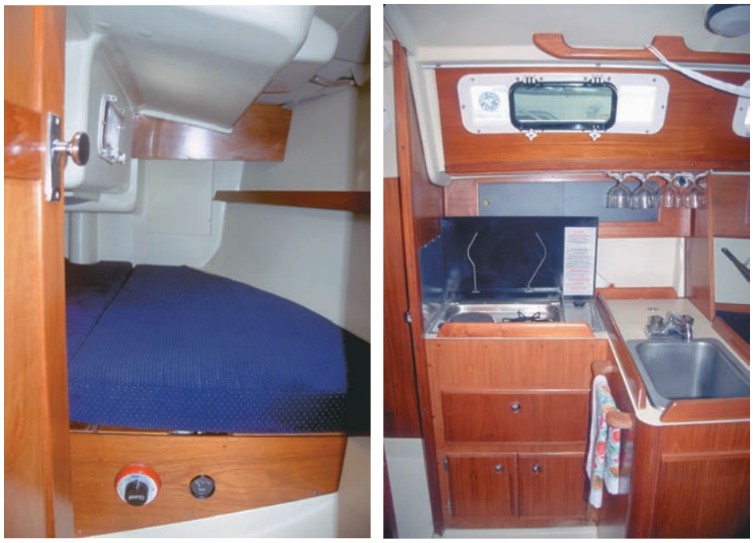
The V-berth, no longer separated from the main cabin by the head and sink on one side and a hanging locker on the other, resembles a settee in the bow. It’s a shade over 6 feet long and 5 feet 8 inches at its widest, easily accommodating two adults. Outboard and above are full-length fiddled shelves and adjustable reading lamps. The large overhead hatch provides for natural illumination and ventilation. Beneath is the 35-gallon plastic water tank, as well as several deep bins for stowage. The partial bulkhead is fitted with curtains; when drawn, they separate the V-berth from the main cabin.
Abaft the V-berth is a wrap-around dinette and settee with a fixed, centerline drop-leaf table. The table is supported by the compression post that passes through it. Above it is a vent leading to the Dorades and two adjustable spotlights that illuminate the dining area. Since the port and starboard arms of the U-shaped settee measure 68 inches, they are not intended for use as berths, except possibly for children. Outboard and above each settee are a full-length fiddled bookshelf, a reading lamp, and a full-length locker with sliding doors. There is adequate stowage beneath the settee cushions and seatbacks.
Just aft and to port is the L-shaped galley, consisting of a deep stainless-steel sink with pressurized hot and cold water, a two-burner countertop stove, and a variety of bins, lockers, and a drawer for stowage. Originally, the counter-top stove was alcohol. Our review boat has been upgraded with a Kenyon combination electric/butane unit. For galley ventilation there’s a screened opening port and for illumination, an overhead fixture that offers white and red light.
Small vestibule
The door abaft the galley leads to a small vestibule with a louvered hanging locker, a fiddled tabletop, and wall-mounted mirror. With the door closed, this makes for an intimate changing area, as well as privacy for the large (74-inch x 61-inch) double quarter berth. This aft cabin’s creature comforts include two opening screened ports, a small ventilation hatch, two reading lamps, a dual-color overhead light, a full-length fiddled shelf, a 110-volt outlet, and stowage beneath the berth.
Starboard and across from the galley is a well-insulated icebox. The lid of the icebox makes a handy chart table. There’s a built-in chart rack on the front of the box and a pencil rack and shelf behind to hold navigation instruments. Above is the electronics locker, which also houses the AC and DC electrical breaker panels. Light and air are provided for by means of a screened opening port. And at night a fluorescent light illuminates the chart table surface.
The door aft of the icebox/chart table gives privacy to the head. In addition to the marine toilet, there’s an integral shower with pressurized hot and cold water, a hand sink and counter, a deep under-the-counter cabinet, a laundry hamper, and a locker with mirrored doors. An opening screened port and a small overhead hatch provide excellent ventilation and daytime light. A combination white/red overhead fixture provides nighttime illumination.
Pearson Yachts utilized both a fiberglass-reinforced plastic pan and overhead liner in the construction of the 28-2. Access to all deck hardware is from behind well-thought-out access panels. The wood portions of the interior, including bulkheads, doors, ladder, overhead handrails, cabinetry, and trim, are varnished teak, while the sole is teak and holly. The joinery is well above average standard. In addition to the opening ports (five throughout the boat), there are two fixed ports in the main cabin.
The rig
The Pearson 28-2 is a masthead sloop with a sail area of 384 square feet, comprising a mainsail and 100-percent jib. The rig incorporates single swept-back foil-type spreaders and has a bridge clearance of 41 feet 10 inches from the waterline to the top of the deck-stepped mast. The standing rigging consists of a headstay, upper and lower shrouds, and a split backstay, all 1⁄4-inch stainless-steel wire. The double-braided Dacron halyards, outhaul, and jiffy reefing lines are all internal. The halyards are cleated on the mast and, to assist in hoisting the sails, two Lewmar #7 single-speed winches are located just above each halyard cleat. The mainsheet is attached to a traveler that’s situated on the aft portion of the bridge deck. On each sidedeck, a genoa track leads to Lewmar #30 two-speed self-tailing sheet winches located midway on the cockpit coamings.
For auxiliary power, the Pearson 28-2 relies on a Yanmar 2GM20F diesel. Coupled to a two-bladed propeller, this 16-hp, freshwater-cooled engine pushes the boat along at better than 6 knots. Fuel is supplied from an 18-gallon aluminum tank. Access to the engine is above average to very good.
Under way
The Pearson 28-2 is a very nice sailing boat. It appears to have no bad manners. It points quite high and is balanced under nearly all conditions. The helm is responsive, and the boat is quick. The review boat’s stock sails had been replaced with a full-battened main and a 150-percent genoa. Even when overpowered, the Pearson 28-2 developed practically no weather helm.
Things to check out
In general, the Pearson 28-2 has aged quite well. Noticeably absent are the extensive gelcoat cracks common to so many of the boat’s contemporaries. With that said, however, there are a few non-age-related items that need to be addressed. The outward hull-to-deck flange is subject to damage and possible leaks if struck hard enough. Check out any rubrail that has been replaced or damaged. Leaking portlights are common. There is a void between the inner headliner and outer skin. Expansion, contraction, and flexing eventually break the sealant’s bond, and a leak develops. With a deck-stepped mast, check beneath for possible delamination. Unlike the deep-draft model, the keel of the shoal-draft model is made of cast iron. This is always a maintenance issue. Lastly, there have been some reports of hull blisters.
Summing up
New from the factory, the Pearson 28-2 came loaded with standard equipment. The only options originally available were draft (shoal vs. deep) and a cradle. In today’s marketplace, the Pearson 28-2 is tough to beat in its size range for cruising comfort, performance, and value. There are usually only a few available at any time, and prices range from $24,000 to $28,000, depending upon condition and upgrades.
Thank you to Sailrite Enterprises, Inc., for providing free access to back issues of Good Old Boat through intellectual property rights. Sailrite.com