Popular designer Bill Crealock drew this one for himself
Issue 39 : Nov/Dec 2004
I was in my early teens when I first fell in love. She was certainly pretty and beautifully shaped. And she was dark blue. Minoru was her name, a 40-foot cutter with a canoe stern.
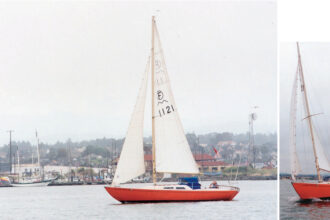
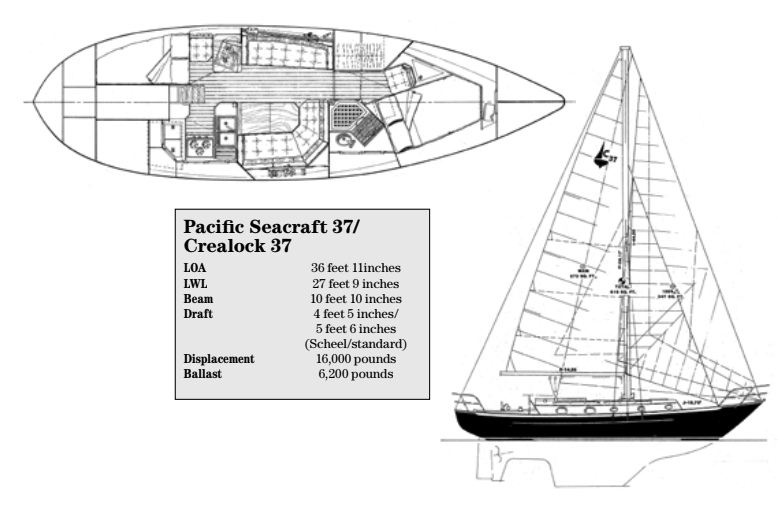
Though I liked canoe sterns, they were too expensive to build in wood, and it was not until the advent of fiberglass that I returned to them. So the 37-foot offshore cruiser I wanted to design — for myself, not for a client — would have a canoe stern with sufficient overhangs to make it work well.
Every design should have a purpose, and the 37 had a clear one. She was to be a boat that would (I hoped) have a touch of elegance, be pleasant to sail and, above all, cruise safely to any part of the world with as much speed and comfort as reasonably possible. The choice of fairly long overhangs was not entirely cosmetic; they would add sailing length. The bow would help keep deck and cockpit dry (as several owners have told me). The stern overhang provided reserve buoyancy and helped to dampen pitching.
On deck I wanted a low cockpit, large enough, of course, to sleep in, and a low bulwark, even if only for its psychological effect. I also preferred a fairly substantial cabin trunk. This would keep hatches well above the deck, allow for good ventilation, provide convenient grab rails and, even more importantly, provide a considerable increase in stability should the boat ever heel that far. I put a raised, molded, king plank on the foredeck to improve footing.
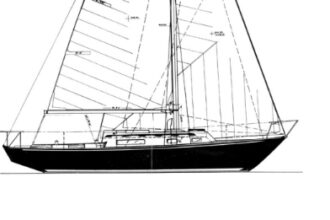
The underbody had to be geared to the central purpose of the design. I went to the split underbody shape — a medium-length keel and separate keel/skeg — for its slightly increased windward ability. Even though I knew that some boats with this configuration had experienced difficulties in heavy conditions, I believed that a split underbody boat could be given as much directional stability as, or even more than, a full-keeler.
Worst conditions
I took what I considered to be the worst conditions the 37 might meet: running for its life, probably under bare poles before heavy wind and seas. If it could deal with that without broaching, it would probably deal with anything else. I devoted a great deal of thought to the after 6 feet of the underwater body. At the end of all that, I felt that the boat would take care of itself under the worst conditions it was likely to meet.
You always wonder, after all the thought and the figuring: is it really going to work in practice? I was lucky; I had phone calls from two owners who had been caught out in just such conditions on opposite sides of the country. They had been running under bare poles before heavy seas, surfing with the needle hitting the peg at 12 knots. By coincidence they both made the same comment: steering had been so easy it would have been more fun with a tiller instead of a wheel.
My choice of rig for a boat of this type was cutter or yawl. Cutter because its staysail works so well with a reefed mainsail in heavy weather and yawl partially because I love having plenty of strings to play with on passage. The mizzen, though small, provides extra drive, especially if fully battened to keep it quiet, and enables one to fine-tune the boat’s balance. The mizzen also makes an easy small first reef just about the time when weather helm might be appearing, giving one the option of a mizzen staysail. Finally, the mizzen shrouds provide support for the aft corners of an awning — possibly the most valuable piece of equipment aboard in the tropics.
The accommodations were kept fairly simple, providing ample ventilation, avoiding large open spaces and sweeping curves on the settees, which work well in port but not at sea. I did not find space for a feature I cherish, the wraparound galley, but interior arrangements are very much personal taste.
I remember just how personal they can be when an experienced couple discussed a new interior we were doing for their larger boat. They particularly wanted a close-fitting wrap-around galley; so close, in fact, that the husband asked me to measure the width of his wife’s hips.
None of my design lessons dealt with this procedure, but of course I duly measured her midship section. As I recall, she had a prismatic coefficient of about 0.52.
Thank you to Sailrite Enterprises, Inc., for providing free access to back issues of Good Old Boat through intellectual property rights. Sailrite.com