Test your seamanship skills in tricky situations
Issue 44: Sept/Oct 2005
SUN GLISTENS ON A PERFECT FRENCH POLYNESIAN SAILING day. The trade wind blows across the deep waters of the pass that cuts through the reef between Huahine and the open sea. The 35-foot sloop cuts a gentle wake as it powers seaward through the pass. Its crewman, Chuck Ryan, a lifelong sailor, had attached the halyards to the sails before he raised the anchor. Now he is clearing up the foredeck while the owner stands at the helm motoring toward their next destination, Raiatea.
Halfway through the pass, the engine quits. Chuck watches bemused as the skipper dives belowdecks to the engine room. Chuck hoists the headsail, goes back to the cockpit, trims the sheet for a beam reach, and sails clear of the pass. When the skipper pokes his head out of the companionway hatch and looks around at the open sea, then glances up at the wind-filled sails, he says, “Gee, that was a good idea!”
Chuck has years of sailing experience in big boats and on engineless dinghies. So his actions came naturally to him. The owner, like most modern sailors, has spent more time with motorized transport. So his actions were just as natural. Play along with us if you want to gain the skills and confidence to think of your sails as highly reliable motivational power — as an extra margin of safety — and then to react instinctively, as Chuck did, should your engine disappoint you in tight quarters.
Though theoretical sailing is no substitute for the real thing, we hope this quiz will get you thinking about the many options open to a boat that is powered by sails and an engine. The next time you are powering into a port, you can hone your seamanship skills by asking yourself, “What would I do if the motor quit right now?” Once you’ve practiced visualizing your responses, try out a few of these maneuvers just as you would do a crew-overboard drill.
Rules for this quiz
- The goal — To stabilize the situation by placing your boat in the safest possible position before you take the time to find out what caused the engine to shut down. The safest position may be out in more open water or comfortably at anchor.
- Tools available — You can use sails, warps, anchors, or dinghies. There are no trick answers or questions. But here, as in the real situation afloat, calm consideration of prevailing and frequently changing conditions is paramount.
- Disclaimer — There are probably other sailing maneuvers you could use to obtain the same results. The hints that follow each question should give you ideas that have definitely worked for us.
Earning points
- If you think first of calling for outside assistance, such as a tow, you lose five points.
- If all your sheets and halyards are rigged and sails are clear to hoist, you gain one point.
- If your sails are set up so both main and headsail can be up (or out) in one minute, add two points.
- If your ground tackle is set up so it is ready to let go within one minute, add two points.
- If you have warping lines coiled and ready, without the need to move other gear off them, add two points.
- If your regular crew knows how to handle ground tackle and sails and is well-versed as to which halyard or sheet is used for each sail, add three points.
- If you practice these maneuvers under way and are left feeling satisfied with only a slight adrenaline surge, add five points.
Scoring
- 10 or above — You are organized and ready to downgrade a sudden engine shutdown from a cruise-ruining experience to simply an interesting incident.
- 7 or below — It would pay to take the time to practice real-life engine-failure drills when you’re out sailing.
Situation A
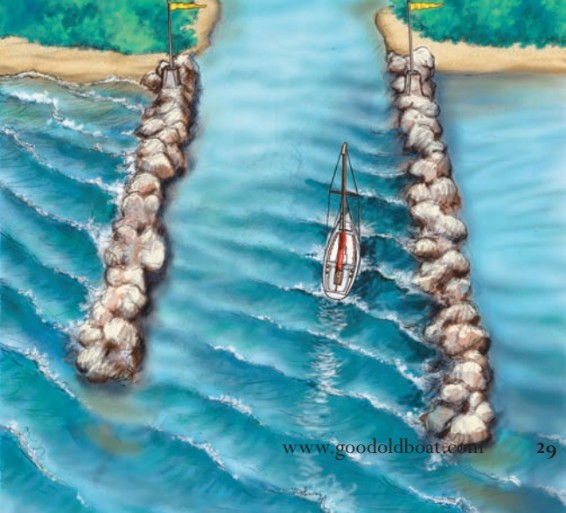
You are inside the breakwater, near the starboard side of the channel, when your engine runs out of fuel and suddenly stops. Since the wind is on the beam and there is a 3-foot swell wrapping around the end of the break-water, the boat is being set toward the rocks to leeward. If you do not act quickly, your boat could be smashed to bits when the swell drops it onto the breakwater rocks. What do you do?
Solution A
You are in a difficult situation as you have very little time to raise sails before you hit the rocks. You also don’t have room to set an anchor. The most important reaction is to steer to head up immediately toward the windward side of the entrance before you lose any boat speed. (This is a reaction that should become just as natural to you as your reaction when the car you are driving stalls and you use the last bit of momentum to move toward the side of the road.) As you head up, you can decide if you have gained enough space to anchor. If not, get as far to windward as possible, then fall off onto the most favorable tack, heading either into, or out of, the harbor.
Move forward slowly under bare poles to gain the time you need to get your sails up and pulling. Your jib would be the best choice once you are on your selected tack, as it can usually be set and working faster than your mainsail.
Hint: the most prudent way to enter this harbor with a beam wind is to keep your mainsail up and your jib ready to hoist or unfurl. We often use binoculars to assess the traffic. If it is heavy, it could pay to wait outside until it eases off. Then you could enter on the windward side of the channel and, if your engine quits, have more time (and therefore room) to anchor or raise sails needed to reach in or out of the channel with safety. Though the rules of the road would put you on the leeward side of the channel in this situation, we would use the rules as guidelines only, especially in fresh to strong winds. We would keep a careful lookout and hug the windward side of the channel.
Situation B
You’ve had a really boisterous sail, and sludge from the bottom of your tank plugs the fuel filter. Your engine quits just as you are halfway through the breakwaters. The wind is brisk and dead on the nose.

Solution B
If there is little traffic and not too much swell, one option is to anchor when your boat speed drops to zero. But if the channel is deep or the holding is poor, this may not work.
Your second option is to hoist your headsail, choosing either the jib or staysail according to wind strength, and back the sail (sheet it to the windward side of the boat) to help pull the bow of the boat around so you can run out to open water. If your mainsail is up, you must push the boom all the way out so the power is off the sail and the boat can literally spin on its axis. Even the slightest bit of power in the mainsail can counteract the headsail and keep it from spinning the boat around quickly. It pays to practice this maneuver out in open water so you can see the effects for yourself. Paying out the mainsheet should become an almost automatic response whenever you want to head off quickly.
Situation C
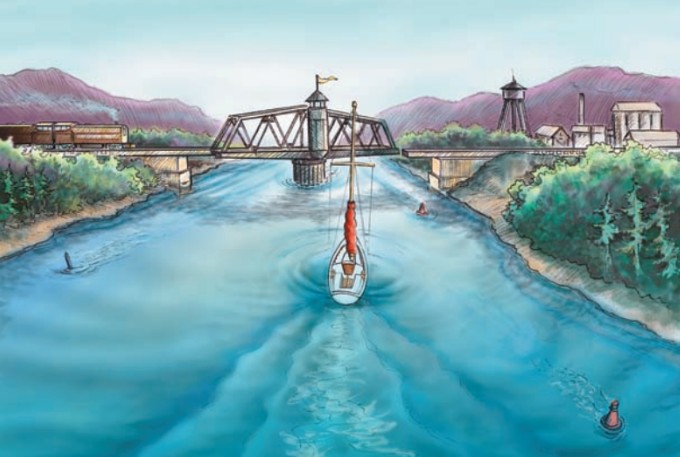
You are motoring through the Intracoastal Waterway. The dredged channel is about 150 yards wide. The current is running with you at about 2 knots. As you approach a railway bridge, your engine gets an airlock. A train is approaching and the bridge begins to close.
Solution C
Quick anchor work is required here. A bow anchor will usually save the day (and your mast). The trick to this with a short-handed crew, of course, is to get someone to the bow fast enough to drop the anchor. The other issue requiring precision is to let out enough scope so the anchor will hold before you run out of room at the bridge.
Hint: for channel sailing, having a stern anchor set up is invaluable. If the anchor is ready to go and in easy reach of the helmsman, you have an emergency brake for the boat. This system works even better if the rode can lead from the stern roller directly onto one of the primary sheet winches. (There is a complete chapter on stern anchor systems in our book, The Capable Cruiser.)
Situation D
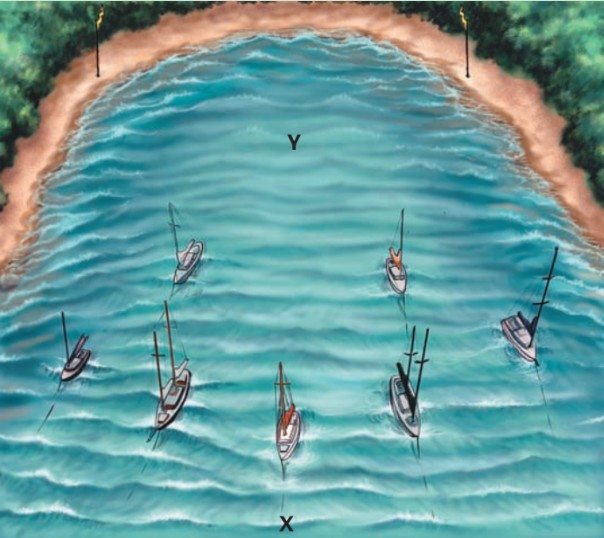
Your boat is anchored at X. The wind turns 180 degrees and you are now on a lee shore. You can’t use your engine as the mechanic is still re-building your starter motor. But the wind is building and you must leave the bay to find a safer spot to re-anchor.
Solution D
Get the appropriate sails ready — put a reef in the main, use a smaller jib, get the halyards in place. Raise your anchor just until it breaks free of the bottom, then let out about 1 1⁄2-to-1 scope so the anchor drags slowly along the bottom. You should drag straight aft, downwind. If the boat tends to bear off and edge toward the boats anchored to port or starboard, let out a little more scope. Once you have dragged back to position Y, you can pull up your sails and recover your anchor as you sail free. In real close quarters, you might have to let your anchor cable go, as discussed in Situation F.
Hint: in crowded situations, when there is reason to be sure, we pay off under sail onto one tack rather than another, and we leave the anchor just holding until the head of the boat swerves onto the appropriate tack. Then we swiftly haul up the last 30 or 40 feet of cable hand-over-hand. If your gear is too heavy to handle manually, don’t risk your back. Buoy your gear, slip your rode, and leave it behind for later retrieval.
In exceptionally tight situations we have added a pendant line to the anchor cable with a rolling hitch, then led the line aft through a fairlead amidships, then onto a sheet winch. By easing out the anchor rode and tightening the pendant, we get the boat to swing beam-on to the wind. We then set sail and let the buoyed anchor rode go first. Then we cast off the pendant and are sailing free on the tack we prefer.
Situation E
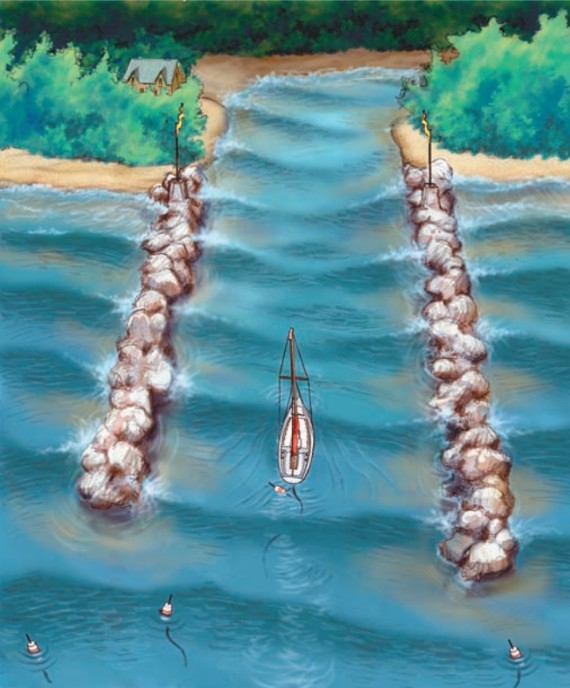
The wind is from astern. The line from a lobster trap becomes tangled in your propeller and brings your engine to a grinding halt just when you are between the breakwaters. At the inshore end of the breakwaters, the entrance takes a bend so you cannot be sure how much traffic you will encounter once you enter the harbor proper.
Solution E
Though this looks like the least adrenaline-producing situation of those so far presented, it holds potential problems also. Most of us would, at first glance, decide to continue into the harbor. If this is your choice, the jib would be the best sail to use because it can be raised most easily in a following breeze. You could simply sail into an open area of the harbor and anchor, then sort out your engine problems.
But what if the harbor is really crowded and full of ferries, fishing boats, and charter boats? It could pay to edge over to the side of the entrance, then head into the wind and set first your mainsail, then your jib, and tack back out into open water. Once out in the open, you can relax and sort your options out.
Hint: just as the jib is almost always the easiest sail to set when you’re running downwind, it is also the easiest to de-power so you can slow down once you are in among anchored boats. Simply let the sheet out completely to slow the boat down. To take more speed off the boat, begin weaving. Put the rudder hard over in one direction for about 10 seconds, then slowly put it hard over in the other direction. Try this sometime in open water; you’ll be amazed at the speed reduction it produces.
Another hint: when you let the anchor go on a downwind approach, ease out about 3-to-1 scope, then have the helmsman swing the rudder hard over to steer the boat toward whichever bow roller you’re using (port or starboard). This should keep the anchor rode from rubbing against your hull and removing the antifouling or topsides finish. You may have to continue to ease out more chain as the boat turns to protect your topsides.
Situation F
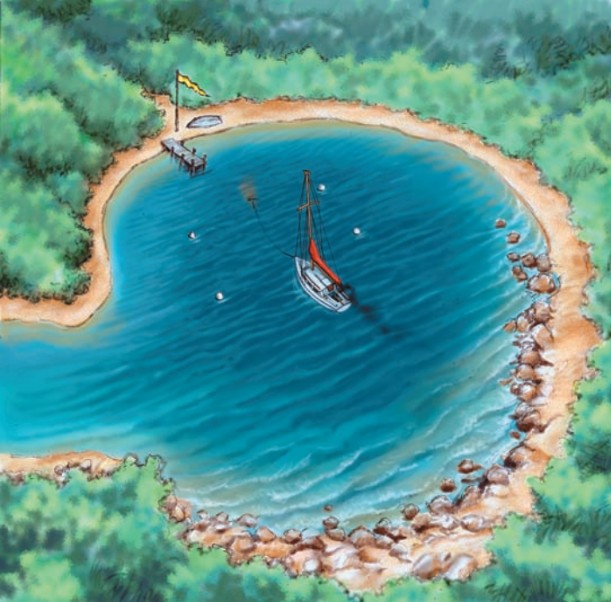
You have motored into a new anchorage. Just as you get your anchor down, you see smoke coming from the engine room. You automatically shut down the engine. A quick look below shows the electrical wiring harness has fried itself by shaking loose from its holders and falling against the exhaust manifold. Given a few hours and the gear on board, you can fix it. But to add to your bad-luck day, the anchor begins to drag slowly and refuses to set, no matter how much scope you put out. You can’t restart the engine until the electrics have been fixed. It’s time for some quick decisions.
This fried-harness scenario did happen to us on a delivery. Fortunately, it was while we were at sea, and Larry was able to rig up an alternate set of connections as we reached onward. The rest of the scenario and the others in this quiz are a combination of situations we have actually encountered during years of sailing without an engine.
Solution F
Plan 1: If time allows, launch your dinghy and row a line to the dock or nearest mooring.
Hint: flake your long warping line into the dinghy. Then row away from your boat, paying out line as you go. It will be much easier than pulling the line off your boat and through the water. Flaking a line means laying it out in a random manner, not coiling it as you would for a line you intend to store on a hook or cleat. A flaked line almost never snarls. We use our stern anchor line for this, as it is always stored in the cockpit locker so it’s available and quick to use.
Plan 2: There’s lots of room around you, so an alternative would be to raise your sails, recover the anchor, and sail out of the bay into open water. There you could sort things out and check the engine. If the engine will not restart, shorten sail and re-enter the bay to anchor with a larger or different type of anchor, one suited to the local bottom conditions.
Hint: if no other anchor holds, resort to your old-fashioned fisherman-type (fluked) anchor. It will usually hold in the rock, weed (kelp), or hard sand that gives other anchors grief.
Plan 3: If you are dragging quickly, get your sails set and buoy the end of your anchor cable with a fender. Slip your rode (let it go), then sail out to open water, as discussed in Situation D. Heave-to outside the anchorage and if you cannot get your engine started, send your crew in with the dinghy to retrieve the ground tackle. Or, if your boat and crew are nimble, sail back in to retrieve your ground tackle once you have sorted things out.
Hint: we have 80 feet of 5⁄8-inch three-stranded nylon line secured to the inboard end of our main anchor chain. It is belayed to the lower part of the bits (bowsprit supports that go through the deck and into the chain locker) with a round-turn and two half-hitches. This knot can be untied under heavy loads. If we want to slip our ground tackle we can pay out all the chain, then easily secure a fender to this line, let it go, and get under way. No need to find a wrench to open a chain shackle, nor is it scary or difficult to handle this soft line (as it would be with chain) when the boat is bouncing around.
Situation G
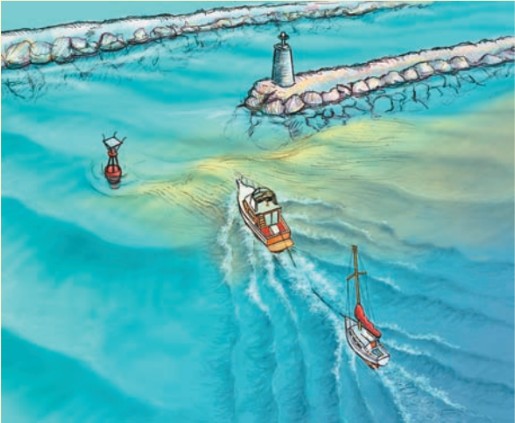
You have accepted a tow because your engine is out of commission and you need to get into a crowded port to begin repairs. Suddenly the boat towing you goes aground. What do you do?
Solution G
The helmsman should immediately head hard to windward. The crew standing by the towline should let go simultaneously. Otherwise, if the boat towing you has less draft, you will run aground also. Worse, if he draws more than you do, you could find yourself ramming the towing vessel at speed.
Hint: whenever you ask for a tow, ascertain the draft of the towing boat. Then be sure to give the folks on that boat your line. This is important should that skipper later be tempted to claim salvage. Be sure you do not use a spliced eye or bowline on your bow cleat. Neither of these can be released once they are under tension. Use a round-turn and two half-hitches or several turns on the cleat before putting a hitch over the cleat so that line can be released swiftly and surely, if necessary.
Now practice
We hope these ideas will spark your imagination. Though many people trust their engines implicitly, remember that every scenario we have described has happened.
There are many things that can stop your prop unexpectedly. Boats frequently get into serious trouble because of that old foe, a line in the prop. Stern anchor rodes and jib sheets are the most frequent culprits.
A final hint: whenever you set a stern anchor, clove-hitch the inboard end of the rode to your gearshift lever. Then, when it’s time to start the engine, you have a reminder to tend the rode and pull out any slack before the prop starts turning. Also, set up a reminder system so you don’t start your engine until the sheets and anchor cable are secured on deck.
Thank you to Sailrite Enterprises, Inc., for providing free access to back issues of Good Old Boat through intellectual property rights. Sailrite.com