A welcome use for scrap mahogany
Issue 41 : Mar/Apr 2005
Our 1982 Hunter 27 had plywood hatchboards that were in desperate need of replacement. St. Angelo Hardwoods in Bristol, Rhode Island, had some nice teak, but being frugal (read cheap!) we went with their mahogany at half the price. After mating two 7-inch by 8-foot boards on edge using a friend’s biscuit joiner, I cut new boards using the old ones as patterns. One coat of Cetol Marine with three follow-up coats of Cetol Marine Gloss made some pretty good-looking boards.
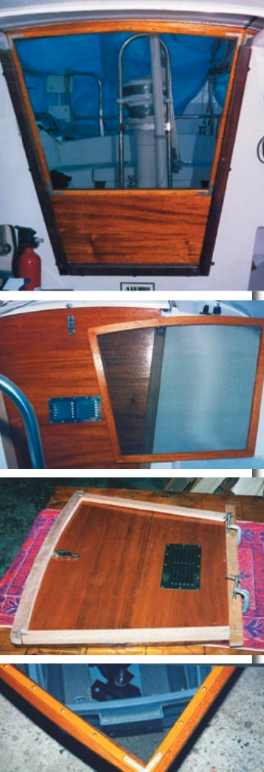
Then I noticed the scrap mahogany lying around and thought, “I wonder what we could use these for; they’re too expensive for kindling.” A frame for a bug screen would be just the thing. They were already planed down to the 9⁄16-inch width needed to fit in the companionway slides; it was a simple matter of trimming the scrap wood to make a screen frame using the boards I had just completed as a guide.
First I made a template of a screen sized to fit the entire set of three companionway boards, thinking that we would end up with a nice-sized bug screen. But when I took it below to see where we could stow a full-sized hatchboard, it was simply too large to stow. So we eliminated the screen from the bottom board and came up with a bug screen that was equal in size to the two top boards. This could fit below with no problem.
The frame was glued and screwed at the corners. We cut ordinary wood screen strip from the lumber yard to fit and gave the frame and strips the same Cetol coatings as the new hatchboards. We pre-drilled pilot holes in the strips and then screwed them down over the stretched-out screen material with 5⁄8-inch stainless-steel hardware. We used plastic coated fiberglass screening, which was cheap and will not corrode. Then we added 2-inch galvanized corner braces.
Now we are secure below at night with plenty of ventilation and no bugs!
Thank you to Sailrite Enterprises, Inc., for providing free access to back issues of Good Old Boat through intellectual property rights. Sailrite.com