How a naval architect shapes the boat’s bathroom
Issue 42 : May/Jun 2005
As any sailor knows, the term of sailing ships when men were men and the crew’s rude toilet was a hole open to the seas, right up in the bows of the vessel. A few vessels, those with long stern overhangs, such as the Down-East “Pinky,” had the toilet hole all the way aft, so I have to wonder what it was called aboard those craft. In any case, today the term “head” is used to describe any compartment with toilet facilities, of course, and is also often used for the marine toilet itself. I’ll use w.c. here for the toilet to avoid confusion.
In modern sailing yachts the head can be situated in a number of locations, as preferred by the owner or designer. Over the years I’ve designed heads in many different areas. Let’s look at some of these and consider the advantages and disadvantages of the various installations.
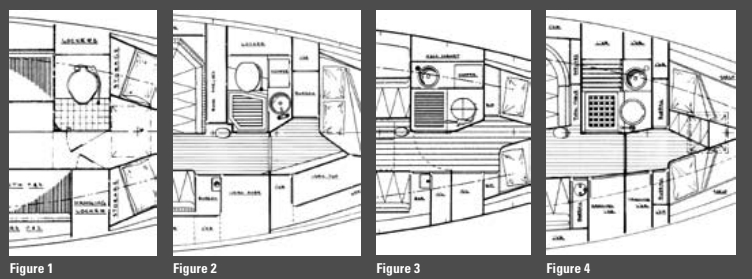
Figure 1 is a typical 31-footer from the ’60s. The head is simply a space for a w.c., almost the standard for smaller yachts of that era and about the minimum for a cruising yacht. This portside w.c. faces athwartship and that can pose a problem when heeled on the starboard tack. Your knees are high, which can make it difficult to get up off the seat as a result. A strong hand grab would be very useful. Often such a small head featured a folding basin that could be pulled down over the w.c. and drained into it after use. I haven’t seen one of those for years so they may not be available anymore. One could easily be made up, though, using a small stainless-steel basin set in a wooden panel that folds or slides away after use.
Figure 2 has a more comfortable head, complete with basin, laundry hamper, and a shower. A curtain can be rigged up to keep the head reasonably dry when the shower is in use. I will add that the type of faucet, such as the Whale Elegance, that is connected to a long flexible hose so it can be used either as the basin faucet or as a shower head, is very useful in tight spaces. Figure 3 shows the w.c. positioned fore-and-aft, and this is much to be preferred at sea. It is equally uncomfortable on either tack but, usually, not impossible to arise from.
Less counter space
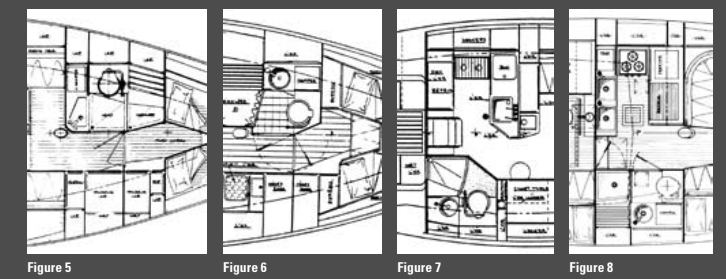
Figure 4 improves the shower even further by fitting a shower seat, albeit at the expense of counter space. The Morgan 38, Figure 5, was the first yacht under 40 feet in which I fitted a separate stall shower and, for all I know, may have been the first boat her size to have that feature. The ladies certainly loved it. There’s always room for improvement though, and Figure 6 features a stall shower, basin, hamper, and a fore-and-aft w.c., all in a 34 footer.
Figure 7 shows an aft head on a 35-footer with a semi-stall shower. The aft head is quite common on modern, beamy cruisers but not my favorite setup as it seems to take up a large chunk of the best part of the yacht. Some also object that it is too close to the galley, but this does simplify the plumbing, and the shower stall is a handy spot to hang your foul weather gear to dry after a miserably wet watch. The head on the pilothouse yacht, Figure 8, is also opposite the galley but has a lot going for it otherwise. The w.c. is fore-and-aft, the stall shower is quite roomy, the location is amidships where motion is least, and it’s handy to both the pilothouse and the saloon.
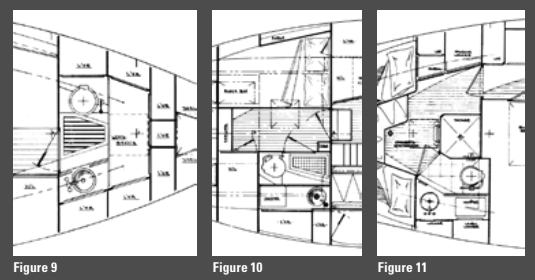
Forward heads are unusual but this 33-footer, Figure 9, was designed as a retired couple’s home afloat. It’s the only head on the boat, so guests have to go through the owner’s cabin to get to it, not always the handiest situation, especially at night. The advantage is that it pushes the owner’s berth farther aft, where the boat is beamier, so they have a real bedroom with a nice, wide double on the port side and lots of stowage, including a vanity, opposite to starboard. Larger yachts, with aft owner’s cabins, often have a head located there.
The yacht in Figure 10 has the owner’s cabin under the cockpit and shows the head off to starboard with the berth opposite. It’s comfortable and convenient, but even better is the very spacious arrangement on the center-cockpit 44-footer in Figure 11 with its large stall shower. Obviously, there is no perfect spot for the head and no perfect arrangement of the facilities, but some are better than others.
Other features
Desirable features in a well-fitted-out head are hand grabs to help one up off the w.c., towel bars, either covered or out of the way of shower spray, and both a toilet-paper holder and paper-towel holder. A good-sized mirror is a must; the back of the head door works well for this. A medicine cabinet is handy but must have a positive locking, not spring-loaded, door. Where space permits, small individual drawers for each crew member’s gear will prove useful as well as a locker below the basin for cleaning materials.
Adequate lighting is desirable and should consist of a minimum of a mirror light and an overhead light. Finally, good ventilation is essential. Either a cowl-type Dorade vent or a low, saucer-type vent with a solar-powered or 12- volt fan works well here. The powered vent fan will help remove moisture and keep mildew down after a steamy shower and help prevent odors.
The basin
The usual basin is a round or oval stainless-steel bowl about 5 or 6 inches deep. This should be set in a counter about 36 inches high. The basin drains overboard through a seacock and should, but rarely does, have a drain trap. Basins that are set well outboard may not drain at all when the boat’s heeled under sail on one tack, and sea water may spout up the outlet in heavy going if the basin is at all close to the heeled waterline.
Both problems can be cured by fitting a positive pump, such as a Whale foot pump, in the outlet line. This has worked well for me in the past, but I would also emphasize that, when at sea, the outlet seacock should be closed if the basin is not in use.
The shower
A minimum space for a usable stall shower is 24 to 26 inches by 27 inches. Even this is snug for a large person. Better is 27 by 30 and larger. Unfortunately, most small yachts are tight for shower space and, in that case, the typical curtained-off area in the center of the head may actually be better than a too-tight stall shower with solid walls. A seat in a stall shower is always useful, as it makes it easier to shower off in choppy seas. The shower head can be the removable basin faucet with hose, as described earlier, or a fixed wall-mounted showerhead, preferably with a hose extension to conserve water and also to keep spray from flying all over the head.
The shower grating is usually of teak. I prefer a grating made similar to duckboards (see Figure 2) as it is easier to make, stronger, and much easier to clean of hair and soap curds than the usual checkered-type grating, (see Figure 4). It’s also easier for me to draw! Usually, a deep metal or fiberglass pan below the grating catches the water and carries it to a sump where, in turn, the waste water is pumped out through a seacock. Stall showers may simply have a non-skid sole sloping to a drain in one corner but, as a result, they usually only drain properly on one tack.
Showers should never drain into the bilge and be pumped out from there. In warm weather the resulting collection of soap scum and dead skin will quickly result in an odor strong enough to gag maggots. Rule and Atwood both make handy enclosed shower sumps, complete with float switch and pump, to eliminate the problem.
Alternately, if the bilge is deep enough, you can drain the shower to a small tank and use a manual diaphragm pump to drain it overboard. The tank should have a removable lid so it can be cleaned out if things do get clogged up, but I’d far rather throw the thing away and buy a new one than face that job. The shower water should pump out through a seacock. Often this is placed slightly above the waterline, in the boot top, to ease back pressure when pumping out.
The water closet
In the good old days of yachting, the w.c. was often a cedar bucket with a fitted seat that could be installed for use and removed when the bucket was emptied overboard. I’ve sailed aboard boats with such a facility, and I certainly cannot agree with L. Francis Herreshoff’s enthusiasm for it. Simple, reliable, and inexpensive to be sure, but embarrassing and illegal to empty in a crowded harbor. Even a Porta Potti, as ghastly as many of them are, is an improvement over the cedar bucket.
The space needed for a comfortably usable w.c. is 24 inches in width, and an extra inch or two will not go amiss if space permits. As pointed out earlier, it is best on monohull sailing yachts if the w.c. faces fore-and-aft rather than athwartship. This is not a major consideration on multihulls due to their lesser heel angles under sail.
When selecting a marine w.c. or checking out the one on a yacht you are interested in buying, measure the seat. It should be about 16 to 17 inches front to back and 14 inches across for home-style comfort. Many of the cheaper marine w.c.s have a seat that is only about 13 inches diameter; barely kiddy size, and probably one of the reasons that Herreshoff hated them so much. Also check the height. The seat, not the lid, should be 15 1⁄2 to 17 inches above the sole of the head. Again, the cheaper marine w.c.s are only 12 1⁄2 to 13 inches high, including the lid. That makes them difficult to rise from, especially for us old geezers, so they should be set up on a base about 4 to 5 inches high for comfort. If you are paying good money for a yacht, new or used, you should be getting one with a workable, quality w.c. in it and not a miserable, child-sized potty.
The w.c. pump itself should be large and powerful; husky enough to suck in lots of water and flush dead rats out through the works. Again, a cheap w.c. will usually fail this test as well. Pumps with lever operation, rather than a stirrup type pump, seem to answer this requirement best and, in this category, I would place the Wilcox-Crittenden “Skipper,” the Groco “Model K-H,” and the Raritan PH-II “Hi-Boy.”
Holding tank needed
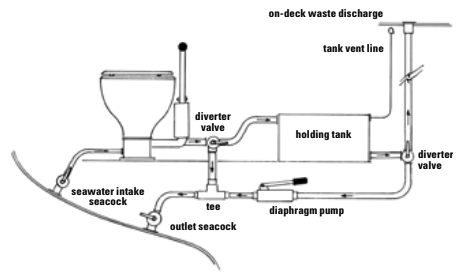
There are many conflicting and confusing laws about w.c. discharge. Since it’s illegal to dump overboard in strict “no discharge” areas, your only choice is a holding tank and visits to a shoreside pumpout station. The diagram at left shows the system, with only two diverter valves plus inlet and outlet seacocks to control things and give you the choice of pumping into a holding tank in restricted waters or directly overboard at sea. Besides, if the holding tank is full, you can empty it at a shore station or turn a valve and pump it out in unrestricted waters. This is the best of all worlds, but label those valves carefully or woe betide.
Although it has been said so many times that it hardly bears repeating, a marine toilet that is fitted below the waterline, or one that will be below the heeled waterline when the yacht is under sail, must be fitted with a vented loop well above the waterline to prevent siphoning and possibly sinking the vessel if the seacock is left open. Even with a vented loop, the seacocks should be kept closed when not in use or whenever you leave the yacht. For this reason they should be fitted handy to the w.c. itself. Finally, for obvious reasons, be sure the intake water seacock is located forward and above the outlet seacock and the latter is on the side opposite the engine cooling water intake and galley seawater intake.
Thank you to Sailrite Enterprises, Inc., for providing free access to back issues of Good Old Boat through intellectual property rights. Sailrite.com