Good manners in a Canadian-built coastal cruiser
Issue 49 : Jul/Aug 2006
Catboats aren’t particularly known for speed, rather for simplicity and stability. There are no headsails to tack and trim, and the relatively wide beam of the catboat gives it great initial stability. All this is true of the Nonsuch 30. Its traditional appearance and 11,500- pound displacement certainly do not suggest speed. Thanks, however, to a long waterline and generous sail plan, on a reach this boat can boogie.
The Nonsuch 30 is an innovative design resulting from the inspiration of Canadian yachtsman Gordon Fisher and the talent of Canadian designer Mark Ellis (see Good Old Boat, May 2003). Gordon was a prominent sailor (past winner of the Southern Ocean Racing Conference) and business leader, who at one time was commodore of the Royal Canadian Yacht Club. When he decided to build a cruising sailboat, he envisioned a catboat with a freestanding rig, at which point he sought out Mark Ellis, who put ink to paper.
In Mark’s words, “Gordon admired the Ljüngstrom-rig from the early 1930s. With a freestanding mast and no boom, this rig was perfect for singlehanding. We eventually decided on a Ljüngstrom-type rig that was modified by a windsurfer-style wishbone boom for better sail control.”
Gordon then presented his vision to George Hinterhoeller in St. Catharines, Ontario, who in 1977 had formed, for the second time, Hinterhoeller Yachts, two years after selling his shares in C&C Yachts. Reportedly, George was less than enthusiastic about the design, but when six members of the local yacht club placed orders for the boat, he readily agreed to undertake the project.
In the years that followed, Mark designed four additional Nonsuch models — the 22, 26, 33, and 36. An upgraded version of the 30, dubbed the Nova, boasted a different interior and carbon fiber mast and wishbone boom. Unfortunately, production of these popular boats ceased in November 1995, when Hinterhoeller Yachts closed its doors for the last time.
History records that the Nonsuch was named after a boat owned by the Hudson’s Bay Company. That vessel was named after the Baroness Nonsuch of Surrey, England, the mother of King Charles II’s two natural sons. A busy lass, the Baroness also bore the illegitimate daughter of John Churchill, the man who later became governor of the Hudson’s Bay Company in 1685.
Nonsuch owners are an active bunch, who boast that their association is one of the largest class associations in North America. The majority of the boats are east of the Mississippi, but owner groups also are found on the West Coast and, in particular, the Pacific Northwest.
Design
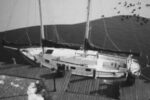
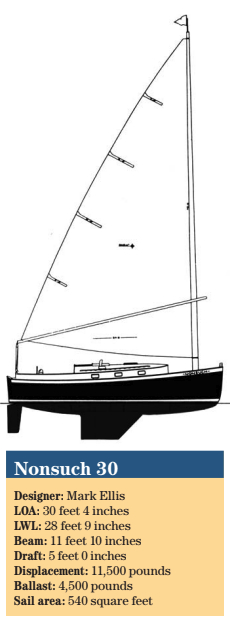
In profile, the Nonsuch 30 is characterized by a plumb bow and traditional cabin. Features of the latter include the rounded forward end of the cabin and the teak eyebrow running above the portlights. An examination of the arrangement plan shows a wide beam carried well aft to produce a spacious interior and cockpit. The plumb bow and stern tend to duplicate today’s modern designs in racing sloops, which extend waterline length to the max. The reason: boat speed increases with waterline length. The formula is 1.34 x the square root of LWL.
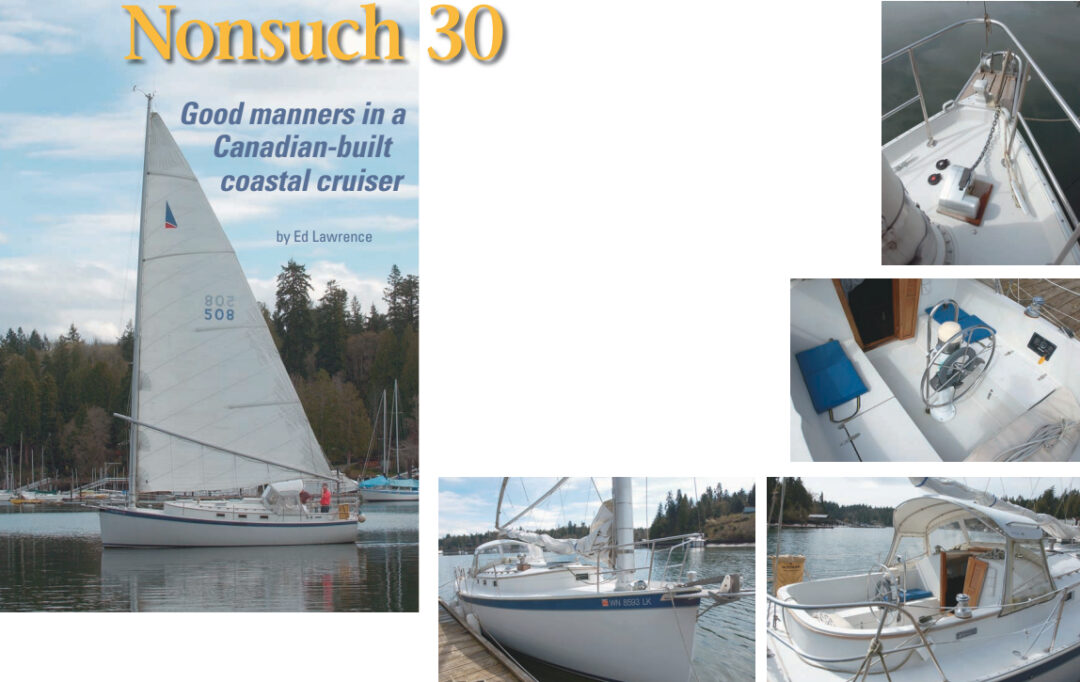
The dominant feature of the Nonsuch, however, is an unstayed mast located within inches of the bow. At first blush, the large-diameter spar has about as much visual appeal as a telephone pole. An aluminum wishbone boom, about the same length as the boat, is positioned high off the deck with sheeting at the end. With a 44-inch freeboard, the Nonsuch might seem incapable of getting out of its own way. Not true. The hull form, which has been favorably compared to that of a Finn and International 14, produces a balanced helm through most wind speeds and sea states.
A relatively flat underbody yields a displacement/length ratio of just 216, which is considered moderately light. Moderate draft of 5 feet is sufficient for creating decent lift, and the semi-balanced spade rudder assures positive control. In these respects, the Nonsuch 30 has none of the bad habits of traditional catboats, such as extreme weather helm in high winds. The sail area/displacement ratio is 17, which is generous even for a coastal cruiser, but that’s because all of the sail area is in one sail. When winds go light, there’s no option of hoisting a genoa, gennaker, or spinnaker.
Deck layout
The deck layout and cockpit are models of simplicity. Since the mainsail lives in a cradle of lines attached to the underside of the wishbone, it’s easily hoisted and doused and rarely touches the deck. Without shrouds, sailtrack and genoa cars, jib and spinnaker sheets, turning blocks, and the other hardware that usually clutters a deck, the decks of the Nonsuch are essentially barren.
The cockpit measures 6 feet on the centerline, and the footwell is 30 inches wide, so crewmembers can stretch their legs without intruding into the space of those sharing the cockpit with them. The wheel is situated well aft and, with a 28-inch diameter, it’s large enough to steer the boat but small enough to allow crew to move fore and aft past it with only minor contortions. The halyard and control lines (reef, boom vang, mainsheet, and “choker”) are led aft to sheet-stoppers on the cabintop adjacent to the companionway, so there’s little need to leave the cockpit. In fact, once the mainsail is dialed in, there’s little for a crew to do except watch for wind shifts.
On the rare occasion when someone must move forward — perhaps to set an anchor — she or he will walk on a 24-inch-wide sidedeck without fear of tripping over a block, car, or shroud. What takes some getting used to is the lack of shrouds to hang onto. There are, of course, stanchions and lifelines, but you have to crouch to reach them.
A popular and desirable option is a short bowsprit that extends the anchor and its rode sufficiently forward of the bow to avoid dings in the gelcoat.
Accommodations
Venture three steps down to the main cabin. You’ll find it to be brighter than those in most boats. Three opening hatches in the coachroof and nine opening ports invite light and fresh air aboard.
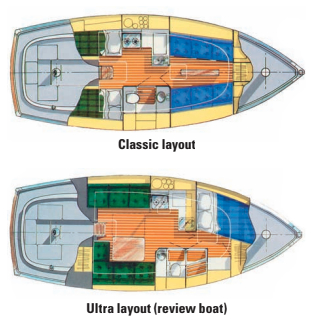
Hinterhoeller Yachts initially offered what it called the Classic layout, the forerunner of the Ultra layout, which became the more popular. The Classic is, to say the least, unusual. In the forward 6 feet of the boat are two hanging lockers and a great deal of storage space created by three transverse and two fore-and-aft bulkheads. The rest of the boat is one large cabin, though there is a moveable partition and a door to divide it.
Forward in this large cabin are two settees with shelves and cubbies outboard and a drop-leaf table on centerline, so if you’re sleeping on the settees, it’s a simple matter to fall into bed after dinner. The drawback is that when dining underway, you’ll be seated in the bounciest part of the boat. For privacy in this part of the cabin you have to raise a slide-up partition between the galley and port settee. A teak door folds against the head’s bulkhead.
The galley is to port amidships, opposite the head. If you want to talk to the cook, you’ll have to sit on the forward section of the port or starboard quarter berths.
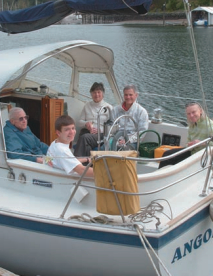
In comparison, Angora, our test vessel, sported the Ultra layout. She is owned by Jay Abbott and his father, Tony, Nonsuch aficionados who sail on Puget Sound. Until recently, Jay owned a Nonsuch 26, his father a Nonsuch 36. Deciding to pool their resources, they sold both so Jay ended up with a bigger boat and Tony one that is more user-friendly for, well, let’s just say one who is old enough to be Jay’s father.
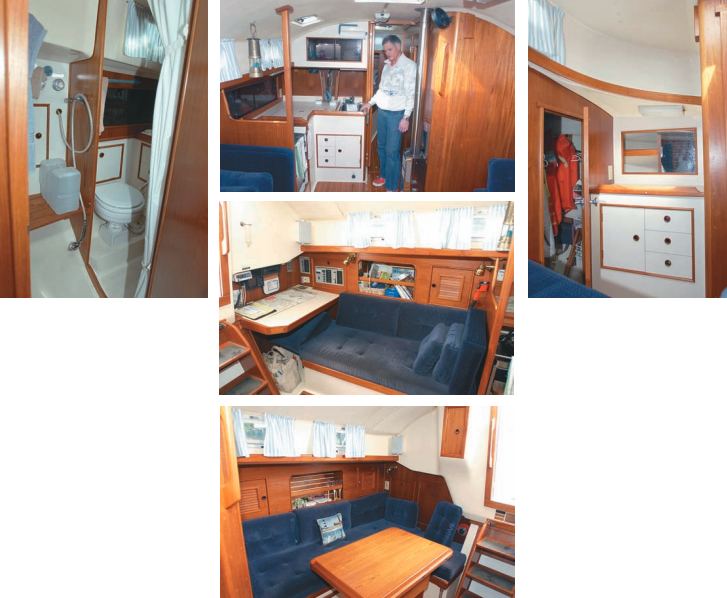
The Ultra model has an 8-foot-long, 10-foot-wide main cabin amidships, with dining table to starboard, full-length settees port and starboard, C-shaped galley to port opposite the head, and a proper nav station aft under the companionway. The starboard settee and table convert to a double berth large enough for a couple or a pair of Labrador retrievers if, like some people I know, you take your dogs sailing. The port settee is 6 feet 6 inches long. The interior is finished with teak-faced plywood and nicely varnished solid teak trim.
The forward stateroom has a hinged teak door and a double Pull-man-style berth offset to port. This configuration frees up space compared to a conventional V-berth that at the head is much wider than two people need; the flip side is that the person sleeping outboard has to climb over his or her mate to get out. To starboard is a larger-than-normal hanging locker into which a businessman’s wardrobe would fit nicely. To starboard is a 16-inch x 30-inch vanity coupled with a large mirror.
The galley is a small but functional space into which a Force 10 two-burner stove/oven combination, refrigerator, and sink have been shoehorned. An icebox is located under a 33-inch x 23-inch counter that provides just enough room to slice a prime rib. The sink, though, is smallish. Outboard are cupboards en-
closed by sliding Plexiglas doors that provide a clear view of the Waterford crystal. An additional cabinet is perched over the sink just high enough that dishes can be rinsed without fear of banging your noggin.
The shower/head compartment is partitioned so that Mom can shower while Dad brushes his teeth, though the arrangement involves a bit of a compromise in that neither space is an ideal size. No matter. The loo is accessible from the main cabin and the forward stateroom.
Aside from having a more sensible layout, my impression is that the Ultra model has more nooks and crannies into which gear can be stowed, so it also seems more utilitarian than the Classic.
Construction
One of the three founding companies that merged to form C&C Yachts in 1969 (see Good Old Boat, September 2002), Hinterhoeller Yachts pioneered work in balsa-cored construction methods. At C&C, the design emphasis was on racing and high-performance cruisers, so lightweight, stiff hulls were critical. After leaving C&C and again starting his own company, George Hinterhoeller continued to earn a reputation for building high-quality yachts with attractive interiors and good sailing characteristics.
The hull and deck of the Nonsuch 30 are balsa-cored sandwiches with skins of unidirectional fiberglass and woven rovings. Bulkheads are marine-grade plywood tabbed to the hull. The hull and deck are joined by a through-bolted, butyl-bedded joint capped with an aluminum toerail.
Appendages are a moderate-aspect-ratio fin keel and freestanding, semi- balanced rudder. The external lead keel is bolted to the hull with stainless-steel bolts passing through floor timbers glassed over with unidirectional rovings, a method that transfers loads throughout the hull.
The heavy, unstayed mast requires the installation of substantial bulkheads in the bow to absorb and transfer the loads. A female mast step is attached to the hull, into which the butt of the mast is fitted, after which a hexagonal male counterpart is added. Then the whole unit is strengthened by stainless-steel screws. The mast is further connected to the hull by a pin at deck level that passes through both mast and collar. Because unique forces are at work on a freestanding spar, it requires regular inspection and maintenance — see the owners’ association website listed on Page 50 for help. Also, it is strongly recommended that the mast be removed when the boat is hauled.
Deck hardware has proper backing plates but, oddly, on at least some boats, the through-hulls have gate valves rather than the much preferred positive-action seacocks.
Performance
We tested Angora despite the fact the Westerbeke diesel engine would not turn over, even though we had freshly charged batteries. (Some early models had Volvo 11C diesels with saildrives, others had Universal 30-hp diesels.) The wind was dead calm.
No sweat. Jay hoisted the mainsail, pointed the bow close to a spot where we hoped some wind might appear, and sailed off the dock at a snail’s pace. The cups on the wind-speed indicator were not moving. But minutes later, a blustery 2-knot northwesterly appeared and the boat began to make way, silently tacking through more than 80 degrees apparent wind and energizing the dockside photographer. In the process, Angora proved the adage that there’s no substitute for sail area — the Nonsuch 30 carries 540 square feet of canvas. Even in light breeze it handles nimbly, turning in its own length.
There are significant differences between sailing a sloop and a catboat. For openers, the only running rigging is the main halyard, the mainsheet, and a choker line dead-ended on the front of the mast that controls the fore-and-aft position of the wishbone. It is led to the forward end of the wishbone, then aft to the cockpit.
The mainsail tack is attached low on the mast, the clew on the aft end of the wishbone. Flattening the mainsail is achieved by tensioning the choker, which moves the wishbone aft and tensions the sail. Reefing is a matter of pulling a line on the underside of the wishbone to shorten the leech while easing the main halyard. The reefed sail then is contained in a cradle in the wishbone. For offshore sailing, a storm trysail is possible and recommended. Check the owners’ association website.
However, Jay says, “We don’t think about tucking in a reef until the wind is blowing 30 knots, because the top of the mast is so bendy that it spills lots of air. I only tucked a second reef in my Nonsuch 26 when the wind was blowing 40 knots.” Combined with a wide beam and a 40-percent ballast-displacement ratio, the bendy mast also makes for a stiff boat.
While traditional catboats are notoriously difficult to handle in high winds owing to weather helm, the Nonsuch 30 is well balanced. Designers have, after all, learned a few things over the years.
The average PHRF rating for the Nonsuch 30 is 186. Compare this number to the one-design racer J/30 at 144, and the 1970s-era Newport 30, reviewed in the last issue, at 174. The Pearson 30 also rates 174. (See sidebar on this page for an explanation of how these ratings are determined.)
The bottom line
There’s no arguing the fact that a catboat is simply one of the easiest boats to sail. Tom Wylie, who designed the Wyliecat 30, once said, “My 70-year-old mother drives a catboat to weather on San Francisco Bay in 25 knots of wind.”
Since the same holds true for the Nonsuch and it also has a turn of speed, any sailor who disdains this boat on the basis of its appearance will be missing an opportunity to sail a fun, well-built boat. On the other hand, if you like tweaking lines and playing with main and headsail shape to improve performance, the Nonsuch 30 is probably not the best choice.
Thank you to Sailrite Enterprises, Inc., for providing free access to back issues of Good Old Boat through intellectual property rights. Sailrite.com