Check out the various ways to reduce sail area
Issue 49 : Jul/Aug 2006
When the wind suddenly picks up or a squall line is approaching, the ability to douse the sails or reduce sail area quickly, efficiently, and safely is vital. If you’re sailing solo, shorthanded, or with infirmities, this important job can be particularly difficult and dangerous. There are high-tech hydraulic and electrical systems that can accomplish this, but for the average sailor, it has to be done manually by either furling or reefing the sails.
Furling means to roll up, or gather, a lowered sail and tie it to prevent it from blowing in the wind.
Reefing means reducing the area of a sail, allowing the boat to continue sailing under heavier wind conditions.
Reefing can be accomplished by many of the same methods used for furling, as long as the reefing gear has been designed to take the loads of a partially furled (reefed) sail.
There are several ways of reefing a mainsail:
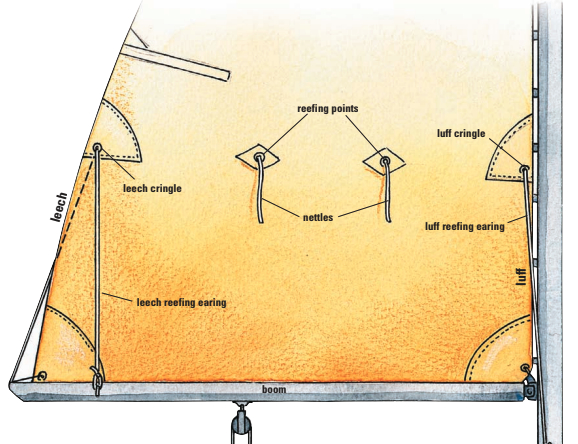
Jiffy, or slab, reefing – This is the most traditional type of mainsail reefing system. In this system the sail has one or more horizontal lines of reefing points. To reef, the lower part of the sail, up to the reefing points, is brought down to the boom by means of cringles on the luff and leech of the mainsail. Lines through these cringles (earings, or reefing pendants) are used to pull the luff and the leech of the mainsail down to boom level. This can be accomplished with two separate lines or with a single reefing line. Alternately, the luff can be pulled down manually and the luff cringle put on a hook at the gooseneck fitting (if the hook has a compound curve, it’s called a ram’s horn). Then, the unused portion of the sail (the bunt) is tied along the boom using reefing lines on the sail (nettles). These lines pass through the horizontal line of reinforced grommets (reefing points) and hang down on each side of the sail.
The earings, or reefing pendants, that pull the luff and leech of the sail down to the boom take most of the load on the sail, with the nettles merely confining the reefed portion of the sail.
Generally, the sail sets better if you use jiffy, or slab, reefing than with other types of reefing systems.
Vertical in-mast mainsail reefing – Rolling the mainsail up inside the mast requires a specially designed mast and roller system, which means a substantial investment if this system is retrofitted on a boat that did not have it. Vertical or horizontal roller reefing for mainsails makes reducing sail much faster and easier for the shorthanded or solo sailor. The trade-offs for vertical reefing are more weight aloft (higher center of gravity), even when the sail is furled, and increased windage, due to the larger mast extrusion. This system also requires a flatter-cut mainsail without a normal roach and battens (although vertical battens are sometimes used), reducing the mainsail area and efficiency. As with all “in the spar” roller-reefing systems, there is the possibility of a jam, which is usually due to operator error.
Vertical aft-mast mainsail reefing – This system rolls the mainsail up on a wire just aft of the mast and thus can often be adapted to an existing mast; however, a new mainsail will be required. As with in-mast reefing, a sail with a roach and battens cannot be used, and the furled sail creates more weight aloft and increased windage.
Vertical retrofitted in-mast mainsail reefing – This system uses an additional aluminum extrusion in which the mainsail is roller-reefed. The extrusion is riveted to the aft side of the existing mast. This usually requires a new boom or one that is modified. The problems of added weight aloft and windage, as well as a special flatter-cut mainsail with no roach or battens, still exist.
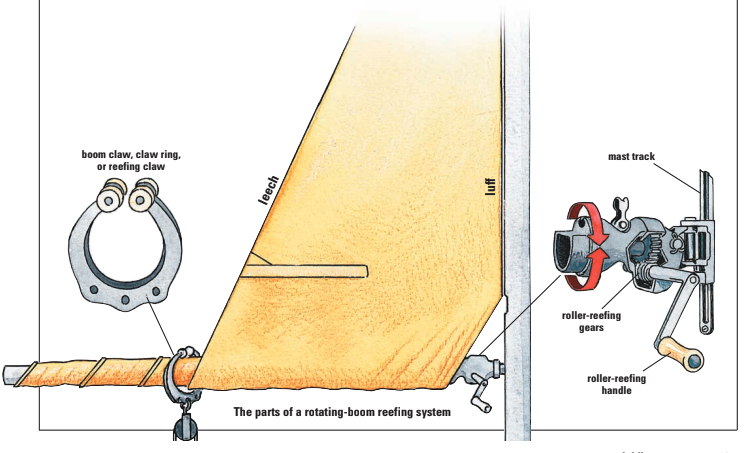
Horizontal rotating-boom mainsail reefing – In this system, the sail is rolled up on a rotating boom. This requires a specially designed boom and goose-neck. On smaller sailboats, the boom is manually pulled out of a spring-loaded gooseneck and rotated as necessary. On larger boats heavier, geared, equipment is necessary to rotate the boom. If the mainsheet block is not located at the extreme end of the boom, then a fitting called a boom claw, reefing claw, or claw ring must be used. This fitting encircles the boom and rolled-up sail like a claw. It is open at the top to allow room for the hoisted part of the sail, with rollers around this top opening and an eye at the bottom to which the mainsheet block is attached.
One of the disadvantages of rotating-boom reefing is that the sail’s luff rope builds up around the forward end of the boom if more than a couple of rotations are made. In addition, there is no clew outhaul, which allows the clew to creep forward. Also, as more turns are taken, the more the end of the boom droops. However, the weight and windage aloft are as low as with a conventional rig, and the sail can have a roach and battens (if the battens are horizontal).
Horizontal in-boom mainsail reefing – In this system, the mainsail is rolled up on a roller inside the boom’s special extrusion. The added weight and windage aloft are much less than with a vertical roller-reefing system, and the sail can have a roach and horizontal battens, as with rotating-boom reefing. With this type of reefing system the mainsheet block location is not the problem that it is with a rotating-boom system, but there is still the lack of a clew outhaul. An advantage of this system is that, should there be a jam, the mainsail can still be lowered, an option that is sometimes impossible with an in-mast jam.
Whichever system is selected, it’s important that you and your crew practice reefing or furling under ideal conditions. A white-knuckles blow is not the best time to learn.
Thank you to Sailrite Enterprises, Inc., for providing free access to back issues of Good Old Boat through intellectual property rights. Sailrite.com