Otherwise rational sailors gild their Lily, a Ranger 28
Issue 50 : Sept/Oct 2006
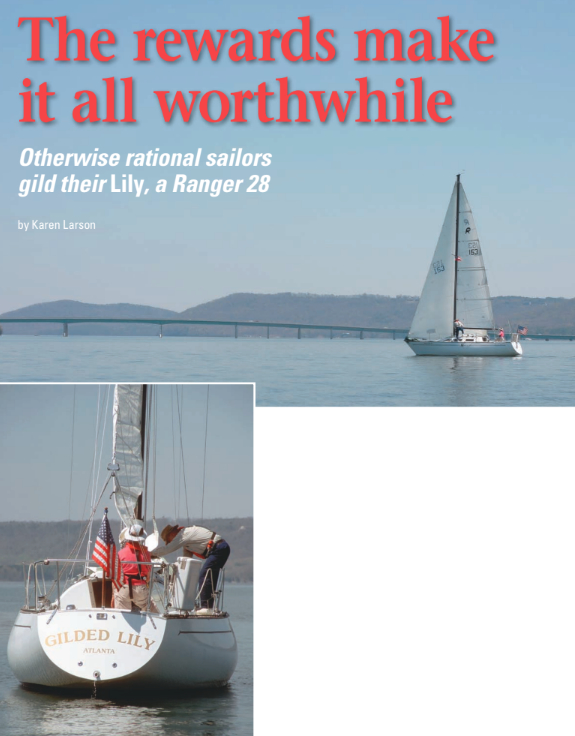
Owning a sailboat is “far more rewarding than you have any right to expect,” says Walt Hodge. His co-captain and companion, Janet Perkins, agrees wholeheartedly. Together they have invested a great deal of love, a bunch of energy, and more than a few dollars into a Ranger 28, now known as Gilded Lily, which they sail on Guntersville Lake in northeastern Alabama.
Lily was neglected, perhaps forlorn, when Walt and Janet found her. But, they’re quick to point out, she was not abused. She called to them, as only a boat can, and they bowed to the inevitable. The threesome formed a lasting bond. “We’re still as delighted with her today as we were nine years ago,” Janet says.
There was a hint of exhaustion mingled in the triumphant exhilaration when Janet wrote to the publishers of a then very new Good Old Boat magazine in September 1998: “A friend loaned us a copy of your publication and we are hooked. What a welcome concept for those of us who nurture and enjoy the ‘oldies but goodies.’ We are currently restoring to health a 1977 Ranger 28. Gilded Lily will be back in the water in a few weeks, looking like a debutante, behaving like a fast woman, and making our sore backs and flattened wallet seem a small price to pay!”
The words in that letter are among the most frequently quoted in Good Old Boat slide presentations and brochures. The letter hangs on a wall in the Good Old Boat office. Janet summarizes beautifully what so many sailors are experiencing with their own good old boats. So after all these years, my husband, Jerry, and I simply had to meet Walt, Janet, and Gilded Lily. We were not to be disappointed.
Rational sailors?
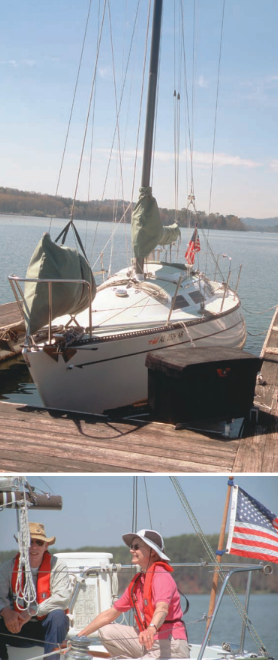
Walt and Janet tell us that they went looking for a boat with a checklist and some cash, as any rational sailors would do. (Rational sailors? Please ignore the obvious contradiction in terms.) “But when we stepped on Lily the checklist went right into the trash,” Janet recalls.
Before finding Lily the twosome first had to kiss a lot of toads. In fact, the Ranger 28 was not in the plan of a broker who took them to the same marina but purposely ignored her. But she looked fetching from the aft view from across the docks. “Wait a minute,” Walt told Janet. “I think we missed one.” Lily had called to him, and the rest was preordained. “There was a real connection there,” Walt says. “I said, ‘This is the right boat. This is the thing to do.’”
The surveyor they hired had other ideas, however. His thoughtful and well-intended advice might have been right for the non-afflicted. But it didn’t dissuade Walt and Janet from what had already become the boat of their dreams. To be fair, the surveyor made some valid points: the bulkhead had bowed, the gelcoat was chalky, bottom blisters were in evidence, the tanks were worn out, the engine had died, the wiring was a mess, the keel bolts leaked, the interior was worn. But what’s fair got to do with it? We’re talking about love.
The engine, an Atomic 4, was barely running when Walt and the former owner delivered the boat to the Travelift for the survey haulout. “The engine was missing,” Walt recalls. “We were near a shoal. I wanted to bend a headsail on as a backup in case the engine didn’t make it all the way.” As it turns out, the boat coasted into the Travelift slip just after the engine gave it up. As they look back on that circumstance now, Walt and Janet say that Lily was doing her all to trade in her former owner for a new set of sailors. “She got just as far as she thought she had to get,” Walt says.
“The surveyor told us, ‘You should run from this one,’” Walt recalls. But, as is true with any story with a good ending, love won out. So the refit began.
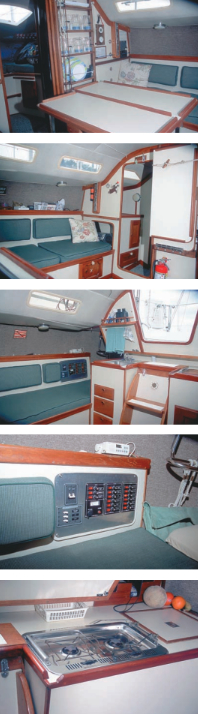
Among the many tasks were adding stiffeners to the bulkhead. While he was at it, Walt built a nifty dish-storage rack behind the bulkhead-mounted table. The boat (her new name had not as yet been determined, but Walt and Janet agreed that it would not be Hey Babe!, which was already emblazoned on the transom) was chalky above the waterline and wet below it. She spent from March to August in the blazing southern sun drying out. When the moisture meter said she was ready, Walt and Janet took her to the professionals for topsides and deck painting along with barrier coating and bottom painting.
Therein lies a story. All the literature says that the Ranger 28 has a 4 1⁄2-foot draft. The shallow draft was an essential on Walt and Janet’s boat-shopping list, since their sailing grounds have many shoal areas. Gilded Lily had just spent six months out of the water drying her bottom out. But who’d think to measure the draft? The literature tells you everything you need to know, doesn’t it?
Hard aground
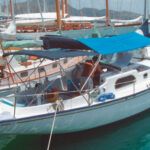
But just 10 days after the big launch following repainting, Walt and Janet went hard aground in an area that should have been navigable. They laugh at themselves in retrospect: “Our previous boat, the Catalina 22, drew 5 feet. We thought we had a boat with a 4 1⁄2-foot draft. Gilded Lily immediately turned into an island for three days!” Walt had to get to work. Janet stayed aboard their baby until she was freed from the sandy shoal. She “commuted” to the grocery store and showers from some distance (not exactly like being nearby in the mooring field) by rowing the dinghy. While the Ranger 28 does have a 4 1⁄2-foot draft, this particular Ranger 28 tall rig version — built at the end of the production run as the company was running out of money and stamina — has a 5 1⁄2-foot draft. Lily may very well be wearing a keel left over from a Ranger 33. At least that’s how Walt and Janet figure it happened. The keel bolts all match from boat to boat. It would be easy to do at the plant.
They scrapped her aluminum deck fittings for new stainless hardware. “There was a lot of lightweight original equipment bought by people who are used to having parties in the cockpit,” Walt says with a touch of sarcasm. “The previous owner didn’t own any winch handles!” Janet adds, “Walt believes in going sailing.” The new deck hardware came from Garhauer. They sing particular praises for the Garhauer quality and customer support when it comes to the traveler, which was installed forward on the bridge deck on a slight curve. Walt added strong 1⁄4-inch backing plates under the traveler fasteners.
They replaced the running rigging. “The blocks and ropes were tired from being in the sun,” they explain. They bought a new mainsail. Walt replaced the fuel, holding, and water tanks and put each in new locations. They decided that one sink on a 28-foot boat was quite enough and removed the sink in the head, replacing that with a shelf. There were the new generator, batteries, and more. All new wiring (there was burned-out wiring at the shorepower connection). Bilge pumps. A drain in the chain locker (“Why did the manufacturer think that was unnecessary?” they wonder). “Of course we couldn’t have done all this if Walt didn’t have the skills and a metalworking shop in the basement,” Janet notes with more than a touch of pride.
Janet recovered the cushions in the cabin and sewed other bits and pieces for use on deck, such as a mooring cover at the companionway, sailbags, mainsail cover, and tiller cover. Walt created a unique tiller stop collar. He replaced worn-out teak at the companionway and the hatchboards with a plastic wood that looks great and requires no maintenance. The portlights are the next thing on the list to be tackled.
Keel-bolt saga
Then there is the saga of the keel bolts. This 1977 fiberglass boat may have had one of the original “swing keels,” Walt notes with a grin. He knew the bolts were loose. But that loose? With the boat on stands and in slings, he removed the nuts (some with no effort), and the keel dropped from the boat a few inches. “Gravity did it,” Walt says. “There was no effort at all.”
The loose keel was repaired by cleaning its top and the mating surface on the hull. Inside the bilge, the keel-bolt washers were replaced with aluminum plates drilled to match the bolt pattern. The gap between the hull and keel was filled with 3M 5200, and the keel was pulled back into place with the keel bolts. Then Lily was lowered to place her full weight on the keel. The bolts were retightened, left overnight, and tightened a final time. No more swing keel.
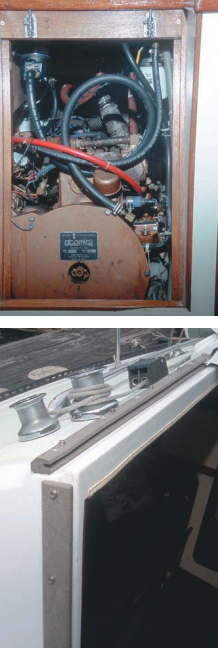
The Atomic 4 that had died at the final moment of purchase was brought back to life with the help of parts from Moyer Marine, which with the addition of a new propeller from Indigo Electronics made the propulsion system efficient.
“The engine has had perhaps 150 hours of operation since we’ve owned it,” Walt says. “I’d be stunned if it has a total of 500 hours on it. The paint still looks good.”
The foregoing list of improvements, modifications, and replacements doesn’t amaze any good old boater, but it does beg the question of cost vs. resale value. Walt and Janet asked themselves whether this boat was a wise investment. (Oops! There’s another of those contradictory terms!)
“Why put a ton of money into an older 28-foot boat?” Walt asks. Then he answers himself. “She’s our cabin at the lake and we love the way she sails. I don’t think we could have bought a boat that suits us as well as this in the new-boat market.
“The pleasure that Janet and I both have gotten from this boat and her refit is immense,” Walt continues. “We’ve shared it. It hasn’t been all me or all Janet. It has been a mutual endeavor. We have both been very rewarded by the results of this effort. We have made many friends as a part of our sailing, in particular, John and Dianne Breyfogle and Doug and Ann Cameron. Also the folks who do the fiberglass and paint work, Custom Fiberglass in Buford, Georgia, have been part of an important network, another very valuable relationship.”
Lily has rewarded them for their efforts by being a good sailer also. “She is nimble. She comes about well. She has a seakindly motion. She has good manners at anchor.” Walt ticks off her finer points on his fingers. He reminds others that the Ranger 28 held the Newport to Bermuda Race record in her class for many years. No small honor.
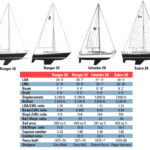
She was designed by Gary Mull (see Good Old Boat, November 2002). She was built by Bangor Punta of Costa Mesa, California, which had bought Jensen Marine and Ranger Yachts in its heyday in 1973 only to stumble and fall with so many others in the mid-1980s. The 28 was the seventh of nine boats designed for Ranger Yachts by Gary Mull. They were: Ranger 26 (1969), Ranger 33 (1970), Ranger 29 (1970), Ranger 23 (1971), Ranger 37 (1972), Ranger 32 (1973), Ranger 28 (1974), Ranger 22 (1978), and Ranger 26 (no date appears for this last boat, an ultra-light-displacement model produced just before the final act of Gary Mull’s rancorous career with Bangor Punta). Keep in mind that the dates given here vary from reference to reference (based, no doubt, on when the design was started or completed, when production began, when the first boat was launched, and so on).
Gilded Lily was not Walt and Janet’s first boat, so they had some ideas of what would work for them before falling in love with this beamy beauty that has a whole lot more space below and on deck than any 28-footer has the right to have.
Water people
Walt was always fascinated by water, and Janet is a gung-ho outdoors person. “Walt and I were a good match,” Janet says. Walt began boating with apple boxes and large mortar mixing trays. He paddled across the Ohio River and back in an apple box. “If my parents had only known about what I had done . . .” he says, remembering. That led to a passion for racing canoes, which grew throughout his adulthood. A give-no-quarter fierce competitor, Walt raced in whitewater, wilderness marathon, slalom, and other events. He went to nationals frequently. “I put 40,000 miles on the van in one year going to events,” he says.
Doug Cameron, a canoeing friend, had a 16-foot O’Day Daysailer and introduced him to sailing, Walt says. “We went to Guntersville Lake. At some point, Doug gave me the tiller and dozed,” Walt says. “I went wing-and-wing that first time and then found out I wasn’t supposed to know how to do that yet. The hook was set right there.”
It was an easy move from paddle to sail. “Learning the foreign language of sheets, blocks, halyards, and so on was an easy transition,” Walt says. “Much was intuitive. A number of things that are fairly useless skills seem to come together for a sailboat.” He went looking for a Flying Scot and instead wound up with a Catalina 22, which needed some help. He learned much about sailboats and fiberglass repairs courtesy of the Catalina, named No Alibis. His training with machine tools and his work in industrial maintenance chiefly as a millwright and industrial rigger didn’t hurt either. In looking back over a varied career, Walt muses that he spent most of his working life fixing things that someone else broke. And that, he notes, fits right in with the demands of restoring a boat.
Janet was a horsewoman who fi gures she put in at least 12,000 miles on horseback and began tent camping in childhood. She loved the out-of-doors and discovered canoeing later in life, when she met Walt. “A friend invited me to a canoeing rendezvous. I had no canoe experience. But there’s a buoyant feeling when you step aboard. I immediately adored it,” she remembers. She was married at the time and considered Walt a friend who helped her find a couple of good canoes and visited with Janet and her husband when Walt was in town.
But Janet’s husband succumbed to cancer, and Janet had a bout with breast cancer in the 1980s and a run-in with Hodgkin’s disease in the 1990s. Some time after the death of her husband, Janet realized that when she talked to Walt, he was a ray of sunshine. “I realized that one of the few times I’d quit crying and laugh again instead was when Walt called,” she says.
Together they took No Alibis deep into Everglades National Park. Walt had gotten quite hooked on this wild part of southern Florida, and Janet enjoyed the entire experience. “You won’t see another human being for days. There are a million and a half acres. It was perfect for me,” she recalls. She took to sailing in the same way: she is usually the person on the tiller with Gilded Lily, while Walt tends to sheets and trim.
Because of her outdoor orientation, Janet says, “When we were looking for our larger sailboat, we didn’t go looking for a ‘Momma boat’ with the comforts in the cabin built with Momma in mind. I accept that [more Spartan lifestyle] as the price of the glory our sailing place has to offer.” Janet’s natural way with words comes easily. Before retiring, she worked writing advertising copy. Later, she was chief financial officer for a corporation.
Gilding the lily
This leads us back around to choosing a name for Gilded Lily. Who better for the task than someone who writes ad copy? Still, it wasn’t easy. Months went by. Walt says he was campaigning heavily for Debtor’s Prison, for obvious reasons.
Janet picks up the thread: “We realized that when it comes to the boat one or the other of us can get manic about something. When that happens, we have to look each other in the eye and say, “It’s a boat.” (Strong emphasis on “boat,” as in it’s ONLY a boat . . . or it’s JUST a boat, after all.)
During the early months, she says, “as the list of what we wanted to do to this boat was growing, we added one more task that seemed to be the straw that would break the camel’s back. I said, ‘All we’re doing here is gilding the lily!’” Choosing that name was a reminder to us that boat units ($100-chunks of money is their definition) can disappear in a hurry,” Janet concludes. By the way, they named the dinghy Lilliput, of course.
It’s a boat, they remind themselves. That may be so. But for Walt and Janet Gilded Lily is the boat. The end justifies the means. Jerry has said repeatedly that the value of a boat can be measured in the brightness of the crewmembers’ smiles. If that is so, Gilded Lily is priceless.
Thank you to Sailrite Enterprises, Inc., for providing free access to back issues of Good Old Boat through intellectual property rights. Sailrite.com