How to prevent things from falling apart
Issue 51 : Nov/Dec 2006
When something vibrates loose on your boat, the result could be anything from a mere nuisance to a catastrophe. To “safety” a fastening is to secure it by using an extra support or backup to keep it from unscrewing, vibrating loose, or at least from falling overboard or into the bilge. Here’s how to “safety” the most common trouble spots on your boat.
First, let’s look at nuts and bolts. My friend’s engine kept slipping out of alignment. It was supported on two flexible mounts by two jamb nuts on the bottom of the engine mount and an elastic stop nut on the top. Vibration caused the two jamb nuts to part, no matter how hard they were tightened against each other, letting the engine drop on the mounts.
The problem was solved with an old machinist’s trick. Drill and tap a hole in the side of any nut you want to lock and lock it on with an Allen set screw. Now the nut is locked tightly, not just by the friction of the set screw but because part of the thread of the bolt has been deformed, so the nut will stay in place (unless turned with a wrench) even if the set screw is lost.
The advantage of the Allen screw compared to the hex-head or other screw you might be tempted to use in this situation is that, if you use one short enough, it won’t extend past the flat of the nut when loosened. This means a wrench can be used on all six flats to make adjustments. The disadvantage is that you have to remember to add an Allen wrench to your tool kit. The advantage to using a hex-head is that it’s easier than the set screw to work if the nut is in a tight spot where you can barely reach or see it. Most square-head set screws have a hole for safety wire. Allen screws, however, are difficult to lock.
Stop nuts
Generally, bolts that are put in with no intention of ever being removed are put in with elastic stop nuts intended for one-time use. If you do remove such a bolt, don’t reuse the old stop nuts. They won’t hold as well the second time. For maximum locking effect with self-locking nuts, no more than three threads of the bolt should be showing. In addition to these “mechanical safeties,” there is Loctite, a “chemical safety.” Brush it on the threads, tighten the bolt, and it’s set.
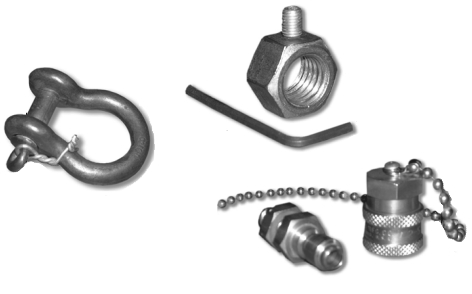
Other fasteners such as shackles, turnbuckles, and shafts are secured with a twist of wire. Usually a hole is provided in the pin of a shackle for this wire. Keep soft stainless-steel wire, such as leader wire, on hand. A turnbuckle that doesn’t have locking nuts can be secured with wire. Wind a few turns of wire on the turnbuckle opposite its tendency to turn, then tape it to cover the roughness.
Safeties that prevent loss are simply leashes that keep something from getting lost or damaging something else, if it breaks loose. Drain plugs, for example, should be attached to the boat with a bathtub chain or bit of line. Most clevis pins have a hole for some sort of captive fastener. Marine stores carry a variety of leashes in different sizes and types to “safety” power tools.
Thank you to Sailrite Enterprises, Inc., for providing free access to back issues of Good Old Boat through intellectual property rights. Sailrite.com