RC model Lasers are more than toy boats
Issue 54 : May/Jun 2007
This morning I participated in a peaceful pastime that I dearly love: sailing. Now as I write this, the wind howls outside, the temperature has dropped into the 30s, and the calendar says it’s late March. How, you may wonder, can an old codger like me say I’ve been sailing at this time of year? Given just a small tidal pond, a slight break in the early spring temperatures, and a radio-controlled model sailing vessel, my pastime is possible. “Windling” it’s called, although I’m not sure whether that term is accepted by the more established radio-control sailors.
Many folks in the seaside community in which I live might mistakenly call it a “childish pastime.” The local policeman stopped his patrol car to ask, “Somethin’ ya got for Christmas?” when he saw me unloading my model boat and sailing gear from my car. True, it has affected me the same way at times. This being a small community, I wouldn’t like for the others to whisper to one another, “That old Taylor guy must have entered his second childhood . . . playing with toy boats!” At the very least, however, I make the local hardware store owner happy selling me all the AA batteries I need to sail my boat.
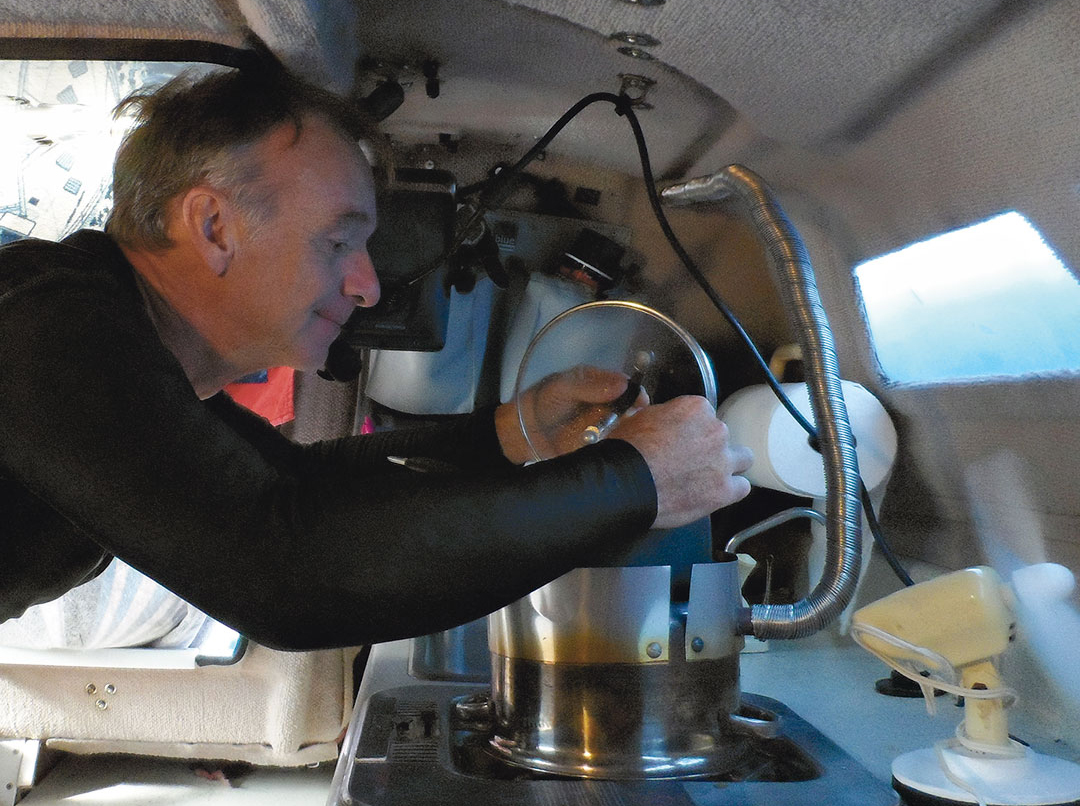
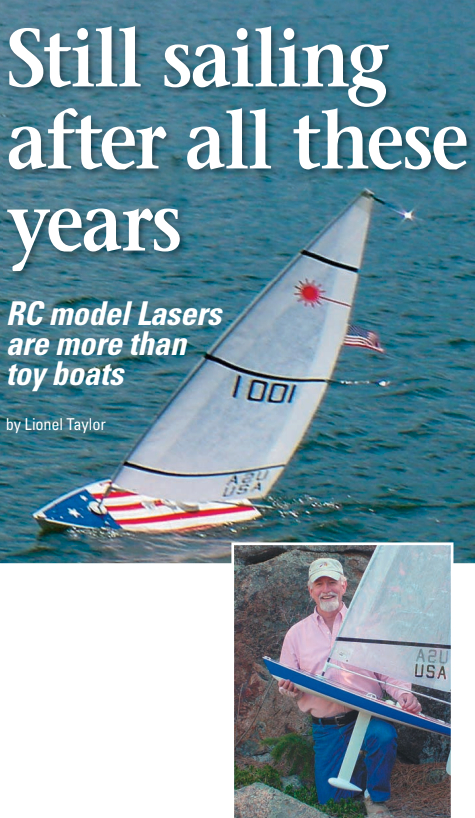
Actually, my RC Laser model is more than a toy: she (we always call boats “she,” even a 4-foot boat is a “she”) is registered with an international one-design racing class and has her own USA sail numbers. There are rules and a racing schedule, including local and national regattas. I’m not sure I’m good enough to enter the nationals, but who knows? I used to be pretty good at racing full-sized sailboats.
Feeling like a kid
In spite of all this, I could be a prime target for querulous comments when I appear at the local post office in early spring garbed like an old fisherman in my muddy boots, old rain jacket, finger-less sailing gloves, and Mystic Seaport sailing cap.
I do feel a bit like the kid I was many years ago when I used to sail my toy boat on a string on the Bronx River in Westchester County, New York. The river was not very wide at that point and anyway I, like most kids, sailed in my bare feet. Maybe that memory is what got me windling some 60 years later. Or maybe it was the sail on a piece of board my grandson, Forest, gave me to play with on my son’s farm pond in Vermont. Anyway, I feel like a kid again when I watch with glee as my model boat maneuvers about the pond, strictly under the control of my right index finger. Back and forth she goes: now on a beat with the sail hauled taut; now on a run with the sail boomed out; now and again heeling to a sudden gust of wind. All this as I sit back on the sternsheets of my rescue dinghy, which is carefully pulled up on the side of the pond, and watch.
I do have one loyal follower about my age who apparently doesn’t think the pastime is childish and who comes down to see me windle when he’s out for his daily walk. He is not a “windler” himself, but he owned a full-sized sailboat that he gave up for an old “stinkpot.” I think he secretly misses his sailboat.
We talk about sailing terms like length overall and speed over ground. “I bet she’s doing 2 1⁄2 to 3 knots now,” he’ll say to me about the model’s performance. I’ve tried to encourage him to get a boat so we can windle together, but his wife, who was along on the last visit, put in a silent negative vote by turning away from the discussion.
To try and make the woman feel there may be something normal about me after all, (she is a friend of my wife — who supports my pastime — and I wouldn’t want my actions to affect their friendship), I said, “I only do this in the cold weather. I sail my 23-foot Pearson Ensign in the summer.”
Time marches on
Fast-forward another five years since I wrote those words. I am now 84. I have gotten so long in the tooth that my mobility has become a problem. I’ve had to sell my big boat because I can’t safely sail her and I don’t want others to possibly put their lives on the line because of my ineptitude. So I’ve become part of the old saying, “Old sailors never die, they just miniaturize the size of their sailboat.” I can still windle.
However, because of my age some things have had to change. When I was younger, I used to sail from the high side of the pond. Because my model boat draws 16 inches, I had to wait for a pretty high tide before I could sail. It meant launching from a position down on my knees and bending over a 15-inch-high bank to get the boat into the water. Recovery was equally difficult because sometimes I could not get the boat back to the exact spot where I’d launched her and where the bank was at its lowest. This often meant water in my sailing boots, which made me none too happy.
Then, when I found I could not get up from my knees anymore, I had to change my launching spot.
Across the pond was a sandy beach, shallow but usable. To use this area, I had to change my sailing attire from shorts and sailing boots to long pants and hip boots. I have to walk out almost 12 feet to get to where the water was at least 17 inches deep. With my 8-pound sailboat in my right arm (sails flapping madly), I’ve had to use a walking stick to keep my balance. At least, the distance I had to bend over was minimal and I could retrieve at any point along the beach.
Dual-purpose chair
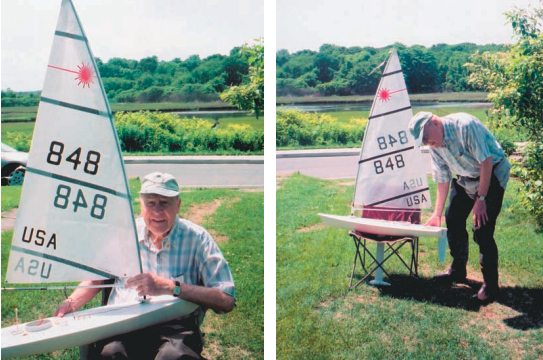
I have a folding chair with an oblong hole cut through the seat. It’s wide and long enough to accommodate the keel. I can position the boat on the chair, assemble the sails and rigging, and then sit in the chair to observe her sailing maneuvers when she is in the water.
I still have a rescue boat, except that I had to buy a small inflatable because my dinghy was too heavy to drag into the water if I had to use it. However, the pond is almost landlocked except at one end where the tide enters, so the risk of losing the model boat is not too great.
It is easier to launch the boat at the beach than it was across the pond and I can park my car, loaded with my boat and all the gear, close by. With my folding chair in hand, it takes two trips to the beach over level ground with no bank to contend with. And I can sail all year round.
I occasionally still get interested spectators who want to know about my boat and the sport of windling. I try to drum up a little interest in sailing model boats because the pond is big enough to put a buoy or two in the middle and do a little racing around them. I’ve had little luck so far.
Model boating and boat racing used to be a popular sport many years ago, enough to have results reported in Yachting and other sailing magazines. National and international regattas were held in salt and fresh water in Britain and the United States with suitable prizes for the winners. The wooden boats were principally built by the owners . . . not sold, like mine, as a finished package. And, of course, they were not radio-controlled. That was to come later.
Got away from them
They sailed pre-set courses corralled by their owners in a rowboat. With a strong wind, their model racers sometimes got away from them nonetheless. I can remember hearing about skippers rowing as fast as they could and not being able to catch up with their larger model boats.
Today, there are still many model boats built by their owners and others, some with parts already cut for ease of assembly. They range in size from smaller than my boat, an RC Laser (length 42 inches, mast height 73 inches, beam 14 inches, weight 8 pounds) to a lot larger.
We are organized by the American Model Yachting Association (AMYA), which sponsors sailing clubs and regattas. Their brochure proclaims it to be a “not-for–profit organization open to all interested and dedicated to promoting the designing, building, racing, and preservation of all model sailing yachts.”
Steve Lang, of the Model Sailing Center in Evergreen, Colorado, says, “The RC Laser has — as one of the most remarkable features — a broad appeal. The Laser is extremely forgiving, allowing novices to learn by making mistakes — mistakes that have no negative consequences to the boat. Kids can play bumper boats all day long with their RC Lasers with absolutely no damage.
“The newest toy for the big-boat set is the Laser. Because of its size it is easy to carry and stow. Boatowners can carry their model boat with them onboard. Whether on a mooring or at anchor the Laser is ready to keep the kids entertained or give adults something to enjoy during cocktail hour.”
Racing around the harbor is a hoot, no matter who is at the controls.
“The model boat is the clear choice for bridging the generation gap,” Steve continues, “A granddad or a dad can relax and enjoy a day of fun sailing with the kids. Kids of all ages will love zipping around the lake or harbor. It is a terrific boat for quality family time.”
I agree with everything Steve says. The RC Laser is a model boat for everyone. There aren’t many sailors who would not have fun windling.
Thank you to Sailrite Enterprises, Inc., for providing free access to back issues of Good Old Boat through intellectual property rights. Sailrite.com