An old affair of the heart still haunts this sailor
Issue 54 : May/Jun 2007
A nor’easter is battering the coast of Nova Scotia, causing this old house to shudder. The sump pump valiantly struggles to rid the basement of water. I am hunkered down, warm, dry, and safe in the knowledge that a basement is not a bilge and, no matter how strong the winds blow, my cozy and commodious cabin is most unlikely to drag off onto the rocks.
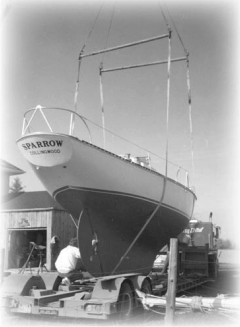
My mind wanders back to other storms in other places. In those times, life was more about stimulation than security and what security there was had a lot do with the design and sea-worthiness of Sparrow, our Rhodes- designed Bounty II.
They say all boats are compromises, in that no design offers it all. That may be so, but if ever there was a boat that came close, it was our Sparrow. She was fast, beautiful, strong, and seakindly. She made very little leeway. At anchor in a blow she was ever the lady, in that she faced into the wind like a little bird perched on a wire.
Sparrow began her life as a kit boat, one of two purchased by John Blunt of Sarnia, Ontario, in 1959. The kit was manufactured by the Coleman Boat and Plastics Company of Sausalito, California, and the design was based on Phillip Rhodes’ 1955 wooden yawl, Altair.
The Bounty II was the first large fiberglass boat ever built and Coleman hired designer Bill Garden to engineer the scantlings. Since fiberglass was a new and untried material for boatbuilding, no chances were taken, and the Bounty II was stalwart to say the least.
John Blunt took his two kits home to Sarnia where he finished them up, outfitted them both as charter boats, and sent them off to Grenada. One of them he named Affair de Coeur.
Reported missing
Rumor has it that one of Affair’s customers failed to return her to the charter company and she was reported missing. The Coast Guard spotted her at anchor somewhere in Florida and went out to search her for drugs. As they approached, the “charter guest” was seen by onlookers heading to shore in an inflatable.
No drugs were found, so the Coast Guard left. Shortly thereafter, the vessel sank. Apparently they had interrupted the fugitive in the middle of a water-pump repair.
This turn of events aroused even more suspicion and the Coast Guard revisited the boat, raised her to the surface, searched her again, and then let her sink to the bottom once more. The story I was told was that the “gentleman” whose hasty retreat went unnoticed by the Coast Guard was in the precious stones business and was not a drug smuggler. (Many years later, while in the midst of extensive renovations, I always nurtured a hope that I might come across a nice diamond or ruby but, alas, it was not to be.)
But back to our story. John Blunt received a phone call from a friend who had recognized Affair. John went to Florida, had the boat raised, hauled, and shipped home to Canada where he had her steamed cleaned and then sold her.
Over the next few years she passed through the hands of several owners and I can only surmise about their dreams for her. Was she too much for their pocketbooks? Did her needs exceed their abilities for boat repairs? Did they just buy her to flip and make a quick buck?
Low windage, long overhangs
What I do know is that one spring day, sometime back in the mid-1980s, I first saw her hauled out in Port Credit, Ontario. She was beautiful . . . everything a boat ought to be: a full keel, low windage, long overhangs, a fine entry, modest in beam, and the product of a long evolutionary process that was all about being seaworthy and fast.
I must confess to having had an inordinate amount of interest in the “fair sex” as a young man. This, I am told, is due to an excess of hormonal activity that occurs around the time of puberty. What, I am wondering, is this then? Could there be some sort of sailboat hormone that prepossesses some men to become stricken at the very sight of a sailboat? All I know about this medical revelation is that the very sight of that beautiful turn of her bilge made my old heart go pittery-pat. She was indeed an Affair de Coeur and I had to know all about her.
The young man who was sanding her bottom in preparation for the antifouling worked in Toronto and lived far enough west of the city that commuting to work was expensive and time-consuming. During the work-week he lived on Affair and could take a bus to work. On weekends he went home to his family. It was from him that I learned she was a Bounty.
I had just returned from two years spent living aboard an Alberg 30, during which time I had crossed over to Spain and Portugal and returned to North America, resolved to work five more years, buy a bigger boat, and move aboard for good.
Over the next few months I found myself drawn to Port Credit. When I wasn’t actually there, I was researching Phil Rhodes and the Bounty II.
Five-year refit
It wasn’t too long before my Alberg was sold and Affair de Coeur was propped up in the backyard undergoing what would become a five-year refit.
I love working on boats, even more so when they are in the water, but moving big boats from here to there, monthly yard bills, and Travelift costs make it much more cost-efficient to keep your boat at home until it is ready.
A heavy canvas tarp and a little cube heater made it possible to keep working inside all winter long. When summer came, the tarp came off, and it was time to work on the decks. The windlass was rebuilt, a dodger added, bow rollers, heavier ground tackle, new sails, the bottom got four coats of coal tar epoxy, the decks and topsides were painted and the interior was redone.
After five years and the investment of mucho money, she was ready to go around the world. On August 31, 1989, I registered her as Sparrow, the third vessel to be registered at the Port of Collingwood, Ontario, that year. We were given a little blue book containing a single page of the most official-looking paper attesting to the fact we owned 64 shares of this vessel of 10.44 Register Tons and signed by Mrs. McEachim, the registrar of shipping.
It was 1992 before the great escape actually began. Sparrow left Colling-wood on August 8 and made her way through the Great Lakes past Sarnia, Windsor, off down Lake Erie through the Welland Canal, and then entered the Erie Bridge Canal, where the mast was lowered.
Seized engine
At Tonawanda, New York, the old Perkins 4-107 lost oil pressure and, having no alarm, the engine just seized up with 1,465 engine hours of service to its credit. Adrift and at right angles to the canal, we had the honor of being rescued by the first private yacht from the Soviet Union ever to visit the USA. They secured us alongside and towed us to an old wharf beneath a bridge, where we tied up directly beneath the downpipe that drained rainwater off the bridge above.
In retrospect, the good life was starting to pale a little. That was a rainy summer, so with each deluge a fresh offering of cigarette butts, muddy water, and soggy trash fell from above onto our beautiful decks. Sparrow shared her new digs with an old wino who liked to sing himself to sleep and whose habit was to retire in the not-so-early hours of the morning.
A replacement engine had to be found, the old engine removed, new cabinetry below had to be butchered, and to be completely honest, a nice time was not had by all. When the main course involves quitting your job, selling your home, and saying goodbye to friends and family, there is a certain amount of stress.
When for dessert you find yourself living under a bridge with a wino who sings very poorly, all the while being showered with cigarette butts and other soggy stuff of indeterminate origin, the stress level might be exacerbated.
Brand-new engine
Three weeks later, Sparrow was off and running once again with a brand-new Perkins 4-108 and a captain who was a bit anal about oil-change intervals.
September 16 saw us at Castleton on the Hudson, the last day I banged my head on the mast while coming up the companionway since it was there that she became a sailboat once more.
There was a hurricane at Cape May and the transmission had to be rebuilt at Annapolis. Were it not for bad luck, or so it seemed, I might not have had any luck at all. Upon reaching Beaufort, North Carolina, my wife left. Since then, I’ve met many a fellow with similar stories to tell. In retrospect, the worse things get on the outside, the more we tend to focus on the immediate problems, blindsiding ourselves to the whole picture. I believe they call it tunnel vision.
In any event, Sparrow and I spent the winter in Beaufort, North Carolina, and over the course of the next few years I made several trips to the Bahamas. I met a new woman, a good thing; the Canadian dollar kept falling, a bad thing. We made a lot of new friends, visited lots of new places, and had many new adventures.
As the dollar fell, our cost of living crept upward and, for this and other reasons, it was time to move ashore. We decided to list Sparrow with a broker. As I expected, the first potential buyer found the boat on his computer. I also expected my heart would break when I signed her over, but I really liked the young man who purchased her. He was me 20 years earlier: a romantic with a faraway look in his eyes and a dream of sailing around the world. He didn’t know much about boats but he knew navigation and earned his living as a commercial pilot.
Unnecessary renovations
He brought a friend with him, one of those experts who knows everything about anything. I hoped Sparrow’s new owner wasn’t gullible or considering any shared fi nancial arrangement with this friend. Most of all, I hoped that this time Sparrow would get to sail around the world.
Sadly, this was not to be. Sparrow was to spend the next few years undergoing unnecessary renovations in a yard somewhere in Georgia. Tragically, her new captain would die in a plane crash a few weeks prior to his intended shakedown cruise.
She is out there somewhere. Is she just a home for a liveaboard, a weekend party boat, a young family’s coastal cruiser? I don’t know, but my wish for her is to cross many oceans and possibly even to circumnavigate the globe. May her masthead make little circles under the starry firmament and may her logbooks be chock full of the lats and lons of faraway places. May she be all she was meant to be.
Thank you to Sailrite Enterprises, Inc., for providing free access to back issues of Good Old Boat through intellectual property rights. Sailrite.com