It’s versatile, efficient, and above all, handsome
Issue 54 : May/Jun 2007
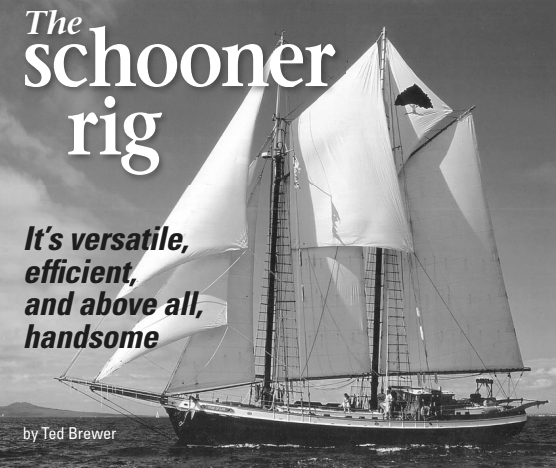
The schooner rig is considered to be distinctively North American. There is even a stale old story of how the name came to be. According to legend, when the first ship of this type was launched and sailing in America in 1713, one onlooker cried out, “See how she scoons!” Apparently scoon is either an old Scots word or an old New England word, depending on which “authority” you read, and means to skim over the water. However, this smacks too much of an old wives’ tale to me.
The “sch” spelling of the word is said to be of Dutch or German origin and, since the Dutch originated the schooner rig back in the 1500s or early 1600s, more than 100 years before 1713, I have to believe that the Dutch originated the name as well. So much for legend.
In any case, the schooner is a fore-and-aft rig with, usually, two masts — a foremast and a mainmast — although schooners have been built with three, four, and more masts. A number of six-masted cargo schooners were launched in the early 1900s. The biggest schooner of all was the ill-fated, seven-masted Thomas W. Lawson, built in 1902. (Note: The T .W. Lawson:
The Fate of the World’s Only Seven-Masted Schooner, by Thomas Hall, is available from Amazon.com. –Eds.)
Her masts were named fore, main, mizzen, number 4, number 5, number 6, and spanker, according to her first master. I can hear it now: “It’s coming on to blow, me hearties, so tuck a reef in the fore, four, and six!”
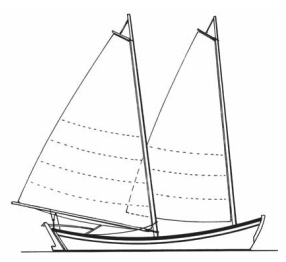
The more typical two-masted schooner is of greater interest to yachtsmen, and the boats come in a variety of styles. The cat schooner, as the name implies, has the foremast set well forward and does not fly any headsails. The Block Island cowhorn is a handsome example of the type; plans for such a boat are shown in Howard I. Chapelle’s American Small Sailing Craft. The schooner foresail is usually set on a boom, but the cowhorn foresail was boomless and overlapped the mainsail. Chapelle recommended the boomless, overlapping foresail for any small schooner seeking improved performance, but it does mean another sheet to tend.
Extended bow
The knockabout schooner sets one or more headsails but has an extended bow instead of a bowsprit, or widow maker, as many fishermen called that protuberance. A number of 100-foot and larger knockabout schooners were built in the early 1900s for fishing off the Grand Banks, but the type never caught on.
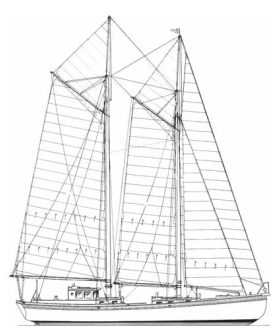
The more normal schooner is fitted with a bowsprit and carries one or two headsails, a foresail on the foremast, and a mainsail on the mainmast. The foresail is usually gaff-rigged, while the mainsail may be gaff or Bermudan. If gaff-rigged, the vessel is known as a bald-headed schooner if she does not carry a main topsail, a triangular fore-and-aft sail set above a gaff mainsail for added area in light-to-moderate breezes. Some schooners, such as the famous Nova Scotian Bluenose and other large fishing schooners, set topsails above both main and foresail, but the majority of schooner yachts only set a main topsail.
These boats are often, mistakenly, called topsail schooners, but that term should be reserved for those schooners that set a square topsail from a yard on the foremast and, occasionally, a topgallant or raffee (a triangular sail set from the masthead to the yard) above that. These are true topsail schooners and the Californian, a 1984 replica of a 19th century U.S. Revenue Service vessel, is a fine example of this rig. Visit the Maritime Museum of San Diego online to see a grand photo and details of this lovely vessel: .
The staysail schooner is a different rig altogether and does not set a foresail. Instead, a stay runs from the mainmast to the foremast above the deck and a triangular staysail is set on that. It may have individual sheets but usually is set up with a boom to be self-tending for convenience in beating to windward and sail handling in general. The Cherubini 48 is a truly beautiful example of a modern staysail schooner and, noted for its very high quality, is one of the very few schooners ever put into production in fiberglass.
Pinky schooner
The only other two production schooners of which I’m aware are a handsome 26-foot pinky schooner weekender that, if my memory serves me, was built in Maine in the late 1960s. My own Lazyjack 32 design is the other.
The little pinky may have been designed by Murray Peterson, a man who created many beautiful small schooners. I’d be interested to know more about the little 26 if any reader owns one and can tell me about it. I designed the Lazyjack 32 based on ideas by the late Dick Ketcham. The boats were built by Ted Hermann on Long Island in the 1970s. Neither of these small schooners is in production now. That is rather sad. I believe the schooner rig has much to offer the cruising yachtsman and family in handiness as well as being the prettiest rig of all.
The schooner is definitely not a racing rig under the present rating rules, but schooners were a serious threat in long-distance ocean racing before World War II. John Alden’s big schooner-rigged Malabars were always strong contenders in the Bermuda Races of the late 1920s and early ’30s and won their share. Nina, a beautiful 59-foot staysail schooner designed by Starling Burgess and built in 1928, won the Bermuda Race in 1928 and again 40 years later, in 1968, much to the delight of many of us old-timers. I have seen Nina racing under full sail, and I can assure readers that it is a sight never to be forgotten.
The fisherman staysail is a large triangular sail set between the masts in light-to-moderate winds. The head of the sail is hoisted to the top of the mainmast, the forward corner to the foremast, the clew is sheeted well aft, and a downhaul from the forward lower corner of the sail keeps the luff reasonably taut. The fisherman staysail must be lowered and reset when the vessel tacks, so it is not a convenient sail in close waters, but it definitely pays its way on longer passages.
Huge fisherman staysail
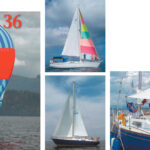
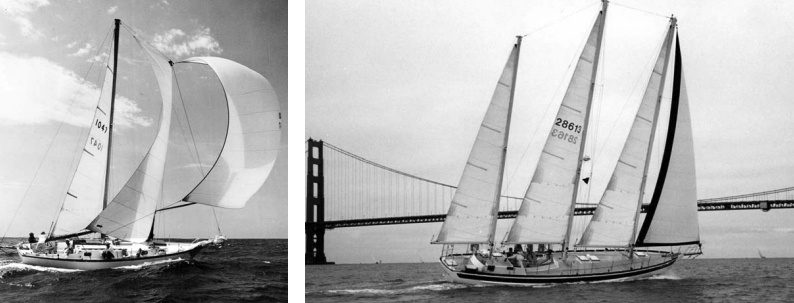
The photo of Tree of Life (Page 13) shows a more or less normal fisherman and that of Ingenue (above left) shows the Bermudan schooner rig dreamed up by L. A. “Pokey” Wheeler for racing under the CCA rule in the early 1960s. The yacht was rated with only a small Bermudan foresail, rarely flown, but that huge fisherman staysail was hoisted on the foremast sail track and acted as an overlapping foresail. It made Ingenue a serious contender off the wind and won Pokey more than his share of silver.
However, racing aside, the cruising sailor might give the schooner some serious consideration for more reasons than one. The first reason is general performance. One of the more popular cruising rigs today is the ketch but, for handicapping purposes, the schooner was rated as a more efficient rig by the Royal Ocean Racing Club. A Bermudan schooner was rated at 92 percent of a Bermudan sloop, 4 percent more efficient than a Bermudan ketch or gaff yawl. Similarly, a gaff-rigged schooner was rated at 85 percent, only 3 percent lower than the Bermudan ketch and 4 percent better than a gaff ketch.
More important is how the schooner can perform on long ocean passages. Last autumn I had an email message from the owners of a 40-foot steel schooner, now in New Zealand. Gary and Jessie Balding were new to schooners, but they were not newcomers to cruising, as they had been sailing for 15 years and made a nine-year circumnavigation aboard their previous yacht. Still, they were delighted with the performance of their husky schooner. In fact, it was their message that prompted me to write about the virtues of the rig, which, like Rodney Dangerfield, never gets any respect.
Homemade squaresail
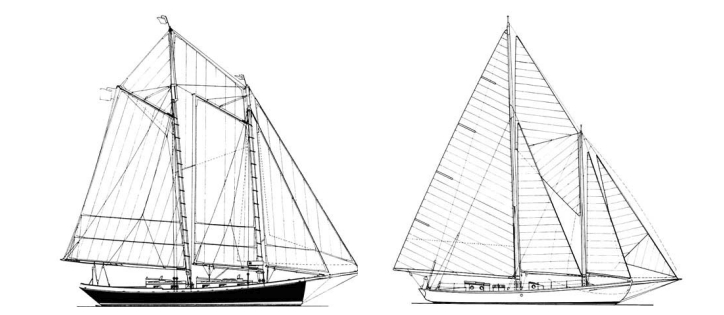
The couple, with their 11-year-old daughter, Sara, first sailed Southpaw, their gaff-rigged schooner, from Oregon to Zihuatenejo, Mexico. On the passage from Mexico to Fanning Island, 2,600 miles in light air, they set a homemade squaresail and raffee to make the passage in 29 days, averaging more than 5 knots. They also had the satisfaction of beating — by 12 days — a 56-foot ketch that left at the same time. Later, on the passage from Fanning to Apia, in the Samoas, they made harbor a day-and-a-half ahead of three modern cruising yachts, one of them a 42-foot fiberglass cruiser/racer.
As for handling storms, the worst Southpaw encountered was a 45-knot gale. They had a storm trysail aboard. I had asked them to try it on both masts during the voyage to see which worked better. However, Jessie advised me that they did not feel the need for the staysail in that gale and had no problems weathering the storm with reefed working sails.
Pokey Wheeler once wrote me that he and his wife had encountered a full gale in the Gulf Stream aboard the 33-foot Ingenue, while en route from Florida to New York. Pokey took down the main as the wind piped up and continued on with the jib and the Bermudan foresail. When the wind strengthened to gale force, he took the jib in, and Ingenue sailed on under the small 100-square-foot foresail alone, still making a few knots of headway to windward and handling the seas and the gale quite easily, according to Pokey.
My own experience tends to bear this out. I recall being at the wheel of a 45-foot gaff-rigged schooner under just foresail and staysail in a stiff blow when the few sloops and cutters we saw were under double-reefed main and small jib or motoring with all sails furled. The heavy schooner handled the weather beautifully; I was greatly enjoying the sail and the hot, rum-laced coffee coming up from the galley until we almost T-boned a very large whale. That made for some quick maneuvering. I’m sure the huge creature had never studied the rules of the road, and I was not about to argue that, being under sail, we had the right of way.
Three-masted schooner
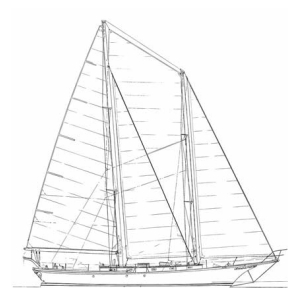
In a larger size, I had always admired L. Francis Herreshoff’s design of the Marco Polo, a 55-foot tern (three-masted) schooner. Herreshoff had convincing reasons for the tern schooner rig on a yacht of this size, stating that it was a rig that could be handled by one man on watch. He pointed out that it is easy to make great shifts in the center of effort (CE) of the sails, keeping the CE well forward to prevent broaching when broad reaching or running in heavy weather, or setting a reefed sail or storm sail on the mizzen mast to move the center well aft if laying-to in extreme conditions.
When a client came to me in the 1980s requesting a 60-footer that could be easily handled by a couple, I recalled the Marco Polo and thought about the old master’s reasons for using the rig. It made good sense to me and, eventually, to my client, so I started on the design of the 60-foot Arden. She was to be built in cored fiberglass but, unfortunately, ill health stopped work on the boat when the hull was partially completed.
I put the project aside as one more broken dream, but a few years later another client asked me to convert the design to steel. This required new, slightly beamier hull lines with heavier displacement, along with a revised sail plan of larger area. The result was Han Solo, later renamed Millineum Falcon, which proved to be very successful. She was beautifully built by her owner and performed surprisingly well in a few coastal distance races. Now an aluminum sister has been built using the same hull lines but with added ballast, and she is likewise proving the worth of the tern schooner rig for short-handed cruising, both coastal and bluewater.
Versatile rigs
The tern schooner can be Bermudan or gaff rigged, as preferred, and either is a versatile rig capable of flying a wide variety of reduced sail combinations to suit any weather. She can set quite an assortment of light-air sails between the masts — such as fishermen and mizzen staysails — for added performance when reaching and running. In any case, the rig allows for smaller and lighter sails than on a two-masted schooner of equal size, thus easing the work for a small crew.
All in all, the schooner rig deserves serious consideration by cruising sailors and designers. Perhaps we would see more schooners dotting our waters if the rig had received even a small part of the attention that has been given to improving the sloop.
Still, although the schooner is not the fastest rig, it has one undeniable merit. As Jessie Balding wrote to me, “Southpaw was, without exception, the prettiest yacht in any anchorage we visited.” That alone may be all the reason anyone needs to own a schooner.
Thank you to Sailrite Enterprises, Inc., for providing free access to back issues of Good Old Boat through intellectual property rights. Sailrite.com