Since 1976 she has been part of the family
Issue 58 : Jan/Feb 2008
Is it possible for a boat to become a member of the family? Is it strange to say, “Hello, good old boat!” out loud when you climb aboard? When a boat has been part of your life ever since you can remember and your dad’s eyes light up with pride every time he talks about her, then the answers are “Yes” and “No,” respectively.
My parents, Henry and Mary Anne, are clinical psychologists (I couldn’t get away with anything as a teenager) whose true passions in life run toward music, horses, and sailing. Dad is an accomplished jazz musician; Mom plays violin and viola.
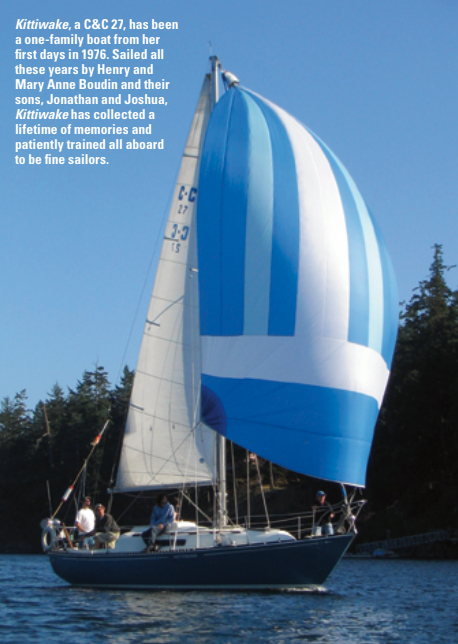
Neither of them spent much time on sailboats until they moved to Vancouver, British Columbia. Dad grew up in Montréal and Mom is originally from Chicago. In Vancouver, a city surrounded by mountains and sea, it is not surprising that a desire to explore nature brought them from the high peaks of Black Tusk to the waters of southern British Columbia. Eventually, this desire led them to a 1976 C&C 27 Mk III named Kittiwake.
Dad’s dream of being on the sea in a wind-driven vessel began small. Long before he set foot on a boat that he could sail, he quenched his thirst for sailing with miniature versions of boats and ships. A walk through my parents’ home reveals models and pictures of boats and ships. The Santa Maria on display on top of a cabinet was given to Dad by his aunt and uncle when he was 13. A model of a ship from the 18th century sits on a bookcase along with a ship named Canadienne, which used to sail the St. Lawrence River. Best of all, a model ship Dad and I built together is proudly displayed on the mantelpiece.
Functional model
A picture from 1981 shows Dad and a less than one-year-old version of myself playing with the fully functional model of a modern sailboat that he built and painted red. That little boat set off a chain of events that would eventually lead to Kittiwake.
Shortly after its christening in the bathtub, the little red boat had its first saltwater voyage, although it kept to the shallows where it could be retrieved if the wind tried to take it out to sea. After watching it sail, Dad decided it was time to upgrade to something a little larger.
Mom and Dad took lessons in Flying Juniors — often ending up wet — and attended Power Squadron courses in an attempt to look like they knew what they were doing. It wasn’t long before they purchased a twin-keeled Vivacity 22, named Gemini.
“We went from sailing that little red boat to owning Gemini in one month,” Mom says.
They sailed Gemini for two years and explored the areas of Howe Sound and Bowen Island, but a growing family created the need for another upgrade. After looking at several boats, they found Kittiwake.
“Henry completely fell in love with her,” Mom recalls. “She has beautiful, artful lines. She’s crafted like a sculpture . . . a work of art.”
“She is a racer/cruiser,” Dad adds. “She is perfect for a family and fast. What makes her an attractive boat is also what makes her perform well.”
You could say it was love at first sight.
Making memories
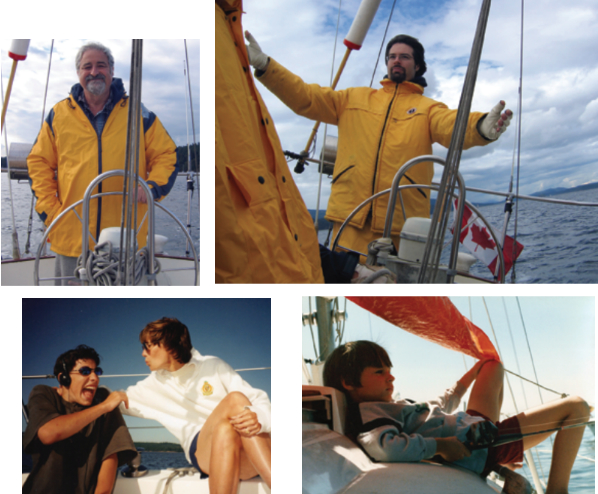
Shortly after Kittiwake entered our lives, we began our annual summer cruises, or “boat trips,” as we called them. We were an interesting crew. These trips often included a full-grown German shepherd and a cat.
There is nothing like loading that last bag full of groceries and untying the mooring lines for weeks of summer exploring. Dad built a dinghy, painted it the same colors as Kittiwake and named it Kiddywake. With this tender in tow, we embarked on cruises that took us across the Strait of Georgia from Vancouver to the Gulf Islands (the Canadian extension of the San Juan Islands). They might as well have been ocean voyages for me.
One of my early memories aboard Kittiwake is when I was 10. We were on a particularly rough Strait of Georgia crossing. While Mom and Dad were on deck trying to keep us headed more or less in the right direction, my brother, Josh, and I were in the V-berth, whooping it up at the feeling of zero gravity we experienced each time the boat crashed down a wave and left us airborne. We thought it was great, but I’m not sure how the cat did on that crossing.
We slogged for hours — often through rough waters — on those crossings, but it was well worth it for the thrill and the reward of making our way into a cozy bay, dropping anchor, and discovering a new world. As children and into our teens, we explored worlds far removed from anything modern and urban. We learned about the wind and tides, how to keep a heading, and how to keep the sails full.
We discovered things like phosphorescence. I would look over the stern at night, turn the wheel with my foot and watch the light show that the rudder put on beneath the surface.
On Wallace Island, we found an old International Harvester pickup truck and a tractor left over from the island’s orchard-farming days. I found myself mesmerized by these remnants of days gone by and, although I didn’t know it, I was getting a history lesson unlike any presented in a classroom.
Discovering treasures
From island to island, treasures big and small were ours to discover . . . from the famous murals in the tiny town of Chemainus on Vancouver Island to small sea creatures that resided in tidal pools. We searched for gold in Pirates Cove on DeCourcey Island but were content to leave with a few sand dollars.
Josh and I learned to row on these trips while we were at anchor. We spent time in the dinghy with the painter securely fastened to Kittiwake’s stern. That way we could practice without being lost at sea. On one occasion the painter wasn’t fastened as securely as we’d hoped. Josh found himself drifting slowly away from us, his rowing skills not yet honed. I — the superhero big brother — donned my life jacket, jumped in, and rescued our tender and its occupant.
To top it all off, we learned how to load a large dog into a tiny rowboat and how pull him up the boarding ladder when we returned from shore. That was nowhere near as difficult as bringing the cat ashore and not losing her.
Being on Kittiwake for weeks at a time gave me a sense of self-sufficiency and responsibility. When you are on a boat, situations arise that you must deal with the only way you know how. Josh had an asthma attack while we were at anchor one night. These attacks often required a trip to the hospital and the use of an asthma mask. That was not an option at 2 a.m. at a remote island. Mom and Dad dealt with the situation by using relaxation techniques and got him through the night. If the situation had become life-threatening, we could have radioed for help.
Almost bluewater sailing
When you are school-age, a benefit of a boat trip in late summer is the chance of missing several days of school due to weather severe enough to prevent a crossing of the Strait of Georgia to get back to Vancouver. Mom did not see such situations in the positive light that we did.
One year, after waiting out a storm for several days, Mom had had enough of sitting tied up at a marina and couldn’t stand the thought of her children missing any more school. The gale-force winds had not settled when she decided that we were going. Josh and I were stashed down below, Mom and Dad put on their bright yellow floater jackets, and we departed.
During the crossing, Mom looked astern only once, thinking it was better to ignore what she saw behind her.
“If you looked out behind the stern, it looked like a 20-foot wave was going to engulf us,” she recalls. “I saw Henry turn pale as he glanced back, and I told him it was better to keep his eyes forward as well.”
Josh had a tendency to get seasick, head below, and go to sleep on these crossings. When the inevitable occurred, Mom was at the helm, so Dad went down below to take care of Josh. While Mom was on deck alone, the wind picked up and Kittiwake began to heel severely. Mom tried to release the mainsheet from the cam cleat, but the force was too great. Dad leapt up through the companionway and used all his weight and momentum to release the mainsheet as the rail disappeared further and further beneath the surface.
We went to school the next day, unaware that our parents had risked our lives to get us there. It wasn’t exactly bluewater sailing, but it sure felt like it.
More (mis)adventures
Kittiwake has provided a lot of suspense and laughter over the years. There was the time that Dad stretched his arms and leaned back against the lifelines, only to find himself going heels-over-head over the side of the boat when the stanchion bent like melted butter. On another trip, we found a dock to tie up to for the night. Mom was halfway stepping onto the dock when Dad realized it was private, powered up the engine, and pulled away. Mom was less than impressed when we fished her out of the water.
Kittiwake’s 30-year-old Atomic 4 engine has generally been reliable, but we have found ourselves without power and without wind from time to time. Being left without sail or auxiliary power caused us to spend one night tied to a free-floating gas dock. We were told we could stay as long as were gone before the sea planes showed up for fuel in the morning.
Some years later, I had friends from out of town on board and had promised them a relaxing sail. We were 20 minutes away from the dock when the “Atomic Bomb” made several strange noises and went quiet. The silence was broken by words of wisdom from my friend, Tony, that I will never forget: “Dude, your engine just died!” I docked Kittiwake under sail for the first time that day.
By dragging anchor in the middle of the night on a kelp bottom amid shrieking birds and lightning (at islands that are rumored to be haunted) and by pitching her occupants overboard and almost falling over while on a tidal grid (it turns out that tidal grids and fin keels don’t mix very well), Kittiwake has provided our family with many stories that will be told for a long time to come. She has also been known to fly a pirate flag in a race and to fire water balloons at her opponents.
Boats and music
Being musicians, Mom and Dad find strong similarities between their music and sailing.
“You have to make sure your sails are trimmed and you have to make sure your instrument is in tune,” Mom says of the connection between the two. “You have to make sure everything works well, and you have to sail and be in tune with the wind.”
Just as improvisation is a part of music, it is also a part of sailing.
“The feeling of sailing is like flying,” Dad says. “When you’re improvising while playing jazz, it’s a feeling like flying, like being in flight. You’re not really thinking about stuff; you’re react- ing to stuff as it happens.”
“And if something comes up, you never know what might happen. Just like in music, in a sailboat you have to be ready for anything within a second,” Mom notes about the similarities between live performance and sailing.
The Canadian Broadcasting Corporation did a TV special on Dad and his band, Eastwind, a few years ago. During one song, the image on the screen cut from Dad playing live to videos of boats under sail. Interestingly, the editor who put that special together had no idea that Dad is a sailor.
Upgrades, or lack thereof
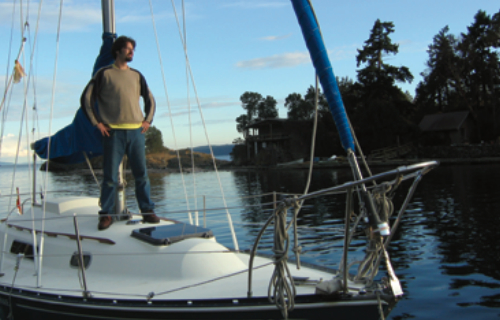
Kittiwake has not needed many improvements over the years. She’s a solid boat, keeping true to C&C’s reputation. The only additions include a jib-furling system and an automatic bilge pump. The rest of her equipment and hardware is original.
Even though Kittiwake is a safe and sturdy boat, there are always ways to make a boat safer. A benefit of owning an older boat is the many opportunities for projects and upgrades. I would rather upgrade Kittiwake than replace her.
After 30 years of being cooled by raw seawater, the original Atomic 4 has succumbed to corrosion and begun to overheat. A replacement or a rebuild with a heat exchanger will be in the cards soon, although the engine still starts vigorously every time. I would also like to upgrade the electrical system and install some toys, such as GPS.
I’m not sure when our adventures on Kittiwake tapered away to jobs and college, but eventually Josh and I grew up.
I gained much from having a sailboat in the family, like the realization at a young age that there is more to the world than TV and video games and that a house can seem too small for a family but a boat — a self-contained, floating home free to go anywhere you want — always has enough room for everyone.
I gained a sense of self-confidence, self-reliance, and resourcefulness. I learned how to read charts, keep the sails full, and what a broad reach is. I felt pride every time I took the helm. The magical moments in time that occurred during our cruising days cannot be replaced, nor will they be forgotten. And that, to me, is what having a boat in the family is all about.
Getting out a lot
Although it’s been a while since we cast off the lines and sailed away for weeks at a time, Kittiwake has been getting out a lot lately on daysails and for races. Although our racing record is not always stellar, we blame the boat’s crew, rather than the boat herself.
We are older now, but Kittiwake is still a big part of my life. I am ready for more cruises, and I look forward to the time when I can take my kids sailing on her, just the way my parents took me.
Kittiwake is still there, waiting for her mooring lines to be cast off for the next adventure.
Jonathan Boudin grew up learning to sail aboard Kittiwake, his family’s C&C 27. He has managed to abscond with Kittiwake, and they still cruise the Gulf Islands in British Columbia together. He uses his time away from the water to write yarns and is a published author.
Thank you to Sailrite Enterprises, Inc., for providing free access to back issues of Good Old Boat through intellectual property rights. Sailrite.com