Comparing three popular centerboard cruiser/racers
Issue 60 : May/Jun 2008
These three yachts were designed as cruiser/racers under the influence of the Cruising Club of America rule. The Olin Stephens-designed 38-foot 6-inch Finisterre began the trend to the keel/centerboard (k/cb) yawl in the late 1950s and ’60s. This resulted in k/cb yawls dotting the waters in sizes from 24-foot Midget Ocean Racers to 60-foot transatlantic racers. After I left the military in 1957, I worked as a yacht broker with George Cuthbertson while he was designing the lovely 54-foot k/cb yawl, Inishfree. These early custom k/cb boats were of the full-keel type, reminiscent of Finisterre. This was echoed by early k/cb production boats, such as the Morgan 34, C&C 31, and Pearson 35.
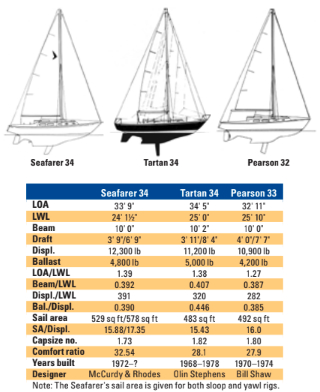
As the fin underbody became popular in the later 1960s, fin-keel centerboard boats with separate rudders appeared, either with a spade rudder or, as on the boats in this comparison, a skeg-hung rudder. The reduced wetted surface of these shoal-fin k/cb hulls will show to advantage in light air, particularly off the wind, while the very-high-aspect-ratio centerboards will provide excellent lift with reduced drag when beating to windward. However, their shoal draft does raise the ballast 1 1⁄2 to 2 feet over that of a modern fin hull, reducing stability, so the boats may feel tender to skippers accustomed to a deep-keel hull. The Tartan could have a tiny edge in stability, due to her 2-inch greater beam and a few hundred pounds more ballast, but it would be slight indeed and hardly noticeable to the average sailor.
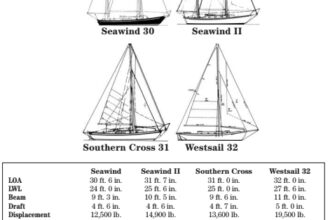
These three are similar in beam, draft, and sail area, but differ in displacement and waterline length. The Seafarer, with the greatest displacement on the shortest waterline, is of the older and heavier school. The Tartan is of more moderate proportions, but still husky, with her 320 D/L ratio. The Pearson, with the lightest displacement and the longest waterline, leans toward the light displacement end of the scale.
Serious contender
The Seafarer, with her greater sail area and shorter waterline, should prove a serious contender in gentle breezes. Under light-air conditions her added weight will not count against her, since low-speed resistance is primarily from wetted surface. The Tartan seems under-powered due to the skinny International Offshore Rule mainsail but should do well in moderate weather. The Pearson is the dark horse with her long waterline, more cutaway forefoot, and lighter displacement. She could show her mettle in a variety of conditions.
In comparing the sloop rigs, a race around the buoys would be extremely close. The result could depend more on skipper, crew, sails, a clean bottom, and the weather.
On the other hand, a yawl-rigged Seafarer can add tremendous sail area by setting a mizzen staysail or mizzen spinnaker off the wind. This should let her slip away from the sloops on the reaches. I would prefer the optional yawl rig for cruising, as the skipper can simply drop the mainsail to get through a squall and still have a balanced rig. It’s an advantage too often overlooked. I prefer the keel-stepped masts of the Seafarer and Tartan to the deck-stepped spar on the Pearson.
The capsize numbers don’t mean a great deal here and cannot be compared to those of deeper-keel boats. Despite a favorable capsize number, the higher center of gravity of the k/cb hull means that she will not right as quickly if capsized. On the other hand, the shoal draft hull is less likely to be tripped and capsized if caught abeam by a steep or breaking sea. In any case, capsizing shouldn’t be a major concern; many k/cb yachts have survived major storms at sea and many deep-keel yachts have been capsized and lost. That is the inevitable challenge of bluewater voyages.
My major concern with these yachts is the ease of repairing the centerboard or replacing the pendant when something goes wrong, as it inevitably will. Other than that problem, all of them will make fine coastal cruisers and, while not Cape Horners, they should prove quite capable of long and comfortable passages at sea given good condition, careful preparation, and intelligent handling.
Ted Brewer is a contributing editor with Good Old Boat.
Thank you to Sailrite Enterprises, Inc., for providing free access to back issues of Good Old Boat through intellectual property rights. Sailrite.com