After 35 years, this boat project still isn’t complete
Issue 60 : May/Jun 2008
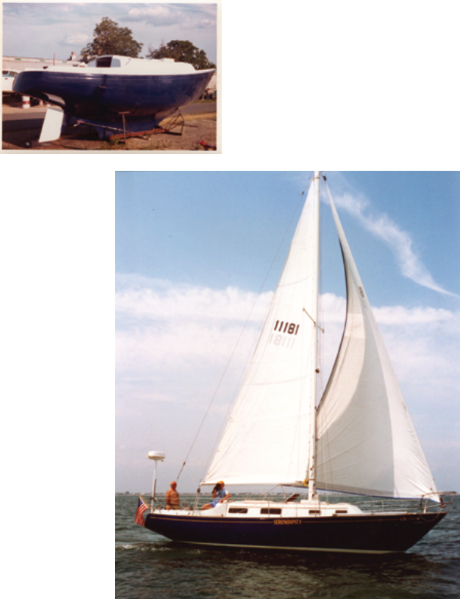
In April 1972, a year aFter he was married, Ed Stanton, of Franklinville, New Jersey, ordered the bare hull of a Seafarer 34 to be delivered to him, right out of the mold. The hull was delivered in August of that year.
Ed was not exactly a seasoned sailor nor boatbuilder; he had never owned a boat before. He was not too familiar with carpentry and not at all familiar with fiberglass. Now, seated in the cockpit of his beautifully finished boat 35 years later, he looks back at the project and says, “If I could do it, then anybody could do it.”
Ed and his wife, Pat, were born and raised in South Philadelphia and neither had much boating experience. In fact, the first time Pat was ever on a boat was when they visited the Seafarer plant to see the boat and explore the options.
Ed is a retired Philadelphia vocational school teacher, who taught welding, primarily to disadvantaged children. “I really loved my job,” Ed recalls, “and I probably learned more from the kids than they did from me. After I started teaching I took a course in sailing, primarily for the college credits, and the following year I chartered a 36- foot sailboat down in the Chesapeake.” He had been bitten by the sailing bug.
Ed’s continuing education finally earned him a doctorate. “I didn’t tell anybody at work that I had my doctorate,” Ed confesses, “I only got it to prove to myself that I could do it.”
Back to Amsterdam
The Seafarer line of sailboats traces its lineage to Amsterdam in the 1950s. These first Dutch-built boats consisted of a 33-foot centerboarder, which came out in 1958; the 28-foot Ranger, which came out in 1959; the 24-foot Meridian in 1961; and the Swiftsure in 1965.
Originally, Seafarer Fiberglass Yachts, Inc., located in Huntington, Long Island, New York, was the U.S. distributor for the Meridian and Swiftsure, but in 1965 the production of Seafarer boats moved from Holland to the Huntington plant.
In 1965, Bill Tripp designed a 31-footer for Seafarer, and later a 39-footer, but in the 1970s most of their designs came off the boards of McCurdy and Rhodes, including the Seafarer 34. (For background about McCurdy and Rhodes and Bill Tripp, see the January and November 2006 issues). Many medium-sized boat manufacturers closed down in the 1980s, including Seafarer, which went out of business in 1985.
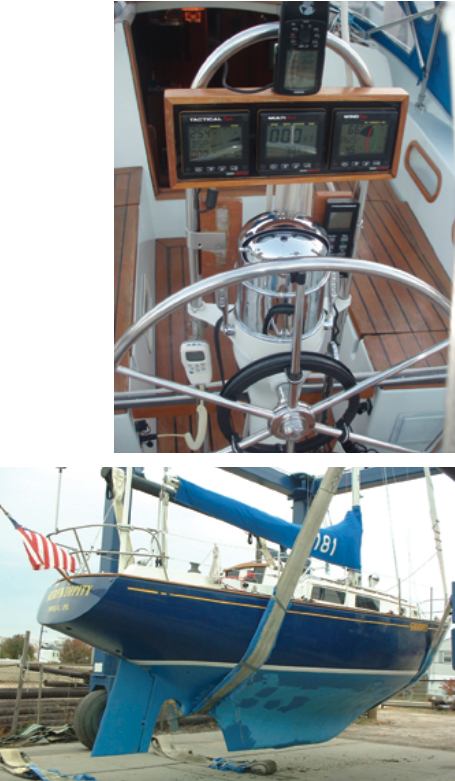
The McCurdy and Rhodes-designed Seafarer 34 hull was manufactured in several configurations. The underwater profile could be either a fixed keel or a keel/centerboard (k/cb), and the rig could be either a sloop or a yawl. Ed selected the k/cb sloop rig for his project. The bare hull was delivered to him with the engine, a Volvo MD-2 diesel, on its bed; the 4,800-pound lead ballast glassed in place; the fiberglass centerboard installed; and the fiberglass rudder, with stainless-steel shaft, mounted.
From there, it was up to him to complete the interior accommodations — that included carpentry, plumbing, and wiring — as well as the mast, rigging, and navigational gear.
Visited boat shows
“I went to every boat show that I could,” he recalls, “I took a tape measure and visited each boat in the show, sitting in their cabins, looking around. . . seeing how they did things and measuring dimensions that could be transferred to my own bare hull.”
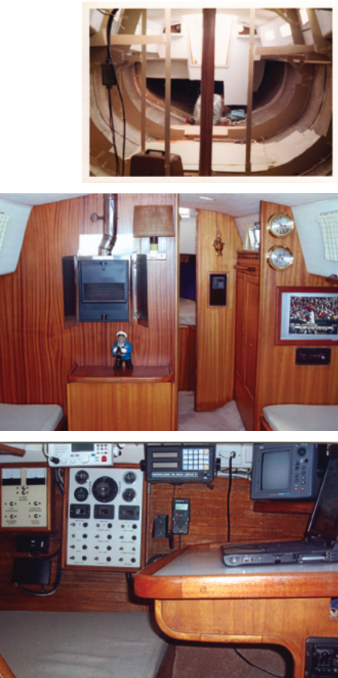
Although it was probably not necessary, Ed decided to add reinforcing ribs to the hull every 3 feet. He did this by gluing 3⁄4-inch garden hose inside the hull, vertically, 3 feet apart, and then encapsulating it with three layers of 24-ounce woven roving, creating fiberglass block-beams.
In looking back at some of his projects, Ed recalls, “I made a lot of mistakes, but nothing that was life-threatening or would have prevented me from sailing my boat.” Along the way, Ed kept meticulous financial records of everything he did.
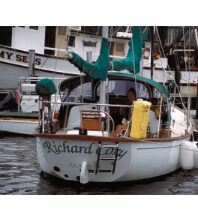
“It probably would have been cheaper if I’d purchased a finished boat,” he reflects, “but it wouldn’t have been exactly what I wanted.” Finally, with two rough bunks installed, and a working head and galley stove, he moved his boat, christened Serendipity, down the Delaware River, across Delaware Bay, and up the New Jersey coast to Atlantic City, where he took a berth at the State Marina.
Some of the projects that Ed tackled once Serendipity was in Atlantic City were to replace the Volvo, which was giving him a lot of trouble, with a Westerbeke. He also had to replace sections of the deck, due to water-intrusion in the balsa core. “Bedding compounds made 30 years ago were not as good as today’s,” he comments.
Specially designed
“Serendipity’s interior and many of her exterior modifications were designed specifically for my family,” Ed says. “When I look at other boats, I just don’t see these special comforts that we have on ours.”
Many years later, when the gelcoat was beginning to fade, Ed painted the topsides with dark blue Imron. Imron is DuPont’s trade name for its automotive polyurethane finish. It’s highly recommended for a boat’s topsides, but not for below the waterline. Also, it should never be waxed. After many years, Ed’s boat still looks as if it has just come out of the mold.
Along the way, Ed found time to go down to the Coast Guard Station in Baltimore and sit for his captain’s license, which, naturally, he passed.
Serendipity is still based in Atlantic City, but she is now in Delta Basin, a small, protected waterway off the larger Clam Creek Basin, where the State Marina, operated by Trump Associates, is located. This puts her minutes away from Atlantic City’s Absecon Inlet, the best inlet on the New Jersey coastline, and access to the Atlantic Ocean. These days, Pat loves to spend time with Ed on the boat — in the marina. When it comes time to sail, she prefers to spend the time on the Atlantic City Boardwalk or at the casinos.
Very competitive
Ed has ocean-raced Serendipity informally and finds that she is a very competitive racer, even with what he calls “an inexperienced crew.” And Serendipity has sailed south to the Chesapeake numerous times, with the longest trip being one to Norfolk, Virginia.
Would Ed tackle a boating project like this again?
“I would never consider selling this boat or building another one,” Ed says. “After all, this one is not finished and never will be. In addition, I couldn’t afford to build or buy another one.” He pauses a moment and concludes, “And lastly, my wife would kill me if I tried.”
Don Launer , a Good Old Boat contributing editor, has held a USCG captain’s license for more than 20 years. He built his two-masted schooner, Delphinus, from a bare hull and sails her on Barnegat Bay in New Jersey.
Thank you to Sailrite Enterprises, Inc., for providing free access to back issues of Good Old Boat through intellectual property rights. Sailrite.com