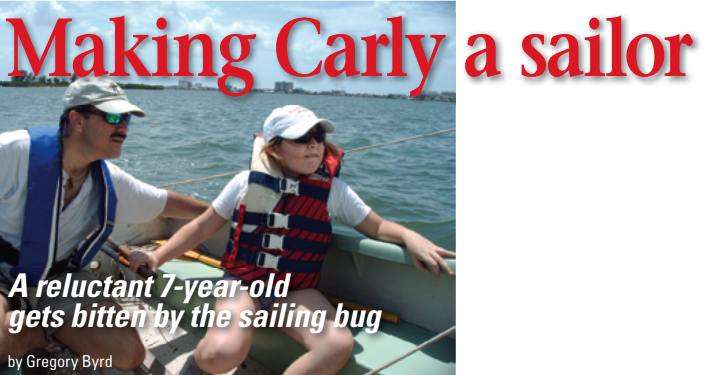
A reluctant 7-year-old gets bitten by the sailing bug
Issue 64 : Jan/Feb 2009
The second time my wife, Shawna, and I took our daughter, Carly, sailing on our Albacore dinghy, I figured someone would call the police. Her 7-year-old imagination had convinced her that the boat would capsize and that sharks would devour us all. My carefully reasoned argument that I had spent 40 years on the water and had never been eaten by a shark elicited neither a smile nor confidence. Of course, there was some reason for her having less-than-perfect confidence in me: on her first trip I had been paying so much attention to making sure she and her mom were happy that I didn’t anticipate a jibe, and the boom knocked me off the boat. But no sharks ate me that day.
While my wife understood that it was for Carly’s own good to spend some time sailing, my daughter came by her fear honestly. Shortly after Shawna and I were married, I bought a Mirror dinghy. I would load it and its spars on my pickup truck topper and drive to the beach near downtown St. Petersburg, Florida. The Mirror was just light enough that I could put it on my shoulders with my hands on the forward bulkhead and walk it down to the water. It was just heavy enough, after hours of sailing, that I stumbled back up the beach like a drunken college student coming home.
Perhaps due to being in love or due to our both being recent college graduates and broke (thus having little other entertainment), my wife happily climbed in the Mirror and handled the jibsheet, screaming as the little boat heeled over in a reach in Tampa Bay. The day we took Carly out, some 20 years later, Shawna whispered, “You’ll keep the boat from heeling over, won’t you?”
Calm enough air
I don’t know how we got Carly from the dock (where she was throwing one of her more energetic tantrums) into the boat, but once we were under sail in calm enough air, she settled down. The morning had been spent watching her firmly-set jaw as she growled “I HATE sailing!” But there is magic in sails. She had to admit early on that she enjoyed my friend Pete’s 30- foot Morgan. Now, though, she rested against the gunwale in the security of her life jacket while the boat moved across the smooth waters near Clearwater under a beautiful blue sky. We tacked, and she gripped the seat hard while the boom swung across and Shawna switched the jibsheet from one side to the other. No one went overboard. There were no sharks to be seen. She smiled a little. An hour later, I had her take the jibsheet. She felt the sail move on the other end. I had her trim the sail. We tacked and she switched from one sheet to the other. She smiled, this time right at me. She handled the jib for another half-hour, no longer worried about the shift of the hull as the wind picked up, but focusing instead on trimming the sail. She was helping to sail the boat and she knew it.
I had her hooked and now I would reel her in. I made some excuse to let her mother take the jibsheet again and cajoled her back to the tiller.
“Take this,” I told her. She looked at me like I had just told her there were penguins on her head. “Steer the boat.” She looked at me again. “We’ll do it together.” And she put her small hands on the tiller alongside my hands, which suddenly looked as large as my father’s ever had. I gave her a landmark and had her steer for it.
Sailing on her own
I recited a mantra for her “push left to go right, push right to go left,” wishing I knew whatever was the standard sailor’s rhyme for this. Soon she was sailing the boat on her own, over-correcting a bit now and then, but in control of the boat while Shawna and I handled the sails like good crew. I guided her to the marina where the breeze was coming right off the dock. With a little help, she steered us in and turned up beautifully into the wind, stalling the boat and luffing the sails as our rail kissed the dock. On the way home in the truck, she said, “This was the best day ever!” Shawna and I sighed.
But this is not all. Carly is 8-going-on-9 now and has sailed with me enough to have taken the tiller a few times. She is comfortable with the jibsheet, with the boat heeling over in a broad reach, and with the hum of the centerboard as the boat gets up on a plane. So I didn’t hesitate to sign us up for the “Lite” division of the Dunedin Cup last September. I know that the Albacore midwinter competitions are held in Sarasota, Florida, but our old Albacore, a 1974 Grampian model, is not in racing trim. The sails are probably 30 years old, she — Villanelle, named after a beautiful form of French poetry — still has her aluminum centerboard, and her rudder is delaminating. My sailing skills are in line with Villanelle’s shape. I sailed a Sunfish as a kid, my dad’s Catalina 22 in high school, and the Mirror dinghy after college. I understand old Phoenician technology well enough to make a boat go and to have some fun, but that’s it so far.
Blissfully unaware
Perhaps that’s a good thing when teaching a youngster to enjoy the sport. There are a dozen things about trim of which I’m blissfully unaware. Villanelle seems to be forgiving enough, even when Shawna and I capsized her on our first outing. She righted easily and we sailed her away, scuppers flowing out, Shawna bailing, her cork-soled shoe heading for Mexico.
So, after maybe four months of not having been out on the water, Carly and I launched our ragged boat for the Dunedin Cup and Kiwanis Regatta next to shining O’Day Daysailers, and paddled through the marina out to the racecourse. Our motley division consisted of two 22-footers and a 14-footer sailed by an older couple and their two granddaughters. We didn’t know enough to circle back and forth at the starting line, so by the time the final flag came down, we were 50 yards behind the 14-footer. As we crossed that invisible line, Carly’s Mickey Mouse cap flew off, landing on the green waves of St. Joseph Sound and drifting sadly away as my daughter cried.
“We get your hat,” I said, “and we lose the race.” She looked at me with her teary eyes. “I promise to buy you a new one after the race.” She nodded and we were off. We had gotten lucky. The 22s were stuck a couple hundred yards behind the start line and seemed to have a tough time coming about. I knew we could catch the little 14 on the running leg of the course where we could get up on plane and the Albacore would show her stuff.
I was wrong.
Perfect tacks
We’d get close, but the captain of the little 14 executed one perfect tack after another, while I put us in irons at least once as I navigated the new experience of sailing a racing course. By the second time around, we were a hundred yards back and knew we’d never catch him. This was fine. My goal all along had been to have a good time for Carly, to make sure we didn’t capsize, and for her to have fun. All of those things had been happening, save the missing hat, which she’d forgotten in the excitement. On the second and last leg of the race, the wind shifted so that it was necessary to make a tack to starboard and then come about port again to make it to the first buoy. I watched the 14 ahead of us as she came about beautifully … and then her mast came down.
“Carly! Look at that!”
“What?” she said. She had been scanning the water for dolphins.
“Their mast is down!” I thought first of the girls on the boat. One of them had been sitting forward. Of course, we couldn’t sail any faster and we would have to come about before we could get to them. By the time I steered close to them, the rescue boat had already arrived.
“Everyone OK?” I shouted.
“Yeah,” we’re all fine, the captain called back. I looked at Carly.
First place
“That means we’re in first place,” I said. She beamed. “We’re outta here — coming about!” I said. She snapped the jibsheet free of the cleat and hauled in the port sheet like an old pro. The 22s were being sailed well and had gained some ground. On our run, we increased our lead. I botched another tack near the final marker but when we crossed the finish line, the judge in the committee boat blew his air horn, gave us a thumbs-up and called out “See you at the trophy table.” I reached toward Carly and gave her a high-five.
“Did we win, Daddy?”
“I don’t know,” I said, honestly. The 22s had likely sailed a faster course but hadn’t reached the start line for a long time. I didn’t know what the rules were. I didn’t know if the race was handicapped. It was an informal race, after all. The serious races took place among the Daysailers, the Beach Cats, the Windlasses (women sailing Optiprams), and the big boats racing in the Gulf of Mexico.
After we hauled the boat out, we walked past the 14 and could see the base of the mast where it was torn and twisted. We learned later that a shroud fitting had failed. It would have beaten us easily. Sunburned, tired, and happy, we strapped down the boat, took her home, and put her to bed. Later, at the cookout, we ate among the real sailors and the sailboats at their moorings. We waited for all the other awards to be announced. Then came our division.
A happy judge
The judge, I think, was happy to see us come in first, because he realized the power an experience like that can have on a young mind.
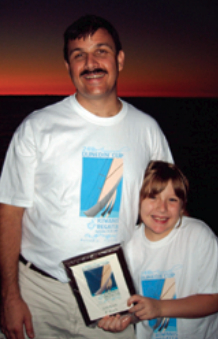
“In the Lite division, sailing in Villanelle, a 15-foot Albacore, Captain Carly Byrd with help from her dad, Greg, as crew!” I gave her a little shove and she bounced up to receive our plaque. We had our picture taken together and retreated to where we had been sitting, Carly with a strong hold on that little plaque.
“We got lucky today,” I told her. She nodded her head as if she understood. And we did get lucky, or rather, Carly did. I’d like to write this story 10 or 15 years from now and tell of her sailing Lasers for her college team or making bluewater crossings, but she sees herself as a sailor now and will, I think, forever. As we drove home that night, full of shrimp and beer (Sprite for Carly), she said in the dark of the truck’s cab as she fought the good sleep coming on from a day working hard in the sun, “Daddy, this was the best day ever.” And she meant it.
Gregory Byrd is a lifelong boater who sails his Albacore and refits a 21-foot Luger Westwind for more distant adventures. He teaches writing at St. Petersburg College in Clearwater, Florida.
Thank you to Sailrite Enterprises, Inc., for providing free access to back issues of Good Old Boat through intellectual property rights. Sailrite.com