Simple, sturdy props for those tricky jobs
Issue 67: July/Aug 2009
Because some of her previous owners had made a habit of not sealing holes they drilled in the deck, I replaced the plywood under the deck of my 1966 Coronado 25. I needed sturdy battens to push deck and new plywood into position and hold them in place while epoxy cured.
I was following instructions: “Brace in position with a batten until the adhesive cures.” Hah! Easier said than done inside a boat when many pieces need to be braced. Each batten has to be cut to the right length. Then, after a few uses, there will be plenty of sawdust and lots of short lengths of batten.
My local big-box lumber store did not have the 2 x 2-inch stock I wanted, so I ended up with 2 x 3-inch studs that I cut to length. These were very sturdy but, when I tried to use them for the second time, they were not the right length. My attempts to reuse too-long or too-short battens resulted in fallen props and iffy epoxy adhesion. To get the job done, I needed a seemingly infinite number of lengths.
While I usually do things the hard way, sometimes (rarely) a good idea pops into my head.
A ripping plan
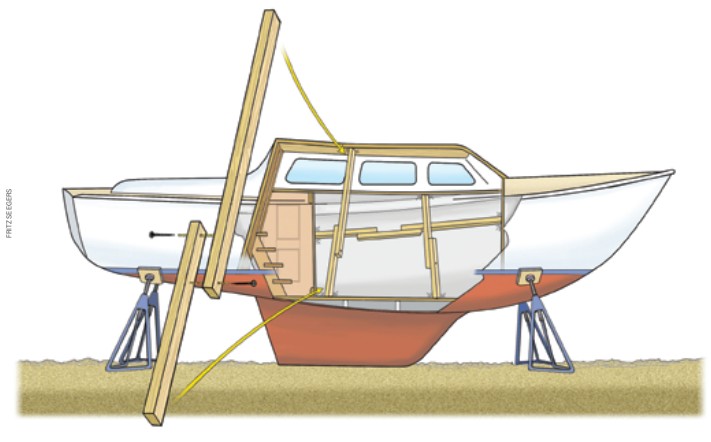
I used my table saw to rip the 2 x 3s in half along their length, making 2 x 1 1/2s. Using self-tapping screws to fasten two (sometimes three) pieces together, I could adjust the length as needed to fit the bracing space. By using only one screw for each piece of wood, I had a prop I could easily and quickly adjust.
The wood to use is governed by cost, availability, and the amount of flex you need or can tolerate for the task. Select an appropriate size and type of wood. A 2 x 3 stud of soft pine was adequate for my maximum lengths between 2 feet and 5 feet. These studs were strong for forcing plywood into place, there was little flex, and the screws didn’t split them easily. If you need less sturdy battens, you could probably use 1 x 1 trim stock for shorter lengths; I fear wood smaller than that may split too easily.
Select a sharp, self-tapping screw like a drywall screw. I prefer Phillips-head screws. The screw needs to be long enough to pass through one piece of wood and penetrate about half to three-quarters through the second piece of wood.
You should also have a reversing cordless drill with a drill bit slightly smaller than the screw-thread diameter. A Phillips-head screwdriver bit makes child’s play of assembly and adjustments.
It’s all in the overlap
Measure the longest length you need to span and add the overlap you think is appropriate given the batten material you’re using. Assume your maximum distance to span is 4 feet and that you need a 1 foot overlap. Any combination of wood pieces 5 feet or more in length can be used: a 3-foot piece and a 2-foot piece or two 3-foot pieces (just increase the overlap). Through one end of each piece, about an inch from the end, bore a hole that will be a snug fit for the screws; you want the screws to be able to give a bit when they’re tightened into the other piece of wood but not so loose that they will fall out. Tighter is better than too loose. The purpose of drilling the hole is to prevent the screw from splitting the wood.
Position two pieces of batten so the two ends with the screws will overlap and the screws can be run through both battens. Hold the two pieces together and extend them so the length is just right (you can use clamps while you’re doing the test fitting). Within a couple of tries, you’ll know what lengths you need for the job and how much to overlap them.
Screw the two pieces together, and your adjustable batten is ready to use. Wedge it into position to hold the work in place. To reuse the stud pieces, unscrew, reposition, swap for other lengths, and screw them back together for a new-length batten.
Now you know why I named my boat An Education — she taught me a lot.
John Cochran has sailed Chesapeake Bay from time to time over the past 20 years. Several years ago, the presenter at a pre-retirement seminar John attended, said, “Don’t forget your dreams.” John listened and is now looking forward to more sailing aboard his retirement project, a good old 1966 Coronado 25 that is in need of extensive renovation.
Thank you to Sailrite Enterprises, Inc., for providing free access to back issues of Good Old Boat through intellectual property rights. Sailrite.com