Up to 50,000 of these stalwart gasoline engines were built between 1948 and 1980
Issue 64 : Jan/Feb 2009
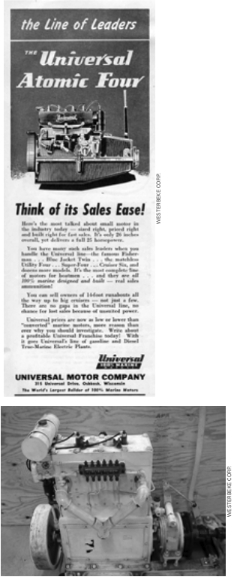
In 1948, the Universal Motor Company of Oshkosh, Wisconsin, introduced a new engine model that soon began to play an important role in the Canadian and American sailboat industry, a role that has continued right up to the present day. In recognition of the dawning nuclear age in which it was born, this engine was called the Atomic. Including the number of cylinders in the name of its engines was a Universal Motor Company tradition, and because the new engine had four cylinders, the full name of the new engine was the Atomic Four, with the Universal model code UJ. Today it is commonly referred to as the Atomic 4.
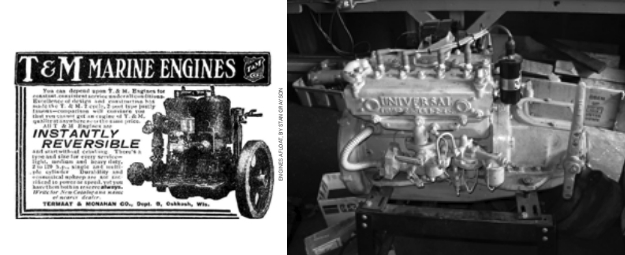
Like all Universal marine engines, the Atomic 4’s roots stretch back to the earliest Universal 4-cylinder marine engine — Universal Model C, first manufactured in 1915 — and even further back to 1898 and the very first engines built by the Fahrney, T&M (Termaat and Monahan), and Badger companies. These companies were the ancestors of the Universal Motor Company, which was formed by their incorporation in Oshkosh in 1913.
It’s a not a Jeep engine!
Despite persistent rumors to the contrary, the new Atomic 4 was not a modified Jeep or tractor engine. It was based on the earlier Universal Utility Four engine, which was very similar to the Atomic 4. In fact, one of the Universal Motor Company’s advertising slogans was “100% marine motors,” because all its engines were designed as marine engines, instead of being adapted from automobile or tractor engines.
The early military and civilian Jeep engine was a 4-cylinder, L-head design (also known as a flathead, with the valves in the block on the same side of the cylinder) like the Atomic 4, but it was twice the size of the Atomic 4 at 134 cubic inches and had three main bearings, whereas the Atomic 4 has just two.
In 1953 Jeep switched to an F-head engine (with exhaust valve in the block and intake valve in the head), which bears even less resemblance to the Atomic 4 than the original Jeep engine. Atomic 4 engines, small tractor engines, early Jeep engines, and many other types of small marine and industrial engines (such as Hercules and Continental) had similar 4-cylinder L-head designs. Because they used the same Prestolite distributors, starters, coils, and Zenith carburetors as the Atomic 4, they looked similar and were often assumed to be the same engine.
The immediate predecessor to the Atomic 4, the Utility Four, Universal Model BN, was introduced in 1933. It
was a 4-cylinder L-head engine with a capacity of 95 cubic inches, which developed 25 horsepower at 2,500 rpm. Unlike the Atomic 4, it was fitted with a Joes Gears integral reversing gear, not a Paragon. Joes Gears were manufactured by the Snow & Petrelli Manufacturing Company in New Haven, Connecticut.
The Utility Four was used extensively all over the world during World War II to power lifeboats for the ships, barges, and tankers of many navy and merchant marine fleets. It was available with an optional magneto ignition and a dual carburetion system that allowed it to run on gasoline or diesel fuel. To burn diesel, the engine was started on gasoline from a small engine-mounted tank and then switched to diesel when it warmed up. The hot exhaust system was used to pre-heat the diesel so it could be used as fuel.
Building the engine
The Atomic 4 was built at the Universal Motor Company factory in Oshkosh, in three main configurations: direct drive (UJ), reduction drive (UJR), and V-drive (UJVD). The Paragon reverse gears and reduction drives used on the Atomic 4 were built at the Paragon Gear Works factory in Taunton, Massachusetts, and the Walter V-drives fitted to the V-drive models were built by the Walter Machine Company in Jersey City, New Jersey.
Most Universal engine parts were cast in-house at the Universal Foundry, which was in a separate building near the factory in Oshkosh (the foundry was torn down in 2000; the factory is still there). Universal engine parts cast at the foundry were marked with the cast-in foundry mark UF (for Universal Foundry) as well as a cast-in model code and part mold number.
The Atomic 4 model code is UJ, and the Atomic 4 block mold number is 1, so Atomic 4 blocks are marked UF and UJ-1, cylinder heads are marked UF and UJ-2, oil pans are marked UF and UJ-4, and so on. Parts on early engines used the same casting numbers as later engines, even though in some cases the design of the parts was changed. For example, besides cylinder head and manifold redesign for newer engines, the belt pulley UJ-79, used on early engines with generators, was cast with thinner sheave sides than later pulleys intended for use with alternators.
Design changes
Many design changes were made to the Atomic 4 over the 32 years it was in production. However, there were three main variants. The early-model engine’s main distinguishing feature was a cylinder head without a thermostat housing and a “flip-top” oil filler cap on the side of the gear housing. These were built until around 1967 (up to serial number 79475). Early-model transition engines were identified by the oil filler cap in the gear inspection cover plate and were built around 1967 to 1969 (serial number 79476 to 170508). Late-model engines with an integral thermostat housing in the cylinder head (incorporating a modern full-flow bypass thermostat) and an oil filler cap in the front of the block were built from 1969 to 1980 (serial numbers higher than 170509).
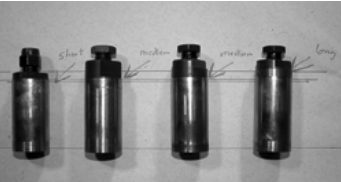
Other major changes to the engine during its production life included a switch from Prestolite (initially 6-volt and later 12-volt) to Delco Remy electrical components; a modified lubrication system and oil-pressure release valve; a better carburetor (Zenith 68); different water pump (Oberdorfer); upgraded valves, valve followers, and springs; revised flywheel housing and cover plate (the new plate was a flat piece of sheet metal instead of the earlier cast piece); and a revised oil viscosity specification (SAE 30 for hot weather or SAE 10-30 for multigrade/year-round use).
Universal also issued several bulletins, including a modification to the oil-pressure release valve to stop fluctuating oil pressure, a modification to the thermostat housing to help cure overheating in hot weather, and a revised fastener torque specification for connecting rod nuts from 33 to 25 foot-pounds.
A lower-power version of the Atomic 4, the Stevedore, was produced for several years starting around 1974. The Stevedore model designation added an S to the Atomic 4 model, (model UJS for direct drive, model UJSR for reduction drive, and model UJSVD for V drive). The Stevedore was built to comply with lower Canadian federal import duties on engines with less than 20 horsepower, because truckloads of Atomic 4 engines were being shipped north from Oshkosh into southern Ontario and fitted in sailboats built in the busy Canadian sailboat manufacturing industry centered there (C&C, Grampian, Hinterhoeller, Alberg, Hughes, Northstar, Bayfield, and others), which was shipping most of the boats they built back to customers in the U.S. (all this before the introduction of the North American Free Trade Agreement).
In 1978, changes to U.S. and Canadian Coast Guard regulations made it necessary for Universal to replace the AC Delco mechanical fuel pump used on all engines built since 1948; they switched to a Facet electric fuel pump with an oil-pressure safety switch.
The previously unused automotive ballast resistor bypass R-terminal on the Delco starter solenoid was incorporated in the system as an oil-pressure safety switch bypass to allow the electric pump to supply fuel while starting the engine before it had built up enough oil pressure (10 psi) to activate the oil-pressure safety switch.
Over the years, Universal also increased the optional equipment available for the Atomic 4 directly from the factory: a bypass oil filter (made by Fram); adjustable rubber engine mounts (made by Bushings Unlimited); high-capacity alternators (made by both Motorola and Leece-Neville); different control panels (some made by Teleflex); and freshwater cooling (made by Sendure).
Even after the engine had been out of production for 15 years, Westerbeke (which later acquired Universal) introduced minor design changes in the form of a new-style graphite head gasket (only one gasket is required as long as compression is under 125 psi), and an optional 180°F thermostat that raises engine operating temperature for longer life and lower fuel consumption designed to be used in freshwater-cooled engines only. Sales of the Atomic 4 grew strongly as the recreational sailboat market expanded.
The end of production
In 1961, the Universal Motor Company was sold to the J. M. Nash Company of Milwaukee, which became Medalist Industries in 1967. Thus, Universal changed its name to Medalist Universal Motors. This new shift in ownership changed the Atomic 4 model designations several years later. The UJ became the 5101; the UJR, the 5102; and the UJVD, the 5103. In the 1970s, Universal also manufactured a single-cylinder engine called the Atomic One and a twin called the Atomic Two, but neither had the level of sales of the Atomic 4 and they are not well known.
At the end of the 1970s, sailboat manufacturers increasingly began to switch from gas to diesel engines, and sales of the Atomic 4 tapered off. Production was stopped in 1980. The price of an Atomic 4 at that time was $2,324. Freshwater cooling was a $398 option.
By 1974, Universal had already begun importing Kubota diesel engines from Japan and adapting them for marine use, so the company was ready for the sailboat market shift to diesels. The company’s early Universal diesels were named Atomic to take advantage of the reputation of the Atomic 4.
Catalina, the largest U.S. sailboat manufacturer for many years, fitted Atomic 4 engines to most of its smaller boats until around 1985 (the engines fitted between 1980 and 1985 were produced in 1979 and 1980 and stored until they were sold), when they switched to Universal diesels.
Parts still available
Westerbeke dealers continue to sell new Universal marine diesels and parts for the Atomic 4. But Atomic 4 blocks, oil pans, valve lifters, and crankshafts, as well as several transmission components, such as Paragon gear throw-out bearing assemblies, are not available. However, most common rebuild and repair parts still can be obtained, including cylinder heads, pistons, thermostats, gaskets, and manifolds.
Many people have wondered if it would be feasible for Westerbeke to begin building brand-new Universal Atomic 4 engines. Many engine shops have approached foundries to evaluate the feasibility of manufacturing new blocks, only to discover that, although it is possible to cast new blocks at a fairly reasonable price, the cost of custom machining each casting to create a viable engine is prohibitive.
This is due to the lack of the original Universal factory tooling and production line. If Westerbeke did begin building a 21st-century Atomic 4, it would require many design changes to bring the engine up to date. The most important design decision would be the fuel the new engine would use.
Nevertheless, even without a new design, the legacy of the Atomic 4 is assured. Like the little engine that could, thousands keep chugging in classic sailboats around the world.
Robert Hess is a licensed marine mechanic at Eastern Marine Systems, a Volvo Penta dealer in Toronto, Ontario. Before joining Eastern Marine, he was a Westerbeke/Universal marine engine dealer in Vancouver, British Columbia. He and his wife, Laura, sail Water Lily, a 1979 Hughes 38, which they repowered with a new Universal M35B diesel to replace the original Atomic 4 UJR.
Thank you to Sailrite Enterprises, Inc., for providing free access to back issues of Good Old Boat through intellectual property rights. Sailrite.com