How to get aid when you really need it
Issue 64 : Jan/Feb 2009
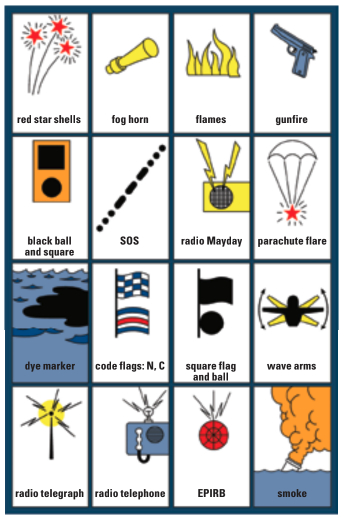
There are many ways a sailor can signal for help: body movements, sound signals, pyrotechnics, terrestrial radio, and via the search-and-rescue satellite radio system.
Visual signals
Visual signals for help may be as simple as slowly and repeatedly raising and lowering your outstretched arms. This is an officially recognized call for help. No extra equipment is needed. This can be effective any time another vessel is nearby.
The display of an orange flag with a black ball and square also indicates a call for help. The black ball may be either above or below the black square. This type of flag is included in many emergency flare kits.
Another visual method is by signaling the Morse code “SOS” with a flashlight or searchlight (three short, three long, and three short).
Pyrotechnics is the visual method sailors usually think of first. Red flares can be either hand-held or rocket-propelled. For daytime, a hand-held smoke flare — one that emits large clouds of orange smoke — is very effective at alerting other boats that are too far away to see hand signals and flags, even those just over the horizon. At night, use hand-held flares or rocket-propelled flares.
Rocket-propelled flares may be either the meteor- or parachute-types, with the parachute flare visible longer than the meteor. If you’re sure that there are other boats nearby, launch two flares about 30 seconds apart. Very often those on the other boat will think they may have seen the first flare. Launch the second flare while the people aboard the rescue boat are alert and looking for it.
Dye markers may also be used but are usually not in the inventory of most recreational vessels.
A white strobe light, flashing at 50 to 70 times per minute, may also be used on inland waters.
Searchlights can be used, provided the searchlight doesn’t blind those on another vessel.
Using a signaling mirror to flash sunlight at a specific boat or plane is another method, but it’s best to practice this technique before an emergency arises.
Audible signals
Two types of horn signals are recognized. The fi rst is a very long, extended blast of the horn; the second is blowing an SOS — three short, three long, and three short blasts.
Repeatedly firing a gun or producing other types of explosive signals about one minute apart is also recognized as a request for aid but is not often used by recreational sailors.
Terrestrial radio signals
When sailing coastal or intracoastal waters, your primary means of sending out a distress signal should be the VHF radio. This signal can be heard by other boats in your vicinity as well as by the Coast Guard. It’s important to learn the procedure for sending out a Mayday distress signal on VHF Channel 16, as well as how and when to use pan-pan and securité signals, even though these aren’t distress signals.
If you have upgraded your VHF with Digital Selective Calling (DSC), the DSC distress signals can be transmitted with the press of a button. In association with an integral or remote GPS, this distress signal will also include your position.
Cell phones should not be your primary way of securing help because, when well offshore, contact with a cell tower may be unreliable. In addition, most cell phones are not water-resistant and 911 operators are not trained to handle emergencies at sea. Furthermore, unlike a VHF radio that can be heard by nearby boats as well as by the Coast Guard, the cell phone provides only person-to-person contact.
For boats well offshore, where VHF is out of range and there are no other boats nearby, radio distress calls can be made using single-sideband radios or the amateur (ham) band.
Satellite search and rescue
The search-and-rescue satellite (SARSAT) system is composed of geostationary (GEOSAR) satellites orbiting about 22,300 miles above the Earth, and low-earth-orbit satellites (LEOSAR), which orbit 528 miles above the Earth, with an orbit every 100 minutes.
GEOSAR satellites are capable of viewing large areas of the Earth and are able to provide an immediate alert for and identification of an activated 406-MHz emergency position-indicating radio beacon (EPIRB). They are, however, unable to determine the location of that beacon, unless the beacon is transmitting GPS coordinates. An EPIRB with an integral GPS is sometimes referred to as GPIRB. If no GPS coordinates are associated with the emergency beacon, then the LEOSAR satellites must determine the beacon’s location using the Doppler technique.
This Doppler-location process of the LEOSAR polar-orbiting satellites may take two or more 100-minute orbits to complete, and this time could be further extended if the LEOSAR satellite is not in view of a ground station.
Thus, a GPIRB that transmits a vessel’s location is of great value. That’s because it avoids the relatively long time involved in using the Doppler-location process of the LEOSAR satellites. (For more on this subject, see “EPIRBs, PLB, and SARTs 101” in the January 2008 issue).
In the absence of any of the above methods of signaling, the U.S. Coast Guard allows any vessel to make any light or sound signals that cannot be mistaken for any other signal.
Don Launer, a Good Old Boat contributing editor, has held a USCG captain’s license for more than 20 years. He built his two-masted schooner, Delphinus, from a bare hull and sails her on Barnegat Bay in New Jersey.
Thank you to Sailrite Enterprises, Inc., for providing free access to back issues of Good Old Boat through intellectual property rights. Sailrite.com