Two sailors were called to a Higher Porpoise
Issue 64 : Jan/Feb 2009
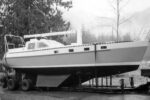
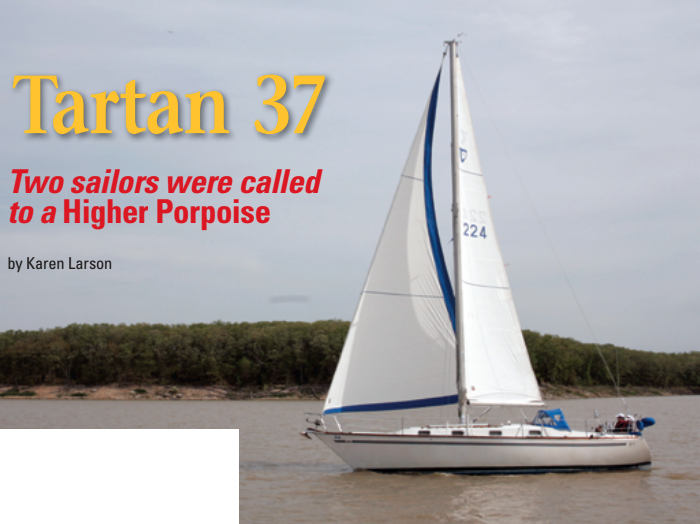
On any given weekend — rain or shine — there’s going to be a party among the sailors on Missouri’s Mark Twain Lake. We’d never heard of Mark Twain Lake or the town nearby, where Samuel Clemens was born, but we were in for a treat when we decided to feature the 1979 Tartan 37 owned by Tom and Sandy Wells. Higher Porpoise, the fin-keel version of the 37, is sailed with great enthusiasm and skill on this reservoir in northeast Missouri.
We first met Tom and Sandy in Annapolis at the Good Old Boat Regatta and were impressed by their many talents and inherent joie de vivre. Sandy absolutely sparkles with enthusiasm and Tom is a mountain of a man surrounded by a halo of creative energy. Wanting to know more about these interesting sailors and their sailboat drew us south to Missouri to greet the spring and an eclectic mix of very high-spirited sailors . . . high-spirited in every way. We’ve never met a group of sailors who can put away a bottle of rum (and whatever else is available) with greater aplomb.
Spring was delayed that weekend. Once the rain came in buckets, the wind blew in the 20- to 30-knot range, and all the boats were accounted for and secured at the docks, an excellent mixture called a Dark ’n Stormy kicked off the weekend’s revelries, most of which occurred in the spacious cabin of Higher Porpoise.
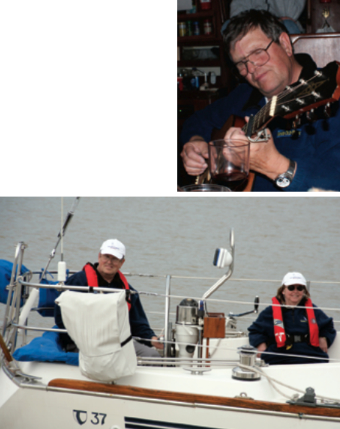
Tom is an engineer who has an aptitude for music. He is able to dream up the words and music to a song for almost any occasion. We were enchanted several years ago when Tom introduced the Good Old Boat song at the Annapolis regatta. That caught our attention; this magazine had never had its own song before.
Sandy was trained as a mathematician. She took a temporary job managing the deli of a grocery store and has stayed there for more than two decades. But she discovered a creative skill later in life when she began building museum-quality model ships, first from kits and then entirely from scratch. These days, the construction of an intricate ship’s model, such as the Pride of Baltimore, will take her about a year to complete in elaborate detail.
Tom’s fault
Tom claims responsibility for the sailing hobby he and Sandy share. He discovered sailing after they were married when he attended an annual picnic with co-workers, a group of young engineers. There was a Hobie 16 at the picnic and Tom and another newbie gave it a whirl. “My companion became frustrated handling the Hobie,” Tom recalls, “and finally handed it over to me. From the moment I took the helm and felt the power in the sails, I was hooked! By the end of the afternoon I was flying hulls. When we came ashore, one of the sailors there said, ‘I thought you hadn’t sailed before.’ When I assured him that I hadn’t, he said, ‘Well, you had better from now on!’”
Willing accomplice
While Tom may have been responsible, Sandy was a willing accomplice. Tom tells the rest of the story: “I went home to Sandy that evening and walked in the door with glazed eyes and a slack jaw. I may have been drooling. I think I mumbled something like, ‘I’m in love.’ She just smiled and asked, ‘What are we going to buy now?’
“I said, ‘How about a sailboat?’ To my everlasting wonder and joy, she said, ‘Sure! Sounds like fun.’”
Since the couple already had two small children when they discovered this thing we call sailing, they agreed that something more stable than a Hobie 16 was in order. They found a neglected Luger Leeward 16 for $1,000 and towed it home for some necessary TLC. The initials of their first names, along with those of their two children, gave them a name for this boat. The names Sandy, Karen, Andy, and Tom created Skat.
Tom tells the story of their first sail: “It was a rather blustery day. We took her to a lake and rigged and launched her. At last it was time to raise the sails. We did so and promptly sailed sideways into the weeds. Lesson number one: lower the centerboard.
“That day Skat taught us what to do and what not to do, and we began a long love affair with her. Sandy added a weather cover for trailering, and we would put our camping gear in the boat and head out each weekend. We sailed numerous lakes throughout Michigan and ventured into the Great Lakes whenever the conditions were right. Sandy and I knew we had found a lifelong passion. We committed ourselves to learning to sail in any and all conditions, reasoning that someday we might have to sail in them.
“We took care of Skat, and she took care of us, and our skills grew. When we moved to Missouri in 1981, Skat came with us.”
Growing family
A few years later they looked around and realized that they had a couple of growing adolescents, soon to be teenagers. No wonder that 16-footer had begun to feel so small. Truly a good investment, they sold Skat for $1,400. The next boat was a new 1986 MacGregor 25.
“A friend made the suggestion that named our new boat,” Tom recalls. “We had mentioned to him that we were thinking of naming her Porpoise, and he asked, ‘Did you get into sailing accidentally or on purpose . . . or should that be on porpoise?’ On Porpoise! It seemed to fit, and she had her name.
“On Porpoise proved to be a wonderful boat. She was a Chevy to be sure, but we learned to sail her fast and well. She won a great many races and took us far and wide. She introduced us to Lake Superior’s Apostle Islands, where she spent nearly five months during the 11 years we owned her.”
During this time, the family also chartered in other more far-flung sailing areas and began to expand their big-water experience while the kernel of a dream took root. Tom and Sandy began to plan for retirement aboard a cruising boat in the 35- to 40-foot range. Tartan 37s made the short list of suitable boats, and they began that casual boat-buying dance that deludes only the potential boat buyers, who claim they’re “not really looking.”
“Memorial Day weekend of 1997 found us traveling to Michigan for a family event. We decided to take the Friday off as well and hop around boatyards in Chicago and along Michigan’s west coast. We were not seriously seeking a boat at all,” Tom recalls. “We were only looking at them to fine-tune our list.”
Not ready yet
One of the Tartan 37s at Larsen Marine in Waukegan, Illinois, had just arrived on a truck from New Orleans after years in the Caribbean. It was not ready to show yet, but Tom and Sandy insisted, even though the boat had yet to be cleaned up and rigged.
“The broker took us to the farthest shed on the Larsen grounds and opened the doors,” Tom says. “There she sat on her cradle — a Tartan 37 with the fin keel we preferred. Her hull looked to be in fairly good condition. The broker provided us with a ladder and a flashlight, and we boarded her for the first time.
“She was a mess. Her deck was dirty. Her exterior teak was weathered and gray. Down below, she was full ofpulpits, stanchions, and all manner of equipment removed for travel. Her interior teak was almost black. Her upholstery was worn and, in some cases, in tatters. I removed the companionway ladder and cover to look at the diesel, which did not appear to be too bad. I turned and walked forward. With each step in this bedraggled, dirty, and jumbled boat, I found an overwhelming feeling growing within: I was home.”
As they drove north along Lake Michigan’s east coast, that feeling gnawed at Tom for several hours before he asked Sandy about her impression of that final Tartan they’d seen. In an effort not to influence her decision, he hadn’t yet told her of his feelings.
“Someplace north of Saugatuck, Michigan, I finally turned to Sandy and began to say, ‘When we were on that last Tartan 37, did you . . .’ That’s as much as I got out when she finished the sentence: ‘Yes! I felt like I was home.’ Oh boy. We were in trouble now.”
Life has a way of working out. They both agree that things that were totally improbable began to pop into place as though they were pre-ordained.
“Marina space that was non-existent was suddenly available,” Tom says. “Where we were not financially able to think about such a purchase, we sud- denly were. We were supposed to have this boat, and by mid-June we had an offer, counter offer, and acceptance. By July, the survey was complete and we closed the sale. By August 1997, she was in the water in our slip at Mark Twain Lake. There was no question as to what name she would bear. When we first began to think about a retirement boat, we decided that, since our 25-footer was named On Porpoise, any move up would mean we had been called to a Higher Porpoise.” The dinghy, which is used to transport the ship’s dog, Boomer, to shore, is aptly named Higher Puppus.
Fine collaboration
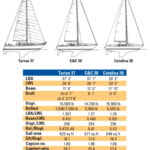
The Tartan 37 is the result of a fine collaboration between the Tartan Marine Company and the renowned design firm of Sparkman & Stephens. In 1975, Charlie Britton, owner of the Tartan Marine Company, wrote a letter to Sparkman & Stephens to share his ideas for a new 37-foot cruising boat. Meetings, discussions, and exchanges of ideas quickly followed, and before long the design was taking form. The boat would be a departure from the more classic lines of earlier boats and, by the time the design was ready for production, it featured a new and unmistakable look that is still reflected in current Tartan designs.
The Tartan 37 was produced with a shoal keel and centerboard. A more race-friendly fin-keel model was also available and was initially produced as the Tartan 38, although the boats were otherwise identical. After a time, the Tartan 38 designation was dropped and all models were produced as the Tartan 37.
From the mid-1970s to the late 1980s, 486 of these boats were produced. The majority of the boats have the shoal keel and centerboard; fewer than 10 percent have the fin keel. A few of the last Tartan 37s built were fitted with a Scheel keel.
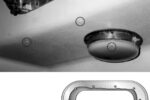
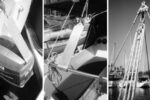
By the time Higher Porpoise came into the lives of Tom and Sandy Wells more than 10 years ago, she was already 18 years old and had spent at least some of that time in salt water. There was work to be done. Under her newest owners’ care, she has been fitted with new sails and rigging. She has new Andersen primary winches and a Garhauer rigid vang. She has a new anchor windlass. Recently, she received new stainless-steel opening ports and a forward hatch. Her exterior teak has been stripped, cleaned, and refinished with Bristol Finish.
Tom has spent many hours reworking the old Westerbeke 50. He says a replacement diesel is an eventuality, but the original power plant continues to function dependably as long as it is maintained and coddled adequately.
Higher Porpoise has been almost entirely rewired. She has new instrumentation and all-new interior light fittings. The galley stove and refrigeration system have been replaced. Sandy has made new upholstery for her and has also sewn all the canvas aboard including the dodger, Bimini, and covers for the helm and mainsail.
A revelation
Sandy also took on the maintenance of the interior teak. She and Tom gleefully remember the day that she first learned what was beneath all that black mildew.
Tom was working to clean the exterior of the boat on that first day at Mark Twain Lake when Sandy shouted from below, “Come here, QUICK!” When one hears that aboard a boat, drastic leakage comes to mind, so Tom dived below in a big hurry. Sandy motioned toward the V-berth, which she had started cleaning with Murphy’s Oil Soap. The cleaning had revealed a beautiful teak surface. As Sandy puts it, “Perhaps the dirt protected it through the years.”
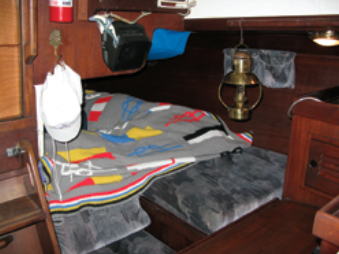
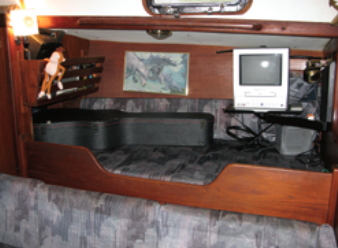
A 1970s-era 37-footer has just enough space for two, with the temporary addition of friends or family. The V-berth has enough headroom for occupants to sit up and maneuver about and enough foot room that they need not play footsie all night. There is stowage below. The main cabin offers port and starboard settees and a pilot berth above the starboard settee. Tom’s ever-present guitar has claimed the pilot berth as its own.
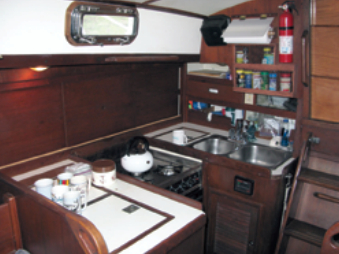
A drop-down table and L-shaped settee to port, and the handy liquor cabinet just outboard of that, make this the go-to boat when the weather gets nasty outside and the crowds gather inside. There is a wide quarter berth to port that provides the seating platform for the nav station. To starboard is a very adequate C-shaped galley in which Tom is the master of heroic breakfasts and Sandy creates the rest of the day’s fare.
Throughout the boat, the interior teak is deep and rich, and little modifications catch the eye — the sort of modifications that come of living on and slowly adapting a boat to your personal requirements. Netting on the spice cabinet in the galley and a swing-out instrument panel are examples of the thoughtful touches that have been added over the years.
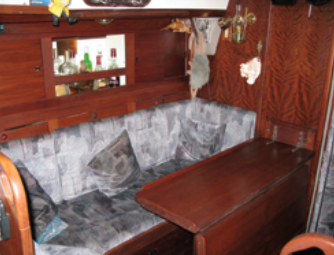
The cabin is filled with sailing books, both serious and whimsical, and oodles of toys. Tom and Sandy are surrounded by friends who like to commemorate special occasions with small stuffed critters and porpoises of all types. It goes without saying that if your boat is named Higher Porpoise, you will have a growing collection of porpoise mementos.
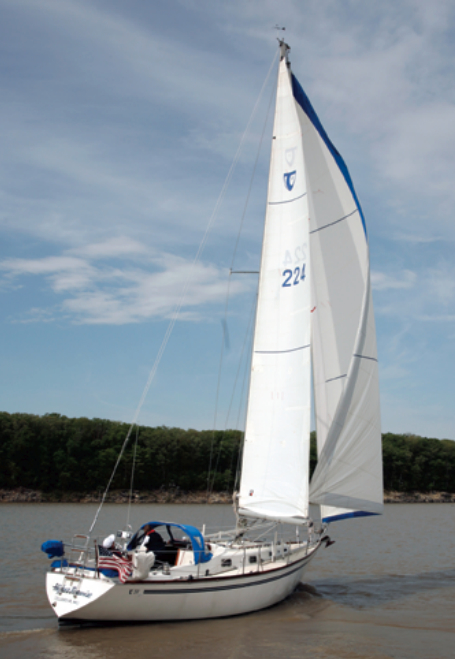
We sailed with Tom and Sandy on a day blustery enough to snatch your cap if you weren’t paying attention. We learned much about sailing on a man-made lake that depends on a dam for its water level and has inlets to funnel winds in somewhat predictable patterns if you have the local knowledge. Jerry’s comments on the sailing experience follow.
How Jerry saw it
“After the photo shoot for this article, Karen and I transferred to Higher Porpoise from Wild Goose, Liz and Jeff Fleenor’s O’Day 322, which had served as the shooting platform. We continued sailing in conditions that were building as predicted. In a reservoir, wind always comes off the land, and wind blowing off the land is normally shifty and gusty. I was invited to steer for a couple of hours in these conditions while Tom and Sandy trimmed the sails.
“The Tartan 37 feels heavy and fairly stiff, but was certainly not immune to the sharp gusts that probably dou-
bled the wind speed and changed the wind direction 30 or 40 degrees with each cat’s-paw. When even the ‘lulls’ put the rail in the water, Tom rolled in some of the genoa to put the boat back on her feet. My impression was that she would take rough going in her stride, giving a better ride than smaller or beamier craft. The long waterline provided good speed. The masthead rig was powerful but did not overpower Tom and Sandy, which made it a good choice for them.
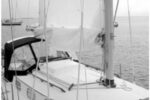
“The roller furler allowed them to make quick adjustments in response to conditions. The main had mid-boom sheeting to a traveler located forward of the dodger, and the mainsheet came into the cockpit under the dodger where it was out of reach of the helmsman.
“This is a common arrangement on larger boats. It takes clutter out of the cockpit and can be strong enough if the boom was designed for mid-boom sheeting to begin with. The dinghy sailor in me, however, cringes at the idea of having the mainsheet out of reach of the helmsman and, unless extensive use is made of the Autohelm, this is not an arrangement that is easy to work short- and singlehanded.
“If you are the helmsman on that boat, you just steer while other crew-members work the sheets. To Higher Porpoise’s credit, she took the gusts with good grace by just steering up; to Tom and Sandy’s credit, they never showed any concern about the boat or helmsman. That led me to conclude that things were within the normal envelope.
“If Karen and I had been alone on our own boat in these conditions, one of us would have had a hand on the mainsheet all the time or we would have shortened sail even more.”
New horizons
Tom summed up his feelings for sailing and the boat they have selected: “As we look back over the years, we are so very thankful that we got into sailing together, learned together, and will continue to sail aboard Higher Porpoise together as long as we are able. Our Tartan 37 will eventually find her way back to the Great Lakes and then outward and beyond. Our retirement will find Higher Porpoise taking us to those new horizons.”
Karen Larson didn’t become passionate about sailing until she met Jerry Powlas. They bought a C&C 30 soon after they were married and (within the limits of a sailboat and short vacations) have been sailing farther and farther afield ever since. They hope to increase their potential range with Sunflower, a trailerable C&C Mega 30, the infamous “project boat.”
Thank you to Sailrite Enterprises, Inc., for providing free access to back issues of Good Old Boat through intellectual property rights. Sailrite.com