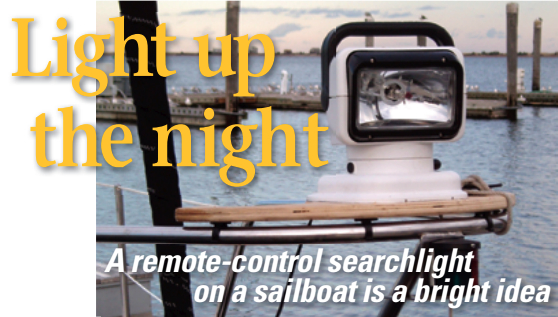
A remote-control searchlight on a sailboat is a bright idea
Issue 65 : Mar/Apr 2009
While preparing my Caliber 28 for a recent solo sail up the East Coast, I was in search of an affordable searchlight I could control from the cockpit. I thought I might have to navigate or enter harbors at night. The thought terrified me, but I knew it might happen and I wanted to be prepared. The challenge was finding the right light and figuring out where to mount it.
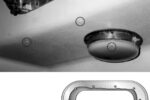
First, I found an innovative search-light company called GoLight. It makes a wide variety of remote-controlled searchlights with several mounting options designed for marine, military, and commercial applications. The RadioRays, with 400,000 candlepower at 5.5 amps, are weatherproof and come in white or black ABS for $200 plus. The newer Strykers have a brighter bulb, are nearly waterproof for more rigorous sea duty, and are also available in chrome for $300 plus.
With my prep fund running low, I wanted the least expensive solution that would still serve my needs, so I sought advice from GoLight. They were honest and helpful. After discussing my needs with them, I concluded the RadioRay 7900 with a suction-mounted base, a separate mounting shoe, and hand-held remote control would be a good choice. It turned out to be a great choice.
Mounting matters
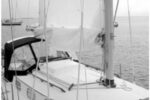
Challenge two was where and how to mount it. Unlike those on powerboats, foredecks on sailboats don’t lend themselves to permanently mounting a searchlight. Any fixture placed near the stem could interfere with anchoring, docking, or sail-handling. The beam had to be able to illuminate to port, starboard, and straight ahead without being blocked by shrouds, stays, or spars. And, as my boat mostly lives on a mooring, the beam also had to clear my anchor platform and illuminate the mooring pendant immediately in front of the boat. For me, the best location to mount the light was on top of the pulpit, but since that would put it in the way some of the time, it had to be temporary. The light, therefore, had to be easy to detach.
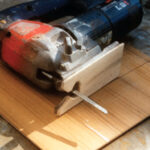
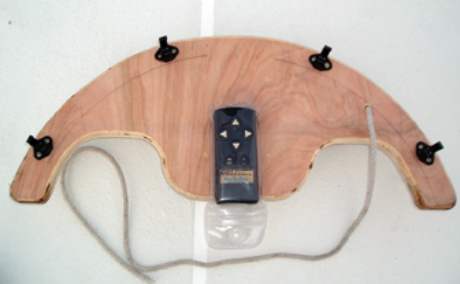
For the platform, I fabricated a boomerang of 3/4 -inch marine plywood on which I attached the mounting base for the GoLight. By attaching four black-plastic 1-inch spring clips on its underside, I was able to clip the boomerang to the pulpit’s 1-inch stainless-steel tubing. I rounded-over all the plywood edges for handling and to minimize snagging lines or sails. The GoLight slides and locks into the base. It is just as easily removed.
For my Caliber, a single piece of plywood suited my flatter pulpit. For older Bristols, Pearsons, and other boats with a curved rail, it might be necessary to fabricate an L-shaped platform that would clip to the top and to the front or side rails. I think three clips are a minimum and four or five are best.
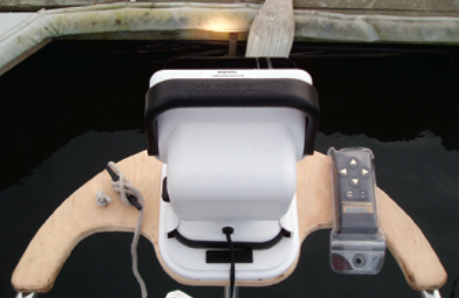
A careful tracing
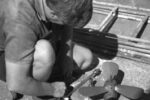
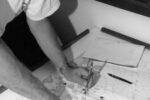
To position the clips, I laid the plywood atop my pulpit and traced a line underneath the front and back of the bow pulpit. While doing this, I held the plywood in place with spring clamps. Because a misaligned clip could prevent the other clips from clamping onto the bow pulpit, I was careful to trace the best line I could. I initially attached each of the clips using one screw only. This allowed them to swivel a bit as I worked to achieve the best possible alignment. Not until I was pleased with the fit did I add the second screw.
I first made the platform for my light in a semicircular shape, but I found it hard to hold when carrying it on deck, so I reshaped it in the form of a boomerang. I later added a just-in-case lanyard that wraps around the bow rail and comes back to a small cleat on top. It occurred to me that if a flailing sail (or arm) happened to dislodge the searchlight base from the rail at just the wrong moment, I could lose my light source at a critical time. Worse, if the light plunged into the sea, it could short the circuit or ruin the light.
For power, I installed a 12-volt cigarette lighter socket in the forward cabin, and led the 15-foot power cord down through the forehatch. To avoid crimping or degrading the heavy-gauge cord in a closed hatch frame, I added heat-shrink tubing for chafe resistance. It’s important to check your hatch frame to locate the softest entry points.
Lighting the way
I usually snap the boomerang in place first, without the light, and cleat the lanyard. Then I open the forehatch, retrieve the GoLight from a V-berth shelf, and slide the light into place. Though I’m always clipped on to the jacklines, I wanted to be able to complete both steps using just one hand.
Using the hand-held remote from the helm, I can horizontally swivel the searchlight 370 degrees and from as close as 8 feet in front of the boat to as high as the masthead. I can use my searchlight like a headlight, lighting my path down a channel. I can illuminate my sails, the better to be seen by bigger ships at night or to light up the foredeck when needed. Also, because the furler and mast block the beam from shining aft, it’s not likely that I’ll be blinded by the light at the helm.
A neat feature on the remote allows me to adjust the sweep rate, or how quickly the light swivels. I prefer a slower sweep rate so I can scan port-to-starboard for the reflective strips on mooring balls and on nuns and cans.
An extra benefit is that I can use my GoLight year-round. My 7900 has a suction-mounted base, to allow temporary mounting to a car, truck, or trailer roof for nighttime trailer loading, tire-changing, or camping. A magnetic mount is also available for use when a vehicle is moving.
Frederick Corey, a furnituremaker, sails New England in fixed-up GOBs and dreams of following his role models, Fatty Goodlander, Fritz Seyfarth, and Herb Payson.
Thank you to Sailrite Enterprises, Inc., for providing free access to back issues of Good Old Boat through intellectual property rights. Sailrite.com