A singular affair with a Pacific Seacraft 25
Issue 65 : Mar/Apr 2009
There’s just no way to explain how a beautiful boat can capture its owner’s heart. You’d think that out in cyberspace there would be some searchable scientific insight on this topic: a clinical trial or two with sensors, gauges, control groups, and placebos. But no; it remains a mystery. All you’ll find when you Google the words “romance” and “sea” together are YouTube re-runs of The Love Boat and some ads for sterling-silver flatware. A definitive explanation for the romance of the sea and the love of boats that sail upon it remains elusive and ephemeral . . . as maybe it should. Steve Duncan certainly thinks it should.
Steve started sailing at age 14 in Puget Sound on his father’s Newport 27. He bought his first boat in 1988, a Sierra 26 named Vela, and spent a lot of time cruising “the islands,” as locals call the beautiful San Juans. He owned Vela until 1997, when, at the urging of a spouse who had the antibody to the sailing bug that had chomped Steve, he sold her. Boatless in Seattle, with all that gorgeous coastline, he turned to the solace that so many desperate men choose: sailing magazines.
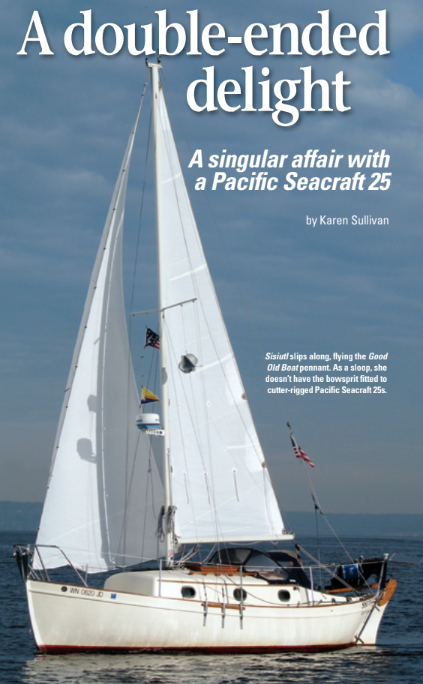
It was a long dry spell until one day in March 2004, when he picked up a copy of Good Old Boat at his dad’s house. There she was . . . the cover girl. A lovely Pacific Seacraft 25. He gazed at her sweet lines, contemplated that saucy sheer, and, oh my goodness, that rudder made his heart beat fast. But she was a model in a magazine and he was just a beached sailor.
Soon after that, he told his spouse he wanted to buy another boat. He’d find one she liked too. She didn’t say no, so he listed the three important factors that would lead him to his next boat. These requirements were hard and fast, immutable as the pyramids: the boat absolutely must have standing headroom (Steve is 6 feet 2 inches), it must have wheel steering, and it must have an inboard diesel engine.
He drove to Anacortes to see a steel 32-footer that incorporated all three features on the list, but it left him flat. Something was missing. The yacht broker, a wily observer of human nature, suggested that Steve take a walk down the dock to see another boat. “I know it’s not what you want,” said the broker, “but why not just have a look?”
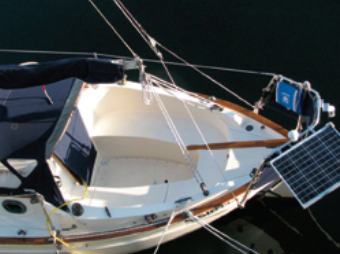
So he did. And there she was . . . the cover girl. Talk about the ship that launched a thousand smiles. “Her lines just caught me,” says Steve. “That sheer, that double-ended beautiful boat sitting at the dock on a sunny day, I was completely hooked. She had full kneeling headroom, a great tiller, and an inboard diesel. I thought, ‘Well, one out of three ain’t bad.’ ”
Steve drove home and was sleepless in Seattle. “I was so blasted smitten by those lines that I couldn’t get her out of my mind,” he remembers. Then he worried: What if somebody else buys her? (Somebody — ironically, a friend of his — almost did.) He called the broker the next morning, arranged sea trials, threw his list to the wind, and bought her.
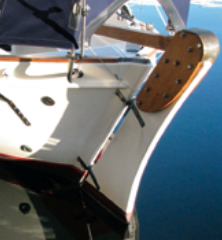
Sure, there was the headroom issue. But a crusty old salt down the dock said, “You know, Steve, there’re only a couple of things I do down below, and I do none of ’em standing up. Do you really need standing headroom?”
Romance in names
Steve kept the boat’s tongue-twister name: Sisiutl, pronounced Sis-YOOL. “It never fails as a conversation starter,” he explains. In Pacific Northwest Indian folk art, legends, and songs, the Sisiutl is a mythical two-headed sea serpent that has tremendous healing powers. It guards homes from evil spirits and canoes from misfortune.
As for why he kept the boat’s original hailing port, a tiny village called Gulkana on the confluence of Alaska’s Gulkana and Copper Rivers, he explains, “It’s more romantic-sounding than Everett.” Alas, his spouse never took to the romance of the sea and didn’t need a Sisiutl guarding the house either.
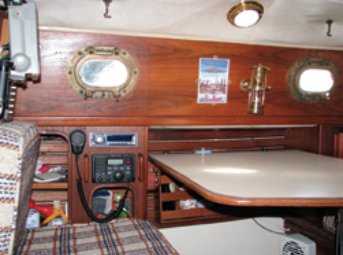
Single once again, Steve carried on. He built a teak mount for the new ICOM 504 radio and added a 40-watt solar panel, which keeps the batteries topped off even in the cloudy Northwest. He also installed a Raymarine GPS plotter, LED interior lights, and new wiring, including a Blue Seas power panel. Having come from Alaska, the boat already had radar and an Arctic furnace, and the previous owner had replaced the corroded aluminum fuel tank, something that is an issue on older Pacific Seacraft 25s.
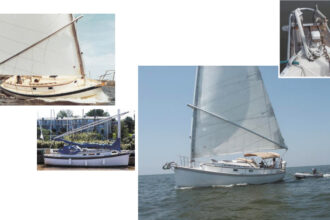
Sisiutl desperately needed new sails. After the settlement emptied his house of most of its furniture, Steve discovered that it made an excellent sail loft. So he bought a Sailrite sewing machine, sailcloth, and instructions and spent the winter making a new mainsail and a 130-percent genoa. He did a good job of it; the sails look and set as if they had been made professionally.
Humble forebears
Despite her genteel charms, the Pacific Seacraft 25’s lines and origins are pure working class. Her designer, Henry Mohrschladt, found inspiration in the practicality and tradition of a past century: he based the boat’s lines on a small and nimble craft that had been in use in New England since the late 1850s: the No Man’s Land boat.
These craft were double-ended and easy to sail and row — they had to be. They were launched and landed through surf on the beaches of Martha’s Vineyard and Nantucket. Their crews sailed them to offshore fishing grounds laden with supplies and sailed them back laden with fish. Those workboat origins, together with first-rate construction practices, have given the Pacific Seacraft 25 an enduring authority you can sense even before you sail one — here is a pocket cruiser that can take it when you put to sea. This has earned the enduring affection, admiration and, yes, love of a whole new generation of owners — make that stewards — who keep a lively dialog going on their website.
Pacific Seacraft 25s have been sailed coastwise and offshore, from gunkholes in quiet bays to far-flung islands across the Pacific Ocean. They sail on days when others stay in the harbor, because this boat likes it windy. “I like to take her out in a good blow,” says Steve. “She’s seaworthy as all getout. If you set the sails right, there’s no weather helm, and she almost steers herself. She’s easy to maneuver and she’ll heave to very well.”
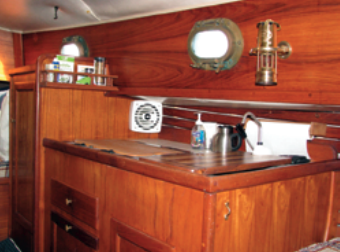
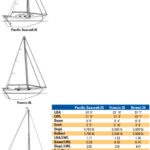
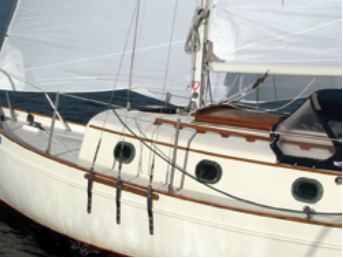
With a 4,750-pound displacement that includes 1,750 pounds of encapsulated lead in the keel; a hull built with 10 hand-laid layers of cloth, mat, and woven roving; surprisingly high bulwarks on the foredeck; and a double-sealed hull-to-deck flange, this boat feels as solid to its modern-day owners as the original No Man’s Land boats probably felt to theirs. Six bronze opening portlights and superb teak joinery call attention to the high standard of finish, and the tabernacle, in which the mast can be raised and lowered, makes the Pacific Seacraft 25 a trailerable cruising boat.
Love’s hurdles
This is not a boat that loves to sail close to windward like a modern raceboat — she doesn’t like short choppy head seas. The 1-cylinder YSM-8 will, according to Steve, “. . . shake your fillings out of your mouth.” Many owners are replacing those old bangers as they wear out and the engine compartment has room enough for a decent-sized engine. Although the 5-foot 2-inch headroom can be an issue, Pacific Seacraft’s innovative zippered headliner cushions bumps. It also allows for easy access to all the wiring.
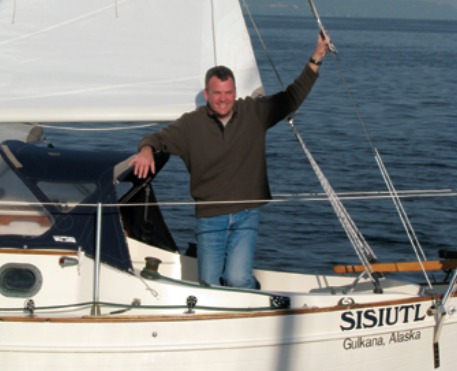
The bridge deck is not high enough, at 9 inches. Keeping the lower dropboard in helps and, if it’s rough, the second one should be in too. A door in the forward cabin gives access to the chain locker, but it can also dump the chain onto the V-berth if it’s piled up. A hatch in the cockpit sole allows better access to the engine than does the one in the cabin, but you have to undo 18 bolts to get in there.
Future improvements for Steve include repowering with a larger, quieter, engine and replacing the standing rigging. This summer he hopes to cruise Barkley Sound on Vancouver Island’s rugged west coast.
But ask him about his most enjoyable cruise ever and his answer is a blend of past and prospective: “I was sailing from the San Juans to Victoria, British Columbia, on a beautiful day. As I sailed down Todd Inlet, I could smell the flowers of Buchardt Gardens on the wind. It was like smelling a tropical island destination, and I pretended that’s what it was.”
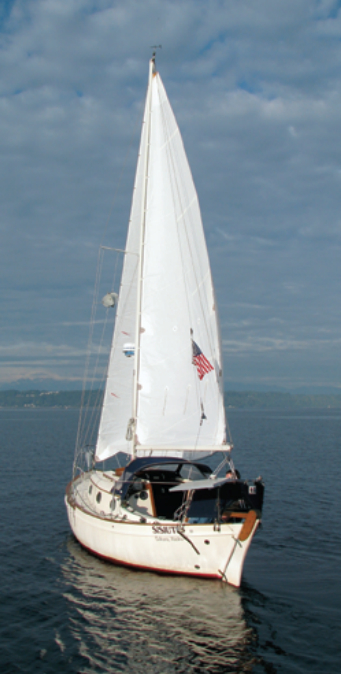
If you have ever had your heart captured by a boat’s sweet lines and seakeeping abilities, and if you have an abiding appreciation for the mystery and romance of the sea, then you are one of the lucky ones. You know that it’s as natural and mysterious as falling in love. If you haven’t had your heart captured yet, don’t worry. You’ll know it when it happens to you.
“Seems like I’ve owned this boat forever,” says Steve.
Karen Sullivan has sailed small boats, then large boats, and now back to a good old small boat, a Dana 24. She sailed it up to Alaska, where she cruised for 5 years. Now she sails out of Port Townsend, Washington.
Thank you to Sailrite Enterprises, Inc., for providing free access to back issues of Good Old Boat through intellectual property rights. Sailrite.com