Factors and choices that may make the difference
Issue 69 : Nov/Dec 2009
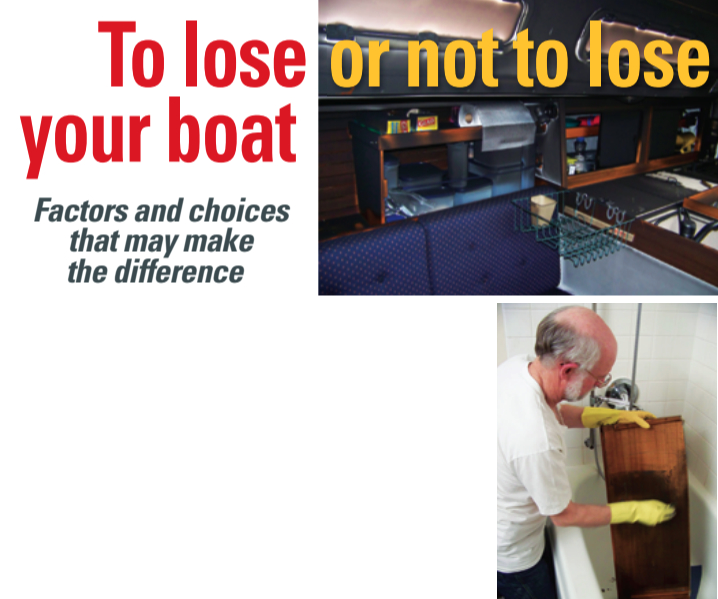
“You may not have enough insured value to save this boat.” The surveyor’s words left me stunned. He had finished his first task: to determine the cause of the fire (arcing within a power strip) and verify that this was an insurable event. Now he had switched modes and was documenting what would be required to make our boat whole again.
I struggled to understand his assessment. Our J/32, Sirius, is a 1997 model, still relatively new — at least to us. To my inexperienced eye, the cost to repair the direct fire damage to the sole of the head compartment and the immediately adjacent bulkheads, should be on the order of $10,000. The heavy soot contamination throughout the boat would require a lot of time to clean up. That might perhaps run to as much as another $10,000 but would surely be less than $20,000. This should still be a fraction of the value of the boat. So how was it that the underwriter might want to cash us out?
Many sailors before us have faced the choices we had to make. And many more will follow. The thought of a well-loved vessel — and all the wonderful memories associated with her — going to a salvage auction is painful indeed. But it does not have to end that way. Our instinctive response was that we would not consider letting go of Sirius while she was still so much with us. This might be a triumph of heart over head, but I suspect that this impulse is an integral part of being good old boaters.
Fortunately, we were able to save Sirius, in part through more than 400 hours of our own labor. Our well-loved boat is now whole again. We have recovered emotionally and financially from the long process. We can now look back on this experience with enough detachment to see some lessons that might be useful for others who face the possible loss of their boats.
Surveyors matter
We were very fortunate that our underwriter chose wisely. Our surveyor was experienced and knowledgeable and dealt fairly with all parties involved. He had considerable experience with boat fires and understood all that would be required for a satisfactory long-term result. He was also a good teacher and was willing to take time to make sure we understood the nature of the problems that lay ahead.
It is clear to me from this perspective that, had we been less fortunate in the underwriter’s choice of surveyor, we should have immediately retained our own surveyor to represent and guide us. (We did make provisional arrangements with a surveyor just in case we needed to determine the salvage value of our boat.)
Your responsibility
For a claim involving a boat, the procedure for getting a comprehensive repair estimate is not the the same as it is with a car after an accident. Not only did we have to get our own repair estimate, but the surveyor pointed out that we could choose the boatyard we wanted to work with. He cautioned us that, if we turned our boat over to a boatyard to do the entire job, the cost might well exceed the amount for which the underwriter was responsible. That amount is the difference between the insured value stated in the policy and the probable salvage value of the boat as is. Plus, underwriters want some allowance for surprises before authorizing a major repair project.
Invest your own time
Your labor contribution can go a long way toward avoiding seeing your vessel go to a salvage auction. We were fortunate that our underwriter was willing to pay owners for their labor while doing repair tasks for which they have the necessary skills. They paid us at an hourly rate about one third that which major boatyards in our area charge for their skilled trades. This made it more attractive to use our labor to try to keep the repair estimate below the threshold where the underwriter would opt to cash us out. However, we would have done this regardless to save our vessel.
Start early
Project Sirius was completed early and under budget. This is rare for major boat projects. One of the reasons for this was that we began sourcing replacement parts before Sirius was hauled out to start the major work. Therefore, all the required parts were on hand when needed. There were no project delays for lack of parts.
An important ally
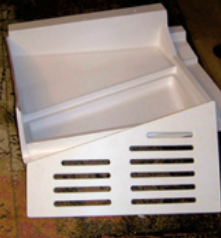
The vessel’s manufacturer, if still in existence, can be very helpful. We enjoyed excellent support from Pearson Composites, the contract manufacturer for J/Boats. The folks there put us in contact with the original sources for parts and materials, such as the vinyl fabric for the headliners, the cushions, the power panels, and much more. They even located the original tooling for the head compartment and were willing to prep it and pull a part to replace the fire-damaged shower pan. This was remarkably good support for a model that had been out of production for more than five years.
Choose your boatyard well
Your choice of boatyard will have a major impact on the success of the project. The yard we chose was quite willing to have owners, or their representatives, working on a major boat project. This was a big plus for us. The final repair estimate assumed that helping restore our boat would be my full-time occupation for the two months she was at the boatyard. This was a real benefit of being retired. The resulting estimate came in comfortably below the insured value so the underwriter had a vested interest in seeing our boat made whole again and would continue to insure her. Not all boatyards are as willing to have owners working alongside their employees. When talking to boatyards, be sure to ask about their policies regarding non-employee labor.
One last chance
Had the underwriter chosen to cash us out, we could have bought our boat back at the salvage auction. Or, we could have negotiated a salvage value with the underwriter so we retained ownership. Then, with title to the vessel and a check from the underwriter, we would have been left to our own devices. Fortunately, we did not have to go down that road.
Durkee Richards learned to sail in the Sea Scouts on the Columbia River. His first date with his sail-mate Mary Jeanne, was on a Snipe. They spent nearly 40 years in the Midwest, chartering boats on Lake Superior until they bought their J/32 in 1999. After Durkee retired, they moved to the Olympic Peninsula and the waters of Puget Sound and British Columbia.
Thank you to Sailrite Enterprises, Inc., for providing free access to back issues of Good Old Boat through intellectual property rights. Sailrite.com