Basic insights into how they work
Issue 71 : Mar/Apr 2010
Much complicated mathematics lies behind the deceptively simple appearance of a boat’s propeller, but it can be described and specified with a few simple numbers and terms.
Diameter and pitch
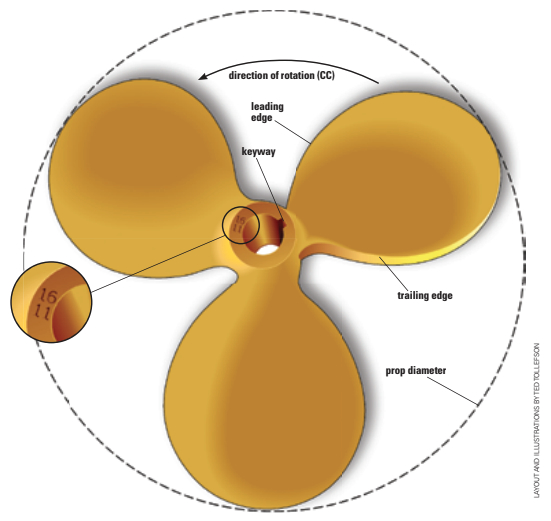
The diameter of a propeller is the diameter of the circle described by the tips of its blades when it rotates.
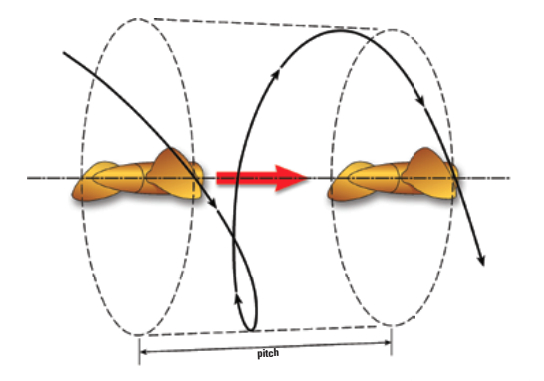
The pitch of a propeller is the theoretical distance it would screw its way through a solid with each complete revolution.
In the U.S., these dimensions are stated in inches, and the convention for specifying a propeller lists the diameter first. A 16 x 14 propeller, therefore, has a diameter of 16 inches and a pitch of 14 inches.
Number of blades
This is obvious. What’s not obvious is that a propeller’s efficiency decreases as the number of blades increases. Although a two-bladed prop is more efficient, the two blades enter the disturbed water flowing either side of the boat’s keel at the same time. On full-keeled boats, this often causes vibration or humming in parts of the boat. A prop with more blades provides smoother propulsion with less vibration.
A three-bladed prop is a good compromise for an auxiliary cruising sailboat with a full keel, since each of the blades enters this disturbed water at a different time. However, the three-bladed propeller will induce more drag under sail, whereas the two-bladed prop, when stopped and aligned vertically — at least on a full-keeled boat — is hidden by the keel, reducing its drag.
Shaft size
This is the diameter of the propeller shaft, exclusive of the tapered end to which the propeller is fitted.
Key and keyway
The keyway is a slot machined into the propeller shaft and into the hub of the propeller. A key fitted into the keyway prevents the propeller from turning on the shaft. This key usually has a square cross-section. In the U.S., the side of that square is designated in inches, so a 1/4 -inch key is used in a 1/4 -inch keyway.
Rotation
The direction in which a propeller rotates depends on the particular engine and transmission. If, with the engine in forward gear, the prop rotates clockwise when viewed from the stern, it is described as right-handed. If, with the engine in forward gear, the prop turns counterclockwise when viewed from the stern, it’s left-handed. On a boat fitted with twin shafts and props, the props will generally rotate in opposite directions, so one prop will be a right-handed prop and other a left-handed prop. Because of their opposite pitches, the props cannot be interchanged.
Thickness
Ideally, propeller blades should be as thin as possible, since more power is wasted turning a thicker blade. As an example, because stainless steel is about five times stronger than aluminum, a prop made of stainless steel can have thinner blades than one made of aluminum, and will therefore be more efficient.
Slip
When propelling a boat, a propeller, because it’s working in a fluid and not a solid, actually moves forward a lesser distance per revolution than its manufactured pitch. Thus a prop listed as having a 14-inch pitch, may only move the boat forward 7 inches for each revolution. The difference between the theoretical pitch and the actual forward movement is termed slip. Many factors contribute to slip, including hull resistance, wind and wave conditions, and the weight of the boat.
Thrust
The propeller propels the boat forward by generating thrust, which in the U.S. is measured in pounds. The propeller on the typical auxiliary creates thrust in the neighborhood of 8 pounds per square inch (psi) of blade area. The power used by the propeller’s blades to create thrust is provided by the engine. A typical propeller only converts about 50 percent of the engine’s power into thrust.
Cavitation
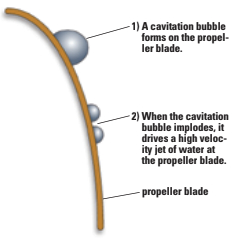
Cavitation is an unwanted phenomenon that accompanies propellers. As a propeller rotates and drives a boat forward, low-pressure areas form around the propeller as the water accelerates past the blades. The faster the rotation of the blades, the lower the pressure, until it becomes lower than the vapor pressure of the water and bubbles of gas are formed (much as when water boils). When these bubbles subsequently collapse under the higher pressure of the surrounding water, they do so violently, creating high-pressure implosions and microscopic high temperatures (thousands of degrees). When the bubbles implode on the surface of a propeller they create explosive noise. What’s more, these implosions and instantaneous microscopic high temperatures also cause pitting of the propeller’s surface. This pitting is higher on propellers made of softer metals. Cavitational pitting can dramatically shorten a propeller’s efficiency and life.
Propeller variants
Folding or feathering propellers and variable-pitch propellers address the problem of drag when sailing. Racing sailors often choose folding props because they are thought to cause the lowest drag. Their drawback is that they do not work in reverse as well as other designs. Feathering propellers create a little more drag than folding propellers but have excellent thrust in reverse. Variable-pitch propellers have about the same drag as feathering propellers but adjust their pitch automatically to maximize efficiency. These propellers have been found to maintain higher efficiency over a wide range of boat speed and engine loading.
Propeller selection
Choosing a propeller’s specifications is a complicated process. In general, you want to start with the largest diameter that will allow adequate clearance between the blade tips and the hull or aperture, use the smallest number of blades that will do the job, and choose the pitch last. (Note: See articles in Good Old Boat by Aussie Bray, March 2003, and Rebecca Burg, March 2008. –Eds.) You can also find guidance in selecting a prop in books and through programs on the Internet.
Don Launer, a Good Old Boat contributing editor, has held a USCG captain’s license for more than 20 years and has sailed the East Coast from Canada to the Caribbean. He built his two-masted schooner, Delphinus, from a bare hull. His newest book is The Galley: How Things Work.
Thank you to Sailrite Enterprises, Inc., for providing free access to back issues of Good Old Boat through intellectual property rights. Sailrite.com