A Euro-style racer with few concessions to cruising
Issue 73 : Jul/Aug 2010
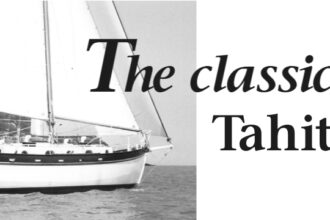
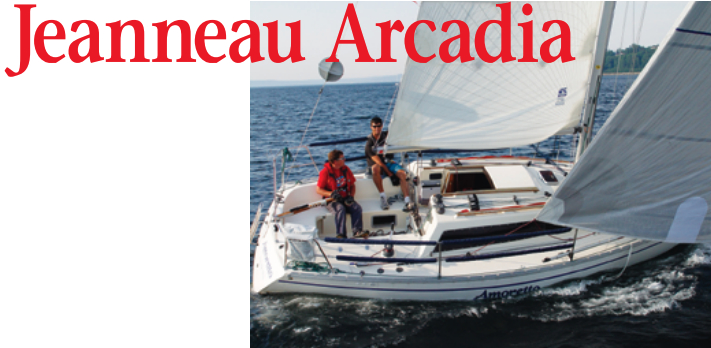
When viewed from dockside, our review boat, Amoretto, a 30-foot Jeanneau Arcadia, appeared to be a solidly built, no-nonsense racer/cruiser with a clear emphasis on racer. She looked like a close-winded boat. On closer inspection, and during sea trials, those first impressions proved accurate.
The boat’s second owners, Sheryl and Marty Bower, belong to the Corinthian Yacht Club of Edmonds, Washington, where Marty serves as fleet captain and Sheryl is treasurer. They’re equally fond of Amoretto and share a keen awareness of her attributes and limitations as well as a familiarity with her pedigree.
Jeanneau was founded in 1956 by Frenchman Henri Jeanneau, who began building outboard runabouts and other small craft before developing a line of sailboats in the 1970s. When things weren’t going so well in the 1980s, the company was bought and sold by several conglomerates, including Bangor Punta, which also owned the American brands O’Day, Cal, and Ranger. Jeanneau got bigger, and for a while was second only to Beneteau. In 1995, Beneteau purchased its old rival. More than 600 Arcadias were built, all of them in France; not many were exported to the U.S.
Design
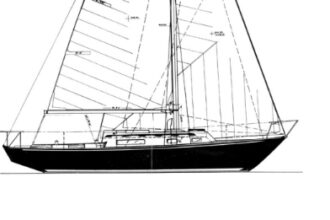
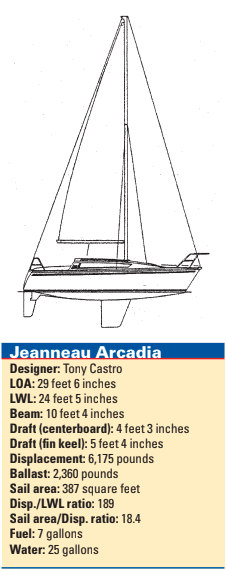
The Arcadia was designed by Tony Castro, who began his career with Ron Holland in Ireland. Tony earned a reputation as one of Europe’s top designers and more than 6,000 boats of all sizes and types have been built to his designs, including Blue Arrow, a British contender for the America’s Cup. Although designed to compete in the IOR Half Ton Class after the 1979 Fastnet Race, the Arcadia isn’t as extreme as radical IOR boats with their pinched ends and exaggerated tumblehome. It does have a relatively light and flattish hull, a high-aspect-ratio keel, and a spade rudder carried behind a small skeg. Keel and keel/centerboard configurations were offered.
With bold slashes of black portlights, Bomar hatches, and go-fast deck fittings, the Arcadia’s overall appearance is distinctly European. In 1985, when Amoretto was built, the look was certainly modern; it still is. In contrast, its construction is rooted in many traditions of sound boatbuilding.
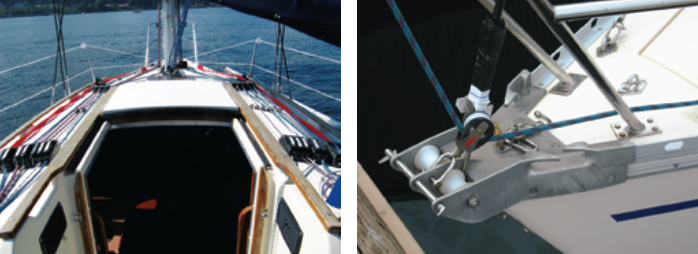
The hull sheer is as straight as it comes, and the coachroof is sleek and sloped. There is no dodger. The shrouds are placed well inboard on wide sidedecks so headsails can be trimmed in tight, and the upper lifelines are brought to the base of the bow pulpit to reduce interference with them.
Construction
The Arcadia’s fiberglass hull is hand-laid-up with alternate layers of mat and woven roving and reinforced in high-stress areas. The deck is hand-laid fiberglass with a balsa core.
The hull-to-deck joint consists of a conventional inward-turning hull flange to which the deck is fastened with 1⁄4-inch stainless-steel bolts also set through the aluminum toerail. The whole assembly is sealed on the inside with a thick layer of fiberglass. This practice almost guarantees a leak-free joint but, if anything goes wrong, it will be difficult to repair.
The stemhead fitting is a well-thought-out aluminum casting that provides a substantial mounting for two bow rollers, a terminus for the aluminum toerails, a pair of chocks, and attachments for running rigging.
Amoretto’s keel is an iron fin, which is prone to rusting; lead is generally preferable. The keel bolts extend up into the bilge area and are sealed with a heavy layer of fiberglass and resin, again making maintenance or removal difficult. However, 24 years after the boat was built, Marty reports no leakage in either the hull-to-deck joint or the keel bolts.
Jeanneau also bonded virtually everything structural to other structural members to add to the boat’s overall strength and stiffness. Just as athwartship bulkheads are bonded (or “tabbed” in industry jargon) to the hull and deck, cabinet fronts are fiberglassed to bulkheads and cabinet sides are bonded to fronts and bulkheads. The cumulative effect of all this fiberglass tabbing is to produce an extremely tough hull, stiffened against loads imparted by the rigging and the washing-machine action of choppy seas.
The masthead rig has upper shrouds, aft lower shrouds, and a baby stay forward. Amoretto has double spreaders and is fitted with an adjustable backstay. A post in the middle of the saloon carries the compression loads from the mast down to the keel. Transverse overhead frames bonded to the hull and deck anchor the upper-shroud chainplates. The lower-shroud chainplates are connected to large brackets bonded to the hull and sidedecks.
On deck
The cockpit of the Jeanneau Arcadia struck me as a combination of features, some traditional and others innovative, some good and some not so good. The seats will hold four persons; additional crew will have to find perches elsewhere. Although Marty and Sheryl find the seats comfortable, I thought they were a little short for my legs and the backs a bit too upright. But racing a boat isn’t the same as cruising, where hours spent in the cockpit demand more inviting seating.
The coaming tops are angled, providing comfortable seats for the crew when the boat heels. The hinged starboard seat and backrest can be raised, like the gull-wing door of a Mercedes 300SL, to access a large, if rambling, amount of under-seat cockpit storage.
The companionway of the Arcadia is forward of the substantial bridgedeck, which is formidable to negotiate but effective in keeping water out of the cabin at the same time as it stiffens the hull in way of the cockpit bulkhead. While the companionway is fitted with dropboards, it also has acrylic doors that fit into gudgeons and pintles on either side of the opening to close it while allowing in light.
Accommodations
The interior is striking. When you go below for the first time, the boat appears suddenly and clearly European. Whether this is to your taste or not, there is nothing ordinary about the space. It’s open and light and well-finished teak is everywhere. The stainless-steel compression post, as much architectural feature as structural member, passes right through the middle of the fixed table but does not intrude on the usefulness of the cabin. Along with handholds on either side of the companionway and port and starboard grips at the galley and nav-table level, the post offers another welcome handhold when things get a bit rambunctious below.
The long tinted portlights, together with the Bomar hatch, flood the saloon with light. Looking forward, past the handsome and well-built table to the too-short-to-use-comfortably V-berth beyond, the effect is of a large and unified saloon space making the boat seem bigger than it really is. At the same time, the 6-foot headroom aft rapidly diminishes as you move forward. In many ways, the Arcadia feels like a 28-foot boat dressed up in 30-footer clothing. In fact, later models that used the same hull were sold as 28-foot boats—the Sun Dream 28 and Sun Way 28.
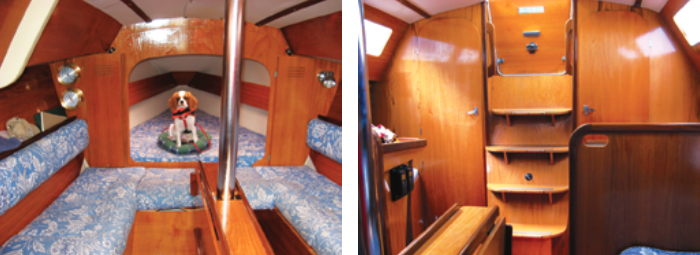
The teak-and-holly sole lies in marked contrast to the modern vinyl overhead that in places barely seems to cover the fiberglass deck molding. Some bits were hanging loose because of adhesive failure. This is easily repaired but can be an annoyance in a boat that contains some high-quality construction and joinery. Marty has replaced much of the original glued-on liner with solid panels he can remove to get at various deck fittings.
Narrow shelving runs along the tops of the settee backs but headroom under the sidedecks will require even persons of average height to slouch when seated — another concession to the exigencies of racing. A nice French touch is a built-in wine rack in the port-side settee near the galley.
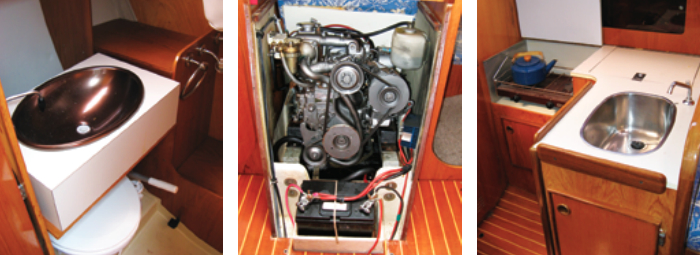
I thought the port-side galley was small for a 30-footer. Part of the counter is hinged to provide access to a two-burner propane stove. A foot pump draws from a 24-gallon water tank and the icebox is adequate.
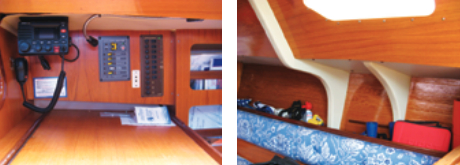
A large navigation table is located to starboard, opposite the galley, where it’s convenient to the cockpit. An 80-amp-hour house battery is located beneath the seat. The VHF radio, a gooseneck lamp, circuit-breaker panels, and materials storage are close at hand.
The view aft is almost sculptural when compared with more traditional interiors. Actually, this attention to interior design is a hallmark of Tony Castro’s office and characterizes all his designs from daysailers to megayachts and aircraft. Full-size doors leading to the head and after cabin are symmetrically placed on either side of the companionway. Lavish amounts of teak plywood balance the expanse of white vinyl overhead.
In the head, the sink is fitted in a counter that hinges down to rest over the toilet. The space is cramped, in part because the cockpit and a large saloon trumped more utilitarian concerns. Although it’s not to be compared with the accommodation on, say, a Catalina 30, it’s workable.
The port door leads to the aft berth, which appears to be a double in plan but in reality is a meandering space overhung by the cockpit. It must be next to impossible to roll over in this berth and it’s hard to imagine two adults sleeping well in here; maybe a boy and his dog. As a cruising arrangement, it would have been infinitely better to add a few more inches to the too-short V-berth and give over this cubbyhole to storage. But this is a boat designed to race more than cruise — and to make a striking impression below. This it does well.
Between the double doors in the aft bulkhead, the companionway ladder panel lifts off, providing access to a small and well-insulated engine compartment and the two-cylinder Yanmar 2GM 20 diesel. Additional access is through the aft cabin.
Marty reports that the engine is easy to service except for the starboard side dipstick that is difficult to find without a mirror. But, as if to balance this inconvenience, a small electric bilge pump was fitted as standard equipment to remove water from the small sump below the packing gland, a difficult place to get at. A mysterious covered hole through the ladder panel turned out to be a receptacle for an extinguisher nozzle to fight an engine fire without admitting more oxygen into the space. That looks like a good idea. The 7-gallon fuel tank seems a bad idea for any but the most dedicated racing skipper.
Under way
On trial day, the Arcadia, equipped with a two-bladed folding Max-Prop, backed down predictably. The noise and vibration were less than I would have expected from a two-cylinder engine and we easily reached hull speed of about 6 knots. Amoretto sails with 110-, 130-, 140-, and 155-percent laminate headsails as well as a .75-ounce nylon drifter, an asymmetrical spinnaker, and a storm jib.
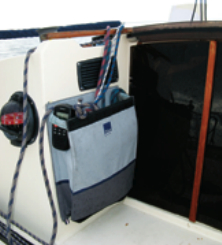
Running rigging is color coded and led to the cockpit where it’s organized with the aid of 15 Spinlock Powerclutches. A Barbarossa 15 two-speed winch is mounted to port of the companionway while to starboard there’s a Barbarossa 14 single-speed and a Lewmar 16 two-speed. Each winch serves multiple line-handling purposes. Two-speed Barbarossa 40s mounted on the cockpit coamings handle the sheets. None of the winches is self-tailing. Barbarossa was acquired by Harken in 1987.
Marty hoisted the main and hauled on the jib halyard while daughter Katie eased the 140-percent genoa into the foil. I braced my feet against the opposite seat and we were off. Winds wavered around 6 to 8 knots in a generally smooth sea and, when we shut down the Yanmar, Amoretto leaned to a freshening wind without missing a beat. She was easy to steer from both the cockpit seat and up on the angled coaming with the help of a Forespar Twist-Lock tiller extension. At these wind speeds, she was well balanced, had virtually no weather helm, and accelerated sharply in the gusts.
Amoretto handled like other boats of her size and type. She pointed well and tacked smartly. Marty reports that the boat can tack through 75 to 80 degrees, partly because of good sails, a trained crew, and the inboard shrouds that allow headsails to be sheeted in tight on the same wide sidedecks that restrict comfort below. She tracked well downwind, showed no squirrely tendencies, and took wakes from ferries and large powerboats in stride
The Arcadia’s PHRF base rating in the Pacific Northwest/Puget Sound region is 188 and Amoretto’s is adjusted to 194. Other regions of the U.S. give the Arcadia ratings of 159 to 191. By way of comparison, locally, the J/30’s PHRF is 139 and the Laser 28 rates 141, while the Catalina 30 and the Hunter 30 both have a PHRF of 210.
Conclusion
The Jeanneau Arcadia’s interior feels small for a 30-footer. Comfort and convenience in the living area take second place to sailing and racing qualities. A certain rakishness of form — a boldness — also sets her apart from comparable American yachts.
Under way, she comes across as a broad-shouldered boat that can be sailed hard. She’s fun to sail, like a big dinghy, and, as I adjusted to her decided idiosyncrasies, her blemishes, and her shortcomings, I found I liked this boat. Comparing the Arcadia with a Catalina 30 is like comparing a Mazda Miata with a Ford Focus. They serve similar purposes in different ways. There is a certain je ne sais quoi about the Jeannneau — something hard to define but something ultimately likable.
Because of its relative rarity, it’s difficult to estimate the value of a Jeanneau Arcadia on the used-boat market. The Internet turned up two currently for sale in Europe at prices exceeding what the market would bear in the States, $38,000 to $44,000. Marty reports that a centerboard Arcadia recently sold on the East Coast for about $16,000. He feels that Amoretto might sell for around $22,000.
Richard Smith is a contributing editor with Good Old Boat. He has built, restored, and maintained a wide variety of boats and sailed them on Michigan lakes and Oregon reservoirs and from harbors and mud berths in the Irish sea. He sails Kuma, an Ericson Cruising 31, with his wife, Beth, on Puget Sound.
Thank you to Sailrite Enterprises, Inc., for providing free access to back issues of Good Old Boat through intellectual property rights. Sailrite.com