Habitual tinkering comes up trumps
Issue 75 : Nov/Dec 2010
Self-steering is the elusive silent partner of every singlehander. Dozens of commercial products have been devised to deliver this blessed grail. They run the gamut from mechanical devices that use paddles, windvanes, sails, lines, tabs, and intricate mounting systems to electronic and hydraulic mechanisms able to keep to a compass course and exert amazing amounts of turning power. Just about everything has been tried to save the solo skipper from the tyranny of the tiller.
Most of these devices are amazingly clever, immensely powerful, mechanically marvelous, and wondrously expensive. While I have been mesmerized by these skipper’s-little-friends, my sailing budget has never allowed me to indulge in their pleasures.
As a result, I have spent more time and money than any sane man should playing with inexpensive, homemade self-steering ideas gleaned from magazine articles and books. Most have involved a web of surgical tubing in various lengths and diameters and lines passed through blocks, tied to various bights in jibsheets and mainsheets, and woven back and forth across the cockpit in most amazing ways. One even used a milk jug filled with more or less water as the conditions demanded.
While most of these systems did actually work, I was never happy with the time it took to rig or de-rig them or the tangle of lines that made maneuvering through the cockpit hazardous.
After giving up on ever discovering a simple and low-cost self-steering method that could be set up or taken down quickly and easily, I found a solution that anyone can make for nothing or just a few dollars, depending on the contents of the parts drawer.
Shockingly simple
My self-steering device is nothing more than a simple line-tensioner such as you might find on a tent guy. But, instead of being made of rope, mine is made of shock cord, a wire hog ring, and a scrap of wood with a couple of holes drilled through it. It was so easy to make that I made two, expecting one to fail or deteriorate. Much to my surprise, both have lasted more than 10 years and have worked quite well on three different boats ranging in size from 25 to 30 feet.
Each of my devices (I call them “the Twins” because they are identical) is made of a 5-foot length of 1/4-inch shock cord bought at a boat supply store. One end is clamped with a hog ring (it could be sewn or whipped together) into a small loop just big enough to fit snugly over the head of the tiller. (I later tied a Turk’s-head around the head of the tiller to keep the loop from slipping off. It adds a nice “shippy” look, even when I’m not using the Twins.)
The other end of the shock cord is passed through a 1/4-inch hole drilled about an inch from one end of a 5 1/2 x 1 1/2 x 1/4-inch piece of teak (any kind of wood would work), doubled back on itself, and passed through a similar hole drilled through the other end of the piece of wood. With a knot tied in the bitter end of the shock cord and pulled tight up against the wood, the line forms an adjustable loop.
In use, the Twins are simple and easy to set up and adjust. Make sure your sails are balanced and that there is just a hint of weather helm to the tiller. If you use telltales on your sails, the outer one on the jib should be flying back smoothly while the windward one should be twirling almost straight up. Telltales on the main should be smooth on both sides of the sail and flying straight back from the leech.
Once everything is balanced, slip the small loop over the head of the tiller and stretch the big loop over a conveniently located cleat, winch, or other strong point on the windward side of the boat. Adjust the size of the large loop by sliding the wood one way or the other until there’s just enough tension to hold the tiller at about a 5-degree angle to windward. In my experience, light winds require less tension while stronger winds require more tension. You have to do some “fiddling” to find the right balance.
In stronger winds, over 15 knots, I put both Twins on and adjust them so they pull together. This system works great on all points of sail from close-hauled to a fairly broad reach.
Honesty compels me to admit that this system does not work very well in drifting conditions, though I have sometimes had success using one Twin to windward and one to leeward. This spread arrangement also works for motoring or for running dead downwind, though you have to be extra careful to watch for jibes as you won’t have feedback from the tiller to let you know the wind has shifted. I once used the Twins spread out on each side like this on a spinnaker run. I realize now that was probably a foolish thing to do (though kind of fun), and I don’t recommend it.
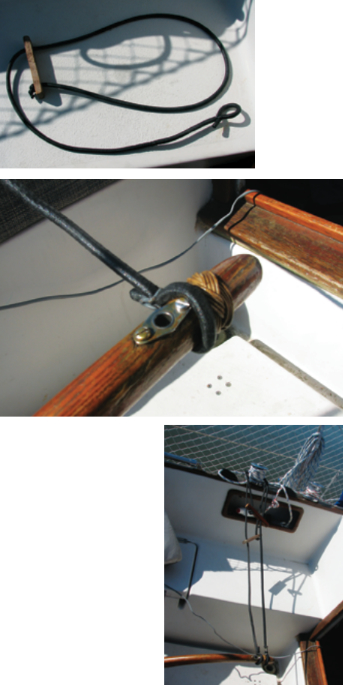
Reliable shipmates
How do they work? I have used the Twins on three different boats on Lake Erie and Chesapeake Bay in conditions from just above drifting to 20-plus knots of wind with waves between 4 and 6 feet. I have found that once they are adjusted properly, the Twins can steer a compass course better than I can.
They can be a bit finicky when the wind is unsettled or in gusty conditions, though adjusting one Twin to steer when the wind goes light and shortening up the other so you can slip it on your strong point in the gusts sometimes works. I would not recommend taking a nap while leaving the Twins to steer the boat, but I once sailed 70 miles in 15- to 20-knot winds touching the tiller only a couple of times all day.
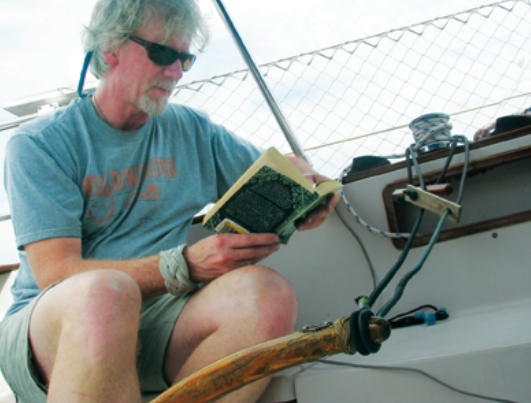
The Twins have made my solo sailing much more enjoyable. I know I can take the boat out by myself and not have to worry if I have to leave the tiller to go to the head, adjust sails, read a book, navigate, make lunch, swat flies, take pictures, or write this article.
Dennis Zimmerman learned to sail with the Ohio State University sailing club in Flying Juniors. After owning and building a variety of small boats, his first “big boat” was a 25-foot Folkboat he sailed with his family on Lake Erie. He now has a Bayfield 29 which they keep on the Sassafras River on northern Chesapeake Bay.
Thank you to Sailrite Enterprises, Inc., for providing free access to back issues of Good Old Boat through intellectual property rights. Sailrite.com