She’s seen a lifetime of devotion
Issue 83: March/April 2012
John Keats wrote, “a thing of beauty is a joy forever.” And although it’s unlikely that the poet was thinking about a sailboat as he penned those lines, beautiful sailboats have certainly brought their owners — and a few dreamers — more than a little joy.
In the early 1970s, it was a Pearson Countess 44 that struck Ron Rueckwald’s eyes and heart as the essence of beauty. With her pleasing lines, generous accommodations, and solid-looking full keel, the Countess was everything Ron thought a boat should be. But that beauty came at a price, and she was beyond his reach.
Ron was working at an airport and flight school in Rochester, New York, at the time. When a cash-strapped flight student found out that Ron was looking for a sailboat, he said, “Why don’t you buy my boat?” Ron agreed to take a look at her, a new but rather unadorned 1973 Morgan 42Mk II. Although she sailed nicely and Ron liked her functionality, his heart remained fixed on the Pearson Countess. Furthermore, he recalls being rather surprised at the Morgan’s minimal equipment. She was essentially a bare boat “without even a stern pulpit,” he says. Ron thanked the young man for the sail and returned to work.
A few weeks later, the man approached Ron and said, “I’m going to make you a deal you can’t refuse.” As it turned out, at that price it was a deal Ron could refuse, and yet he was warming to the idea that maybe this was the boat for him. He countered with a more reasonable offer, thinking there was no way it would be accepted. He was wrong.
That was 37 years ago and it was the beginning of an unexpected relationship with a classic sailboat. Ron is still a bit struck by his good fortune. “Who, out of dumb luck, looking for something else,” he says, “buys a boat that they come to love so much they keep it for 37 years? That says a lot for the boat.” Indeed it does, but anyone who has seen Pied Piper knows that the other partners in that relationship deserve at least an equal measure of recognition.
A childhood passion
Ron says he was first drawn to boats as a child. “As a kid, I received Popular Mechanics and Popular Science. I was fascinated by the powerboat and Chris-Craft ads.” He recalls sending in a request for brochures that resulted in a salesman showing up at his dad’s office one day. “My dad was less than thrilled,” Ron says with a laugh.
He discovered sailing after enrolling at MIT. “There was a sailing pavilion with a beautiful little launch that I wanted to run,” he says. “I found out that I had to have four sailing ratings in order to qualify, and so I started sailing.” By the time he had earned his ratings, qualifying him to operate the launch, his priorities had shifted. The beauty and challenge of sailing captivated him. “I think I operated that launch one time, but by then it didn’t matter — sailing was my interest.”
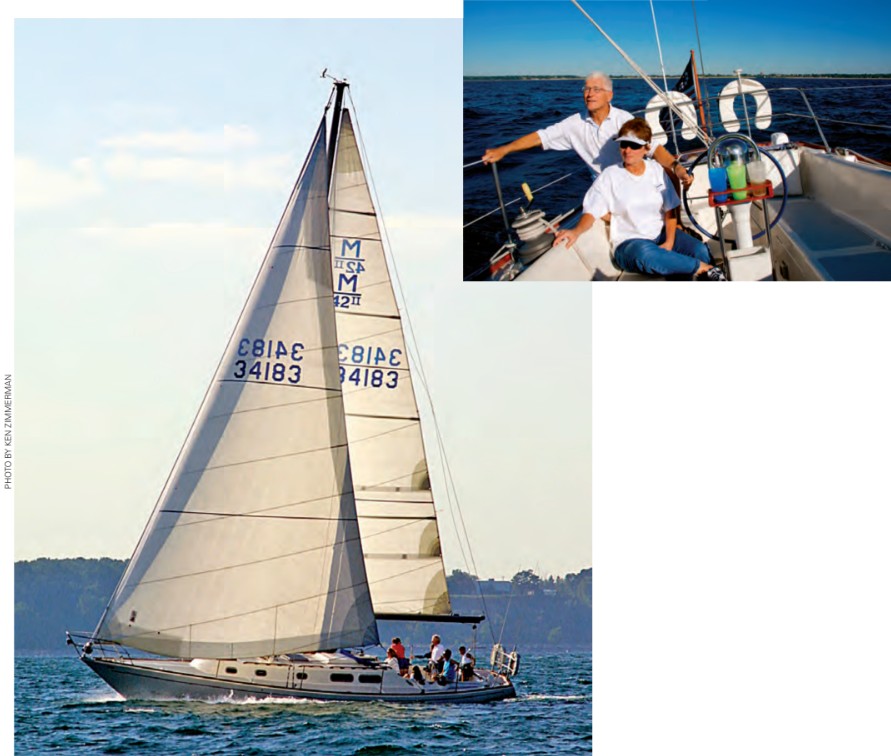
Ron says he made the leap into boat ownership with a big boat because, as the father of a young family, he wanted to keep his family safe. Shortly after he purchased the Morgan 42, Ron had her name duly changed from Copernicus to Pied Piper. As chief Pilot of Flying Operations in Rochester, and often trailing his two young boys behind him, Ron chose a name that reflected two of his passions. He had Pied Piper emblazoned on the transom in the characteristic Piper Aircraft font. Ron adds that over the next few years, the name acquired even more significance on Lake Ontario as the competition trailed Pied Piper around the racecourse on Wednesdays and Saturdays. Accompanied by a flight student, an accomplished 8-Meter sailor, as his tactician, Ron and Pied Piper cleaned up in the Jib-and-Main division during three years of racing on Lake Ontario.
Morgan pedigree
Given her heritage, it’s not surprising that Pied Piper has always been a strong performer.
Pied Piper’s hull was laid up at the Morgan Yacht Corporation facility in St. Petersburg, Florida, in 1971. Two years later, her first owner purchased her and sailed her for a year on Lake Ontario before Ron bought her in 1974. As Ron describes it, Pied Piper, hull number 50 of 55 built, was one of five Morgan 42 Mk IIs that were caught between changes in the International Offshore Rule (IOR).
The Morgan 42 Mk II, which was available as either a yawl or a sloop, owes its heritage to earlier CCA designs, including the popular and attractive Morgan 41, a full-keel centerboard sloop with an attached rudder — itself the descendant of a classic CCA design, Paper Tiger. Her designer, Charley Morgan, a long-time member and supporter of the CCA, said that he wanted to design a boat that was more than just a competitive racer but could safely and comfortably carry her crew in even the most demanding conditions. “I wanted her to have good accommodations, excellent sea-keeping ability, and to be sturdy,” he says. Charley had an opportunity to find out if he had succeeded with the design: he owned and successfully raced two 42 Mk IIs and, after being beaten around quite a bit in the Gulf of Mexico, he could attest to the boat’s seakindly behavior.
As Charley describes her, the Morgan 42 is a transitional design, evidenced by her bolted-on fin keel and strut-mounted propeller that contrast with her pronounced sheer and long overhangs. The changes were rather moderate, however, and the boat shares many of the same classic lines and design features of her older sister, the Morgan 41. In fact, Morgan Yachts used the deckhouse for the 41 on the 42 Mk II, not just to save tooling costs, Charley says, but because it was such an attractive design.
A voyage deflected
In life as at sea, the winds do not always blow fair. Ron and Pied Piper left Rochester in 1976, bound for the Caribbean. Floods delayed their trip through the New York Barge Canal, but they eventually transited and had the mast stepped at the junction of the canal and the Hudson River. “I ended up in New York City, then went on to Atlantic City, but by then it was too cold, too late, and I had no crew,” Ron says. He wintered aboard Pied Piper in Annapolis, where he recalls spending a few sleepless nights listening to the unnerving sound of the hull crunching against the ice.
Rather than continue south in the spring, Ron stayed in Annapolis and spent a year cruising Chesapeake Bay before landing a job in Ohio. Pied Piper was trucked to Sandusky, Ohio, and deposited in the waters of Lake Erie. The new location put the pristine cruising grounds of the North Channel and Georgian Bay within reach. Ron says he managed to squeeze in four or five two-week trips — sometimes with his boys, other times with friends.
In 1987, Ron married Dorinda, who says she had a love for the water from very early on. She had grown up racing Interlakes with her dad on small lakes in Ohio. Eventually, as she grew older, the boats grew too — first a Coronado 25, then a Pearson 30, and finally a Pearson 35. Dorinda spent her childhood and teen years venturing with her family from their homeport in Sandusky, Ohio, to ports all over Lake Erie.
After Ron took a new job, rather than have Pied Piper trucked to her new port in St. Joseph, Michigan, they did what any reasonable sailors would do: they spent three weeks bringing Pied Piper on her own bottom across three lakes. “It was a wonderful experience,” Dorinda says. “It was a little rushed, but we had a great time.”
A lifetime of care
Pied Piper’s classic lines and the meticulous care Ron has lavished on her over the past 37 years have drawn the attention of many an admirer at her home port of St. Joseph on Lake Michigan. You often hear the term “Bristol” applied to boats, but few boats probably live up to that honor. Ron could write the book on Bristol fashion. He has brought his engineering background from MIT and his technical experience in aviation to bear on virtually every system aboard Pied Piper. Some of the features are obvious. Pied Piper appears to defy the effects of time — it’s hard to believe that her deeply glossy gelcoat is approaching its 40th birthday. Her teak toerails are finished bright and flawless, and her topsides reflect a near-perfect image of the water.
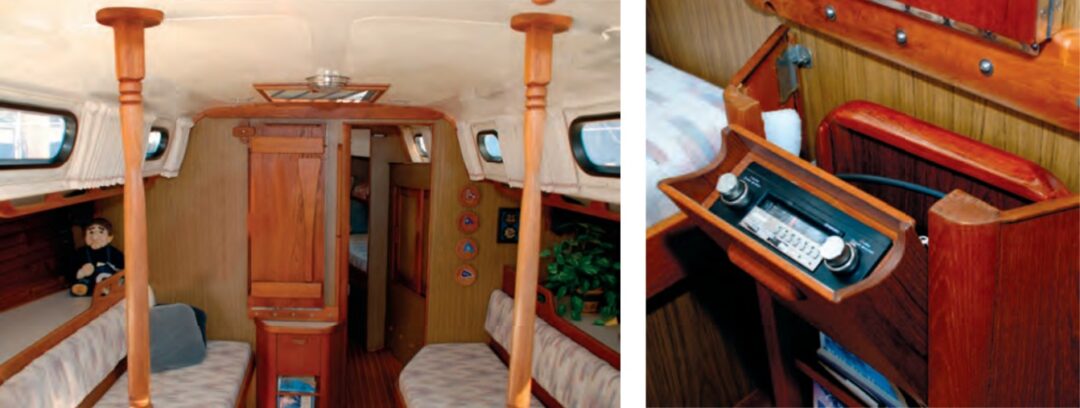
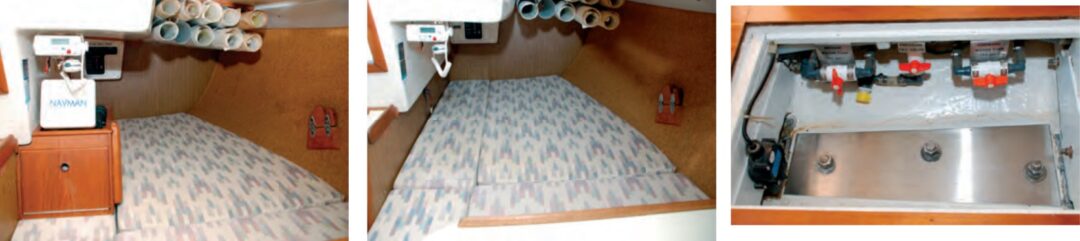
Inside, her traditional layout is much as it was when she left the factory, and yet everywhere you look, Ron has tweaked and improved it. In the forward cabin, which is a traditional V-berth arrangement, Ron built finely crafted teak storage lockers in the outboard corners, adjacent to the bulkhead. He sized them so the remaining berth fits a queen-sized sheet, and yet each locker easily accommodates crew clothing. If there’s anything obvious about their construction, it’s that the quality surpasses the factory joinery.
In the main cabin, Ron turned the unused pilot berths above the port and starboard settees into storage shelves, carefully routing and shaping the leeboards to match the surrounding trim. Beneath the bulkhead-mounted table, Ron built a stereo cabinet that doubles as a magazine rack and storage unit. The invisible joints and smooth corners are indicative of Ron’s skill.
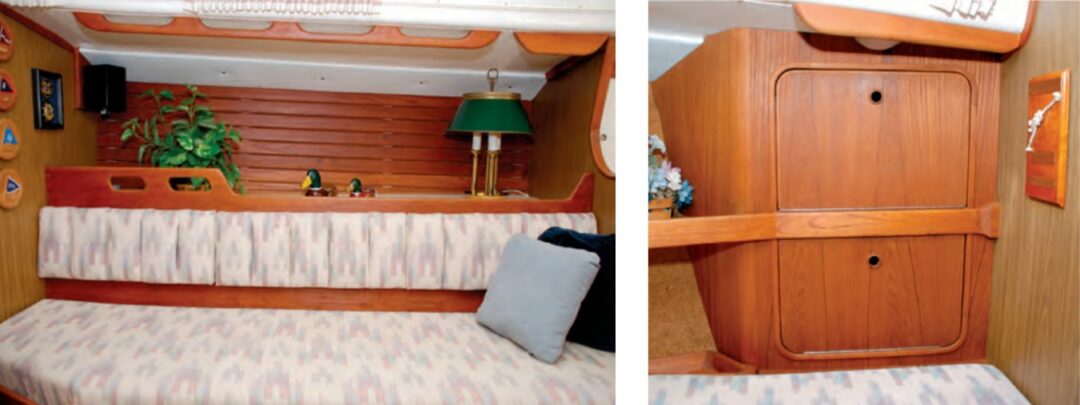
Other modifications to the cabin include a removable storage box — again, teak — in the quarter berth in lieu of the factory-installed wet locker. When the storage locker is removed, the quarter berth is large enough to accommodate two guests. And for those peaceful evenings at anchor with the warm company of friends, Ron added a wine cellar, which was, he notes, very much a part of the yachting scene not too many years ago. Yes, Ron has style.
areas, at right.
Updated but preserved
Only the consummate good old boater would see style in places like the bilge and the engine compartment.
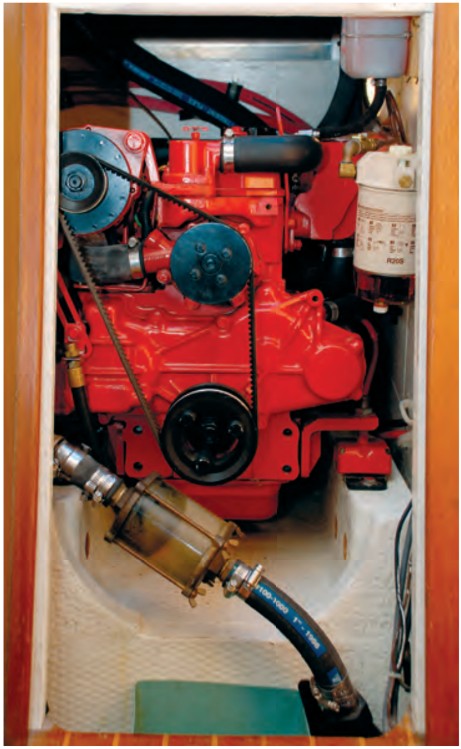
Ron replaced the original Atomic 4 with a Westerbeke 38-B in 1996. If Ron’s theme is order, precision, and elegance everywhere else, there’s little reason to expect it would be otherwise in the strictly utilitarian spaces. It’s evident that Ron’s background in flying, with its emphasis on preventive maintenance and regular inspections, is part of his boating philosophy as well. The engine compartment is spotless. Likewise, the bilge is clean and dry — a thick stainless-steel backing plate that Ron installed overtop the original steel plate virtually gleams.
Whereas most owners would likely replace older instruments with new digital equipment, Ron has lovingly preserved the original Datamarine wind and depth instruments and had them refurbished. From stem to stern, Pied Piper is the picture of Bristol fashion.
Ron has brought Pied Piper a long way and yet, in many ways, he has kept her exactly as she was. She still gleams like new, but now she has the systems she lacked all those years ago: a 110-volt shorepower system and battery charger, wheel steering, stainless-steel holding tank, and many other details too numerous to catalog.
Oh, and, yes, she has a stern pulpit, too, and a classic ensign perched smartly on her taffrail.
Classic performance
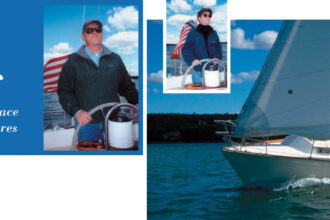
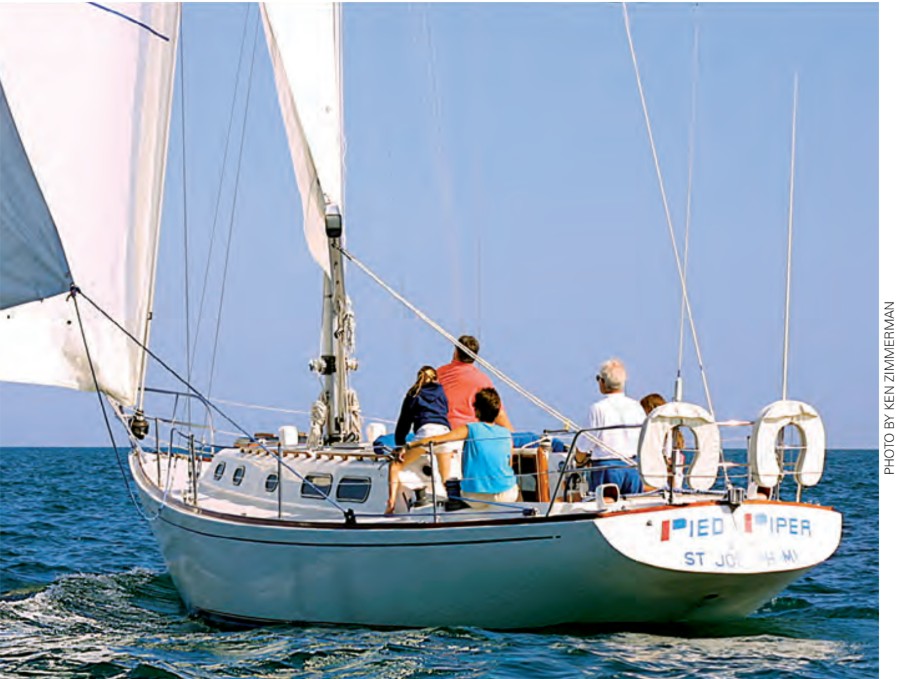
Ron and Dorinda graciously offered to take me out for an afternoon sail last fall. As we entered the channel and headed for the lake, Ron hoisted the main and unfurled the genoa. A fresh southwesterly, blowing 10 to 12 knots, swept us along easily at 6 knots. For such a large boat, with a displacement of 18,500 pounds, she accelerated quickly and had a surprisingly light touch. Ron turned the helm over to me. I was impressed with her balance and her responsiveness. The high cockpit coaming provided a comfortable backrest and a secure ride. Her generous and unobstructed sidedecks made going forward easy; however, despite its good looks, the non-skid is not very aggressive, and my trip to the bow proved to be awkward, even for a guy who is pretty nimble on his feet.
The majority of Ron and Dorinda’s sailing is to local destinations these days — South Haven, Grand Haven, Muskegon, Saugatuck — but to hear Ron recall passages made to the North Channel and Georgian Bay, it may not be too long before Pied Piper leads them once more on a new adventure.
David VanDenburgh started sailing with his parents at the age of 3 and has been afloat ever since. He’s now introducing his young sons Jakob and Joshua to the world of sailing. A high-school English teacher, he maintains and sails Ariel, his family’s Cape Dory 36, on Lake Michigan.
Thank you to Sailrite Enterprises, Inc., for providing free access to back issues of Good Old Boat through intellectual property rights. Sailrite.com