A boat search takes an unexpected turn
Issue 89 : Mar/Apr 2013
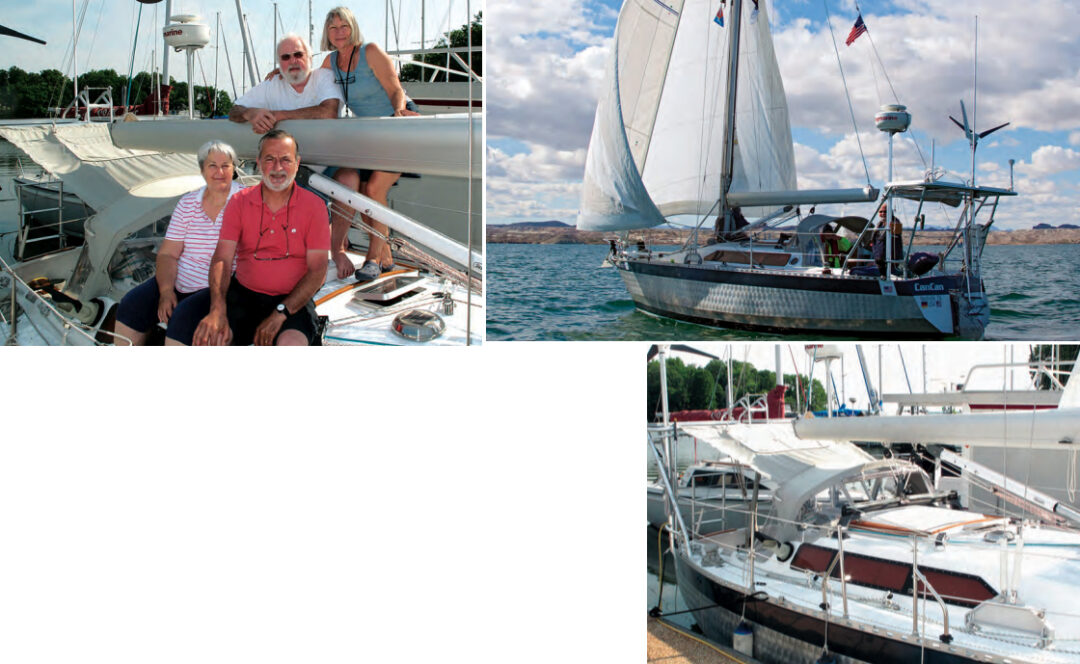
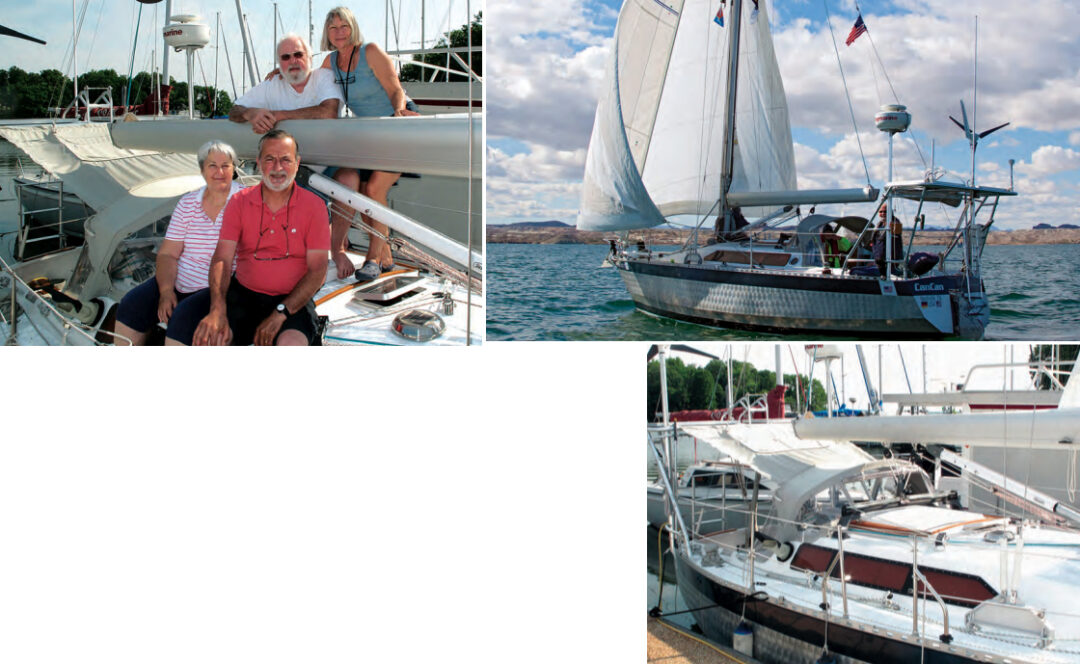
As I write this, Christine and François Ferbos have returned home to Bordeaux, France. They were in the U.S. to visit their son and his wife who reside here, but they made time to visit us in Nashville, Tennessee, and we were delighted to see them again after six years.
During that six-year interval, my wife, Gabi, and I have completed the import, refit, and conversion of the 30-year-old French-built aluminum sloop Christine and François helped us acquire on the French Riviera . . . and thereby hangs yet another tale of enduring friendships between like-minded cruising sailors from opposite sides of the “pond.”
We keep our boat in the marina at the Paris Landing State Park in West Tennessee. This is on Kentucky Lake near Paris, Tennessee. While they were here, we treated our French crew to Jack Daniels, barbecue, and catfish. We could not resist showing them that Paris, Tennessee, has its very own Eiffel Tower, albeit a slightly smaller version. We learned that catfish is not eaten in France, as it is considered a “trash fish,” but we may have changed that perception with these two at least. (Maybe it was the “Gentleman Jack!”)
If that tale ends with a recent visit from our French friends, it actually began just after Hurricane Katrina when Gabi and I decided that — after 10 years of owning a small “retirement” house on a tributary to Perdido Bay on Alabama’s Gulf Coast — we had exceeded our limit of hurricane tolerance and the associated hassles with insurance companies, boat and dock damage, and loss of 100-year-old live oaks. We sold our place (and cruising catamaran) and moved back to Nashville, boatless for the first time in 40 years.
It was time to reconsider what being on the water and sailing was going to mean for us going forward. We had owned and sailed almost every kind of sailboat from a large and very heavy Finnish motorsailer to small daysailers and a multihull. We had chartered in many places outside the U.S. and really enjoyed our travels. We realized the enjoyment of diverse sailing locations and cultures was a major part of what we wanted going forward. Tennessee is generally as good a sailing place as most inland venues can offer, but the yen for distant waters and new experiences is still strong within us. The focus of our next-boat investigations eventually turned toward what could be done with a trailerable boat.
The appeal of trailering
As Gabi and I are in our early retirement years, we don’t have the time, energy, or financial resources to keep a 40-plus-foot cruising boat in a marina or to sail from a location in the southeastern U.S. to the Sea of Cortez, the Pacific Northwest, the Great Lakes, or the many wonderful inland sailing venues in the U.S. and Canada. Perhaps we can’t do all this by water — but we can do it with a boat that gets there by Interstate highway at 65 miles per hour in a few days and at much less expense when compared to sailing there. As a bonus, we have no continuing dock rent, insurance is cheaper, and hurricanes no longer pose a threat.
Having owned a couple of trailerable boats in the dim past, we recognized that there are some thorns in that rosy picture, but once we decided to accept the hassles and built-in limitations of trailer-based sailing, we listed what was important to us in a sailboat and what had worked well and not so well in previous boats. Those considerations had to be merged with what was possible to afford, achieve, and pull over the road. While there is no “perfect boat,” most sailors have strong preferences for certain designs and build methods. We’re no different.
Our “perfect boat on wheels” needed to be at the upper end of what could be done with a trailerable sailboat without requiring special permits, as our wish list included full standing headroom below, an enclosed head and shower, ample stowage and sleeping accommodations, a galley with a real oven, and a diesel auxiliary engine. Our list had more specifics, but suffice it to say we wanted the volume and capacities that placed the boat at the upper end of what was really practical to tow.
One challenge was finding something a 65-plus-year-old couple could manage unassisted when launching and recovering, rigging, and stepping and unstepping the mast. It should also be safe and seaworthy enough for limited offshore use but have very shallow draft, be easily beached, and be able to remain upright on its own bottom without stands or additional supports. All this turned out to be a very tall order. So tall, in fact, that we were considering building from scratch. But since we really didn’t have the “scratch” or time to do that, I was ready to chuck the whole trailer-based concept as just not possible when the “French Connection” saved the day.
A Sonate sings their song
One evening while surfing the Web, I stumbled upon some European boat-listing sites. The featured boat on one home page was one I’d never heard of. It was built of aluminum and seemed to have the hard-chine lines of a big sharpie, and it was shown sitting on the hard flat on its own bottom. It was one of the Alubat OVNI series from the design board of Philippe Briand and built on the west coast of France.
My interest caught fire. I researched the Alubats and their design history and I liked what I found out, but although a few of their older discontinued models embodied some of our basic require- ments, the company had never made anything intended for trailer-based use. I learned they had built a 28-foot model called the Sonate 28. It had a design weight of 8,500 pounds and internal ballast. It also had a heavy fully retracting swing keel and a retractable rudder in a cassette (similar to a daggerboard but inside a transom-mounted sleeve, it can be raised and lowered but it does not kick up). These features gave it shallow draft and a low profile on a trailer while still offering standing headroom below. (Note: The original rudder was damaged by hitting a submerged object and a new kick-up rudder from Ruddercraft was installed in its place. –Eds.)
There were none of these boats in the U.S. and few for sale in Europe. I could find only two listed at that time and both were on the French Riviera not far from each other.
Buy a 1982-vintage boat in France? I initiated contact anyway, thinking that at least I could get more details on this boat. One was in the hands of a local broker and the other was being sold by its owner (soon to become our French connection). Some emails got the current status and asking prices of each one. We did have a trip scheduled to visit Gabi’s dad in Cologne, Germany. What could it hurt to detour for a few days and see one or both boats?
Riviera rendezvous
We emailed François, the owner who was selling his own boat, to say we were coming to see Nicotine (I still don’t know why he and Christine chose that name). He offered to pick us up at the Marseilles airport and drive us to Bandol, where Nicotine was in a slip. Next, he and Christine insisted that we stay aboard Nicotine to “get the feel” of the boat. We had not expected that level of hospitality but quickly accepted. Big mistake. If I had any notion of “tire kicking” and nothing more, that intent soon flew out of Nicotine’s hatch. We were hooked.
We sailed on Nicotine as crew for François and Christine and were sold on the way she performed. The OVNI 28s were semi-custom production boats with several choices of interior layouts. Nicotine was an exceptional example, but her layout presented difficulties for her conversion for usein the U.S. She had a very small galley and a tiny head compartment forward where we would have had to do major surgery to install a holding tank and the associated plumbing.
François nonetheless provided information of the kind you can only get from an owner with years of experience in maintaining and modifying his cruising boat. Most of those tips are now incorporated in our boat. He also understood what faced us in the conversion to U.S. regulations and agreed with me that perhaps Nicotine would not do for us. Then, to my surprise, he offered to drive us down the coast to see and help inspect the other OVNI 28. Neither of us knew much about it, other than it was for sale, was owned by a Belgian, and was in the hands of a broker in St. Raphael. I jumped at the chance to have an experienced pair of eyes on my side as we inspected it.
A perfect candidate
Balbuzard (French for osprey) was only a year older than Nicotine. The broker had the keys and the asking price . . . but not much else. François, Christine, Gabi, and I went below and discovered the boat’s interior layout to be exactly what we needed. Balbuzard had a much larger galley, a head compartment amidships near a space under the cockpit where we could put a holding tank, and a more usable nav station and electronics area. Of course she had some downsides due to age and wear and tear, and some visible defects (and some not so visible) but, taken as whole, we saw in her an almost-perfect candidate for what we wanted.
François went into a spirited bargaining posture with the broker, as only the French can do with such flair. It was amazing to watch. The broker got the owner in Belgium on the phone and an offer was made and accepted that lowered the asking price a little. The deal was done.
Suddenly, we owned a boat sitting in a marina on the French Riviera and became responsible for some high-euro dock rent. We had to get her home as quickly as we could. After a local survey gave her a clean bill of health, we completed the purchase and immediately rechristened her CanCan in celebration of her aluminum bones and French heritage. The broker and the previous owner agreed to deliver her by water to the port of Marseilles, where I would have her loaded aboard a specialized DYT (Dockwise Yacht Transport) ship for delivery to Florida.
After considerable paperwork, a lengthy process to get her home, and a long wait, CanCan arrived on schedule at Port Everglades, Florida, where we met her in U.S. waters for the first time. Her batteries were completely dead as they had been left on by the loading crew in France, but once we got her ancient diesel fired up, I motored her out of the flooded well deck of the DYT ship and into the ICW. We took her to a nearby DIY boatyard, where she was hauled out for de-rigging and transport preparations.
Ft. Lauderdale also provided us with a custom aluminum, tandem-axle trailer that was built for CanCan by a trailer specialist company near the boatyard.
Custom conversion
After the new trailer was completed, we proceeded across Florida to the St. Petersburg facilities of JSI (Johnson Sails). We had previously met with JSI representatives and naval architect Cortland Steck to discuss the design and fabrication of deck systems that would enable us to raise and lower mCanCan’s mast by ourselves.
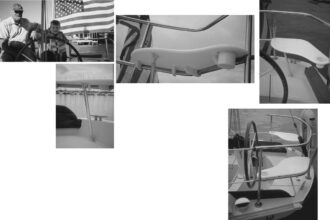
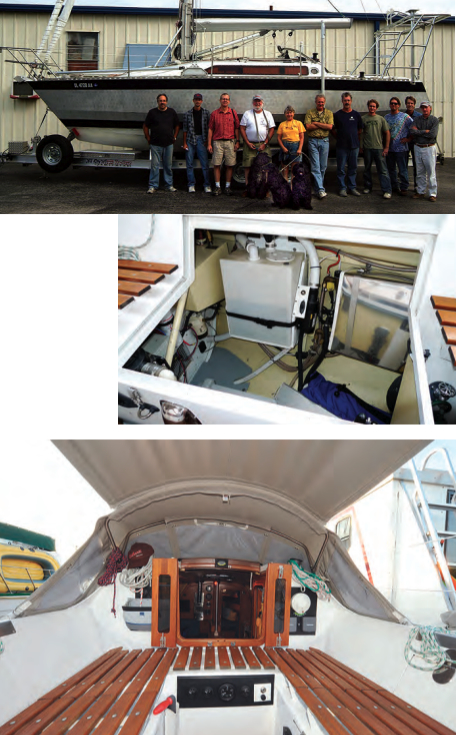
Cort designed and drew up shop plans for our new stern arch and mast tabernacle system. JSI also inspected our existing rig and replaced any questionable components, including all the standing rigging. By the time Cort and the JSI folks were finished, CanCan was ready to leave Florida as the very first trailer-based Alubat ever created and the only Sonate 28 of any configuration ever in the Americas. We were, at last, ready for the final phase of making CanCan a legal U.S. citizen. Before leaving, we had to have a class picture of all the wonderful and talented JSI folks who had worked so patiently and hard for us to bring our vision into a tangible and well-engineered reality.
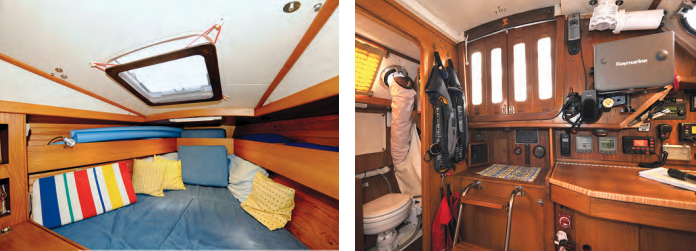
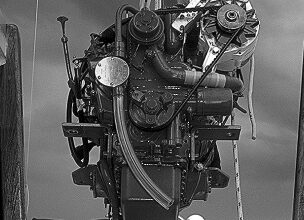
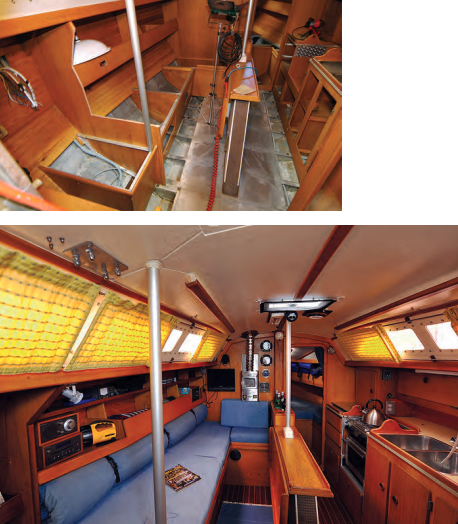
Nearly a year after her purchase date in St. Raphael, we had CanCan home at last and in my shop for the final phase of the conversion. Her original interior of sapele wood was in remarkably good shape, so most remained intact as we began our interior alterations and refit that included every system in the boat, from plumbing to electrics. CanCan also received a new 2-cylinder Beta diesel in the process and, when completed about a year later, she had pressure hot and cold water, a propane system for Gabi’s new gimbaled stove, and a full complement of new electronics, including an SSB radio, wind generator, and radar. She now has 110-volt shorepower and an inverter, powered by a much larger bank of batteries, to supply the outlets when away from the dock.
Her foresails left JSI in a “Solent” configuration, where two roller-furling headsails on two forestays fitted one close behind the other are used as a twin-sail downwind rig instead of a spinnaker. She also gained in-boom furling with a single-speed powered deck winch that does all the heavy lifting, including raising the mast via Cort’s ingenious design that uses our twin whisker poles for an A-frame.
Gabi made new cushions and canvas. I experimented with an air-to-air system for the refrigeration and air-conditioning, as we wanted to be able to run every system on the boat (except the diesel) while the boat was on her trailer. We have found that ability to be useful on occasion while we’re on the road, as the boat can double as a very nice hotel room. The solar panels do a fine job of running a pair of 12-volt Engel fridge/freezers that we built into the interior cabinetry. These use solar-powered deck vents to exhaust their hot-air output. We replaced the worn-out electric head with a new Raritan PH-II manual model, fitted all new sanitary hoses, and installed a legal holding-tank system.
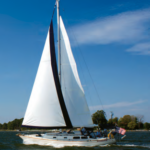
CanCan is in full commission now and has seen three seasons of use in U.S. waters, from the Gulf Coast to Lake Huron’s North Channel and all the way out to Lake Havasu in Arizona for the Havasu Pocket Cruiser Convention. She sails in salt and fresh water and, in spite of her additional cruising amenities, manages to show a lively personality. She took first place in a cruising-class regatta on Kentucky Lake one fall. She does everything we wanted in our big trailer-based sailboat and has also taught me the tricks of maintaining an aluminum hull, which has turned out to be my all-time-favorite hull material.
On reflection, would we do it again? The best answer I can give for that is that I have moved yet another older gal into my shop for a makeover. This one, a Westerly Pageant 23, arrived as a derelict. She already sits on her new trailer. We hope François and Christine will come help us launch Ladyship when she’s ready to hold court again.
Rob Hoffman began life as a Tennessee river rat and discovered sailing while in the U.S. Navy. A tinkerer, Rob refits boats and “builds stuff.” Even as he and his wife, Gabi, enjoy sailing CanCan, he has taken on another project: Ladyship, a Westerly Pageant 23.
Thank you to Sailrite Enterprises, Inc., for providing free access to back issues of Good Old Boat through intellectual property rights. Sailrite.com