The evolution of the three-cornered mainsail
Issue 89 : Mar/Apr 2013
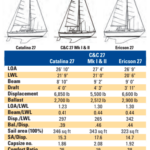
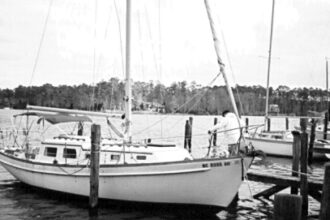
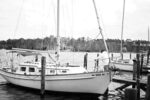
The three boats in our comparison this issue have almost identical sail plans. Each is a masthead sloop with a Marconi mainsail. The Marconi main is now almost universal on every modern rig configuration, be it sloop, schooner, yawl, ketch, or catboat. However, as we saw in the sail plans for the typical English cutter and the American sloop (see “What is a Cutter?” November 2012), this was not always the case. The gaff-rigged mainsail dominated through World War I and only gave way to the simpler, and ultimately more efficient, modern mainsail configuration in the 1920s.
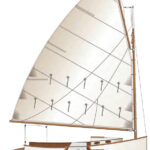
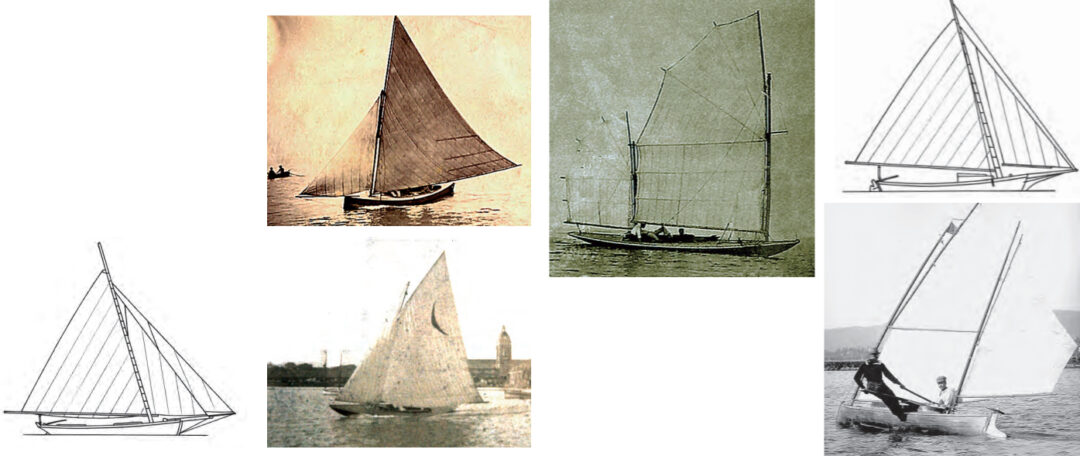
Although the three-cornered mainsail existed in the 19th century, it was usually confined to working sail, as typified by the Chesapeake Bay bugeyes and skipjacks and the sharpies of Long Island Sound. The only place it appeared on racing craft was in Bermuda, where the high-performance Bermuda sloops and dinghies used what was then referred to condescendingly as the leg o’mutton mainsail. This configuration so impressed British naval officers stationed in the colony, however, that they often went home with Bermuda dinghies and sloops in tow. They raced these boats in England with very good results. Thus, the three-cornered mainsail was referred to as a Bermudian or ’Mudian mainsail in many countries of the old British Empire, including Canada.
The 13-boat fleet at the Royal Halifax Yacht Club (precursor to the current Royal Nova Scotia Yacht Squadron) in 1857 included eight ’Mudian-rigged vessels. The top boat in the fleet, the Ebenezer Moseley-designed Mystery, originally carried this type of mainsail in 1850. Halifax was at that time a major outpost of Britain’s Royal Navy and had direct communication with the British naval establishment in Bermuda. The commodore of the Halifax club at that time was a Bermudian.
A question of sail area
The focus in Halifax on Bermudian-rigged vessels, however, did not influence the major yachting centers of Cowes, New York, and Boston. There were limits to the size of boat that could successfully fly this rig, and up to the introduction of the Seawanhaka Rule in 1884, there was no restriction on the amount of sail area that could be flown on any boat. (It was said that “A tax on sail area is a tax on seamanship.”) Until that time, therefore, there was no need to improve the efficiency of a sail plan because more speed could be generated by adding more sail area. (Note: For more on the ways rating rules have affected sailboat designs over the years, refer to Ted Brewer’s article in May 2000 and Bob Perry’s article in January 2012. –Eds.)
There were also obvious technical difficulties in flying anything other than the gaff-rigged mainsail. Trees grow
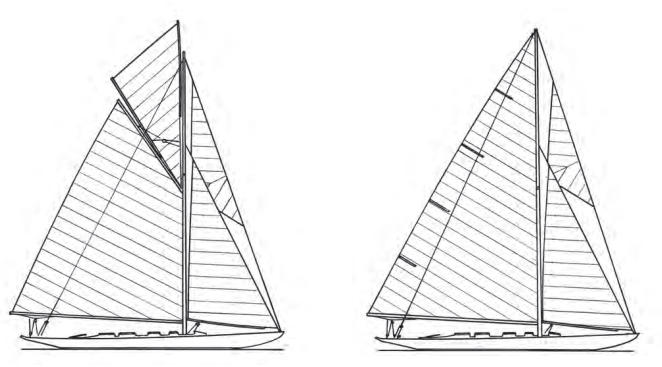
only so tall. To achieve additional rig height, sailing ships extended their masts with overlapping topmasts. This was true for yachts as well. Since the mainsail was either lashed to the mast or held to it with hoops, the luff of the mainsail could only extend as high as the crosstrees at the bottom of the topmast. A gaff was used for additional height. Even more area could be added above the gaff by hoisting gigantic jackyard topsails. Over time, gaffs became more vertical, especially in smaller racing boats. The gaff itself became a direct extension of the mast and the resulting sliding-gunter rig very closely approximated the appearance and performance of modern pole masts. These gunters on smaller boats were often made from bamboo, the lightest material available.
When sail area began to be measured and used in the calculation of yacht ratings, yacht designers took a hard look at the efficiency of the mast and rig. The first result was that rigs became taller. (Previously, additional sail area had been gained by lengthening bowsprits, which were themselves further extended with jib booms.) They also increased the length of the main boom so it extended aft of the boat almost as far as the bowsprit extended forward of it. This configuration lowered the center of effort of the rig, something that was often desirable in the beamy and shallow “skimming dishes.”
Stiffer boats and taller rigs
With the new design rules and the evolution of the compromise cutters, boats became much stiffer, especially with the addition of outside ballast and separate fin keels. Taller rigs could now be more easily carried. Greater rig hight was also a result of the influence of the new science of aerodynamics. Airfoil theory was being applied to yacht rigs by people like Manfred Curry, who demonstrated the improved efficiency of rigs with the higher aspect ratios. At the same time, British designers were experimenting with eliminating the overlapping topmast by housing the now often hollow topmast in a socket in the top of the mainmast, making the topmast an extension of the mainmast. They then eliminated the upper yard on the topsail and had the luff of the topsail attached to the topmast by means of a track and slide system. In some configurations this topmast was even able to retract into a hollow metal mainmast . . . pretty sophisticated stuff for the 1890s!
At the same time as these development were taking place in the larger yachts, great strides were made in the designs of rigs on smaller craft. Nowhere was that more evident than in the high-performance sailing canoes. Due to their narrow beam, stability was paramount, and the sailing canoe quickly progressed from a heavy ballasted hull form, in which the sailor reclined on the bottom and steered with foot pedals, to lighter unballasted hulls where the sailor perched on a sliding plank to maximize righting moment. The evolution of multi-battened batwing configurations on sliding gunters, often made of bamboo, brought lighter, more efficient rigs with lower heeling moments. Eventually, the number of battens was reduced to a minimum, the sliding gunter was eliminated in favor of a pole mast, and the true modern rig evolved. All this is exceptionally well documented by W. P. Stephens in Traditions and Memories of American Yachting. It is no coincidence that Stephens, himself a builder and early advocate of sailing canoes, introduced this rig on his Seawanhaka Cup winner Ethelwynn.
Hollow masts
In larger craft, however, as long as the length of the mainmast was a function of the height of trees, there was not going to be much progress in the evolution of the mainsail. Things really began to change with the development of hollow riveted-metal masts and hollow glued wooden masts.
The metal masts were first built for the large four-masted steel barques at the turn of the 19th century. It wasn’t long before this technology was applied to large racing yachts. Yachtsmen had been aware of the advantage of hollow wooden spars since John Cox Stevens’ centerboard sloop, Maria, used a long hollow main boom built with barrel stays when racing the newly launched America. By the end of the 19th century, builders were making attempts to bore out the centers of masts to reduce weight. But it wasn’t until the development of reliable non-water-soluble wood glues at the beginning of the 20th century that true hollow wooden spars could be built. Once that technology developed, there was no limit to the possible height of a single-piece pole mast.
This is where the American term Marconi rig enters the sailing lexicon. These new taller metal or glued wooden spars needed a whole new rigging system to keep them standing. The additional wires made them look like the radio towers the Marconi Company was erecting across the country, so these new spars and their rigging became known as Marconi rigs.
Slow acceptance
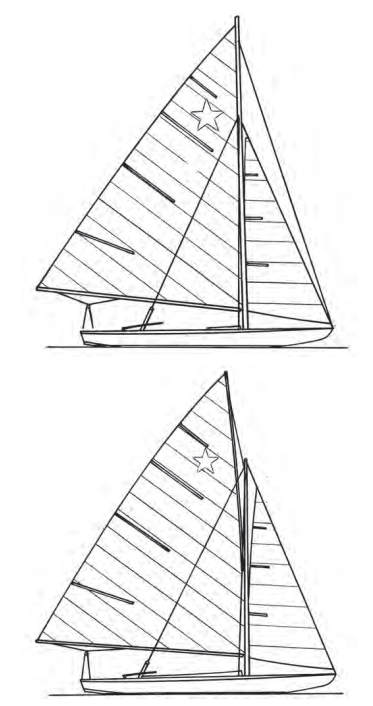
The leg o’mutton, Bermudian, or Marconi rig was not an instant success. As mentioned, W. P. Stephens used a very-low-aspect-ratio leg o’mutton rig on his Seawanhaka Cup winner, Ethelwynn, in 1896. This is believed to be the first time this rig was used in international competition, but no other challenger or defender in the early history of that contest (including the rigs of the many winners from the drawing board of Herrick Duggan) sported such a sail plan, although Duggan came very close with many tall gunter rigs. The Star class, designed originally in 1911 with a gaff mainsail, toyed with the Marconi rig in 1918 but abandoned it in favor of returning to the gaff, before finally adopting the new rig in 1921 with a much more slender mast.
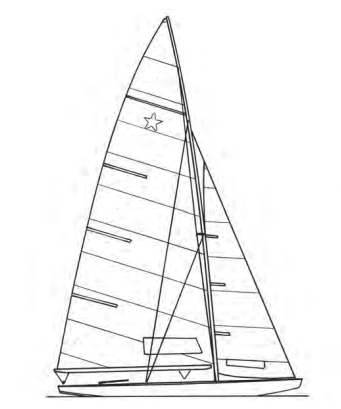
After the introduction of extruded aluminum masts in the 1950s, there was no turning back. Whether you call it leg o’mutton, jib headed, Bermudian, or Marconi, the three-cornered mainsail is now the norm in almost all modern sailing craft.
Rob Mazza is a Good Old Boat contributing editor. A sailor by passion and yacht designer by vocation, his long career around sailboats began at C&C Yachts back when now good old C&Cs were cutting-edge new.
Thank you to Sailrite Enterprises, Inc., for providing free access to back issues of Good Old Boat through intellectual property rights. Sailrite.com