Variety is the spice of the sailing life
Issue 92 : Sept/Oct 2013
One of the greatest aspects of offshore and coastal cruising is meeting other like-minded souls out there who are sailing the world’s oceans, dealing with the same logistics and difficulties, and reaping many of the same rewards as we are. There’s no question that mixing with the local people, blending in with the cultures of the various countries we visit, learning what we can, and sharing what we have with others is largely what cruising is about . . . but it is also about meeting other cruising sailors.
In port, we often socialize with cruisers from many different backgrounds, countries, and ways of life. Yet, as we all find ourselves in the same places doing the same sorts of things, bonds are formed. At any cruiser bar or beachside potluck, sooner or later the conversation will drift to boats, rigs, and systems.
In the many years we’ve been sailing schooners and ketches, one of the questions we have been asked most frequently is, “Why do you sail a ketch (or schooner)?” The answer we give is the result of analyzing many factors. Having sailed most of our lives, we have accumulated experience with many different rigs.
Rigs have changed
Thanks to modern sailmaking materials and sail-handling equipment, we are seeing bigger and bigger boats being handled by smaller and smaller crews. It is not uncommon to come across 50- or 60-year-old couples sailing 50- or 60-foot yachts relying entirely on electric or hydraulic furling and anchoring systems.
When we began cruising, I remember clearly thinking, “I’ll never have a roller-furling jib. They always fail!” In the early days of roller furling, it was often jokingly referred to as “roller failing.” As this equipment has improved, due to a proliferation of manufacturers competing to build the best and most reliable systems, things have sure changed and for the better. We now believe that roller-furling jibs are probably the single most important safety system developed for sailboats during the 20th century. Roller furling keeps the crew off the bowsprit and, when combined with in-mast mainsail furling, keeps the crew in the cockpit for all sail handling, something that can be a real safety factor in high winds and big seas.
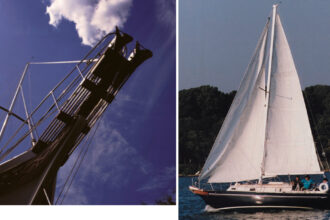
Conventional wisdom maintains that a sloop is the most efficient cruising rig for upwind work. Cutters — so popular in the days before reliable roller furling became commonplace — are becoming extinct as they are being replaced by roller-headsail sloops and rigs referred to as double-headsail sloops that have two, and sometimes more, roller-furling sails near the stem ready to be used in different conditions.
Few ketches, so popular in the 1970s and early ’80s, are built anymore. When they are, they are rarely smaller than 50 feet. Most people elect to have a single stick in an effort to create the most efficient and simple rig for upwind work. That most long-distance cruising is (don’t we hope?) accomplished on a reach or downwind, and that these modern designs often rely on very sophisticated, expensive, and complicated sail-handling gear, is considered by most to be “normal” these days. As a result, little thought is given to some of the more traditional rigs that graced anchorages and sailed offshore and coastal waters in years gone by.
Having owned quite a few sloops, several cutters and ketches, two schooners, and a brigantine over the years, my fiancée, Gayle Suhich, and I usually have a different view from most about the best rig for cruising when this topic comes up at the beachside discussions.
Sloops
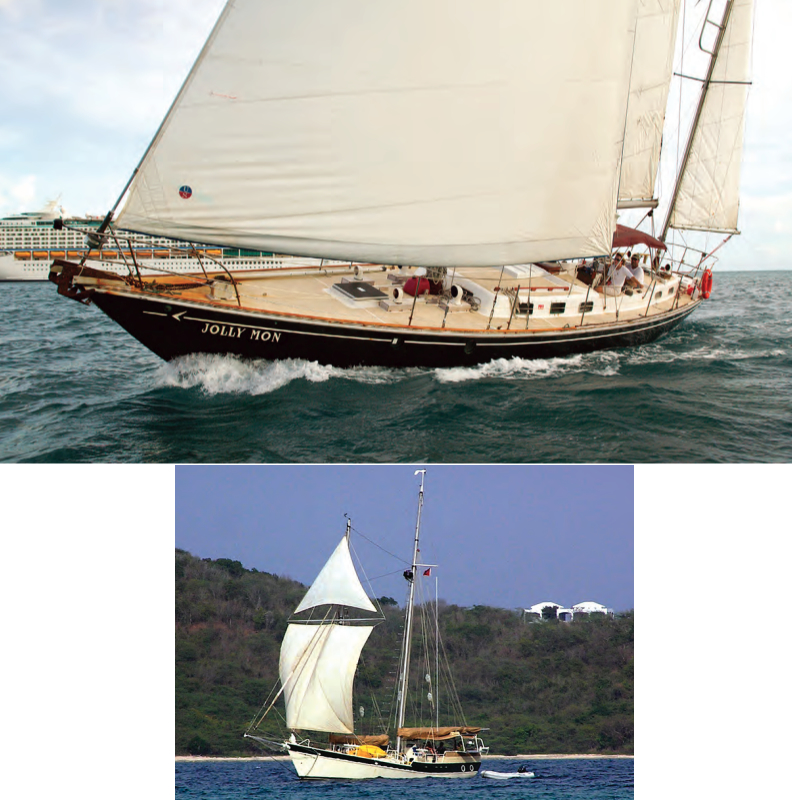
Sloops, as we all know, are simple. If you can sail at all, you can probably make a sloop perform reasonably well, and if your goal is to have the simplest rig, a sloop is a good choice. For many people, sail handling and trimming is a bother. Many who race sloops would say that having two sails for going upwind and a spinnaker for downwind work is quite enough of a challenge. Just getting the most out of those two or three sails is satisfying and fun for many, and that’s OK.
Cutters
It’s generally accepted that cutters were developed as a way of offering easier sail handling and greater flexibility in balance than a traditional sloop rig could offer. With the cutter, a smaller jib could be bent on and a staysail could create the extra sail area needed to provide good drive, but each sail was smaller and therefore easier to handle. In the days before roller furling became commonplace, this was a good alternative to dealing with large jibs that had to be dropped in a hurry in squally or rapidly building conditions. The concept of the cutter is brilliant in that, as the sails are reefed and dropped, the sail plan comes well inboard. The mast is also more adequately stayed than it typically is with a sloop rig. The downside, of course, is that the rig has more windage, an inner forestay that gets in the way of easy tacking, and it’s more complicated, making it a more expensive rig to maintain.
Ketches and yawls
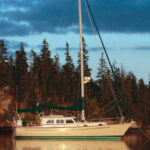
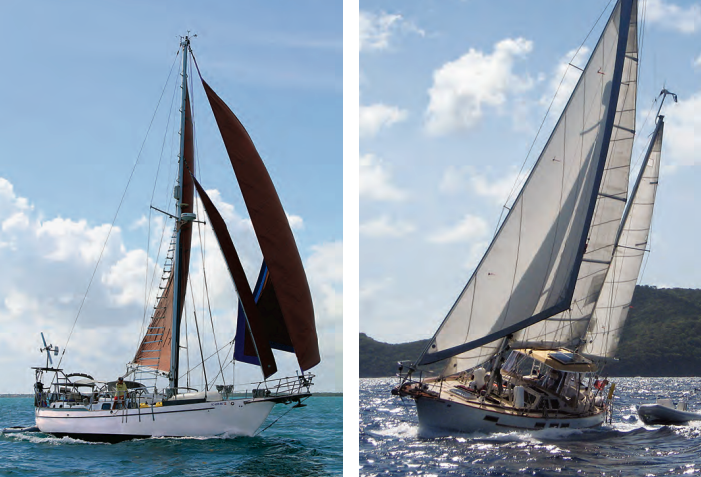
Ketches, and to a lesser extent yawls, share some of the simplicity of the sloop rig while offering the ability to have much greater control over the center of effort of the sail plan. A split rig provides a lot more flexibility in terms of how the sails are set or which sails are set in an effort to achieve a good balance between upwind and downwind performance.This flexibility offers the potential for self-steering, even without an autopilot or windvane.
Within normal crew limitations, a properly sailed ketch can carry more sail longer in a rising wind than a sloop of similar size. Reaching is a ketch’s strong point, and we all hope our cruises will provide a lot of reaching. If built with a relatively long jib luff, a ketch can do quite well upwind and, because each sail on a ketch is typically slightly smaller than one on a similar-sized sloop, the stress on the rig and gear are less. The crew has an easier time sailing the boat as well, despite having to deal with the extra sail.
Cutter ketches, or staysail ketches as they are often called, are quite common and offer tremendous flexibility in a rising wind. On one very squally passage up the Yucatan coast aboard one of my ketches many years back, we put a double reef in the mainsail and left the full mizzen up and the jib fully out. When the heavy squalls came through, we dropped the mizzen right in the cockpit and rolled in the jib. We were nearly instantly reduced to a heavy staysail and double-reefed main, a sail plan that worked well in the stronger 40-knot winds. When the squalls moved off, we simply rolled the jib back out and raised the mizzen. The double-reefed main was a little under-powered in the lighter winds between squalls, but we hardly noticed it.
Sailing upwind in heavier air, many sailors use just the mizzen, jib, and staysail. We have done that on occasion, but if conditions are squally and variable, reefing or dropping and raising a main four or five times in a watch to keep the boat moving well is a lot more work than just dropping or rolling in a headsail.
Schooners
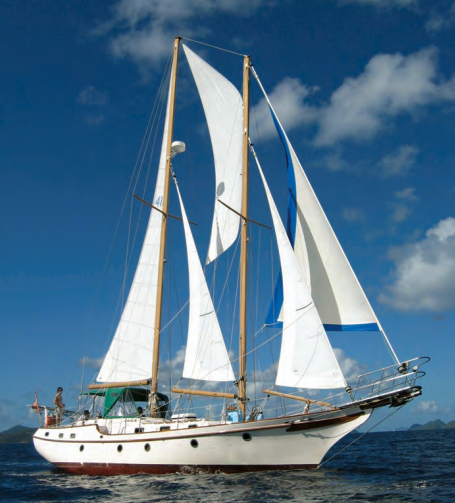
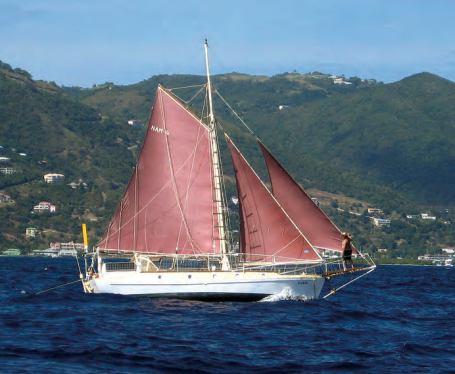
Schooners offer even more flexibility when balancing the boat on various points of sail and, in most instances, each sail on a schooner is a bit smaller than you might find on a similar-sized ketch. While luff lengths are usually shorter on a schooner, limiting their upwind capabilities, few boats can catch a properly sailed schooner off the wind or running. A schooner rigged with a yardarm and a square sail will sail downwind better and with less effort on the part of the crew than any other rig.
In the days before self-steering and autopilots, the schooner rig offered the best solution to the dilemma of short-handed sailing. With a schooner, you can undertrim the main a bit so that when the boat falls off, the main will fill properly and pull the boat back on course. When the boat sails too high, the main loses power and the center of effort moves forward again. Then the foresail and jib (or jibs) pull her back on course.
It is an interesting tidbit of nautical history that the schooner America, which sailed across the Atlantic in 1851, managed to beat every racing yacht she was matched against in Europe. Largely because of the success of the America, racing schooners were still being regularly built up to World War II and campaigned for many years after that.
Catboats and their cousins
A number of catboat-type rigs have been introduced over the years for cruising. The attraction, or marketing ploy often put forth, was that the rig was simple, easy to handle, and rugged. With the introduction of roller-furling mainsails and in-boom furling, many people who might have chosen a catboat or cat ketch/schooner may choose the simplicity of these modern furling rigs and for good reason: they are better upwind performers and typically better balanced off the wind than a catboat-type rig. That said, as long as one does not mind dealing with a large mainsail and a long boom, the cats and cat ketches can be a lot of fun to sail and are great reaching rigs.
Gaffers
The gaff rig has been largely forgotten in the last 40 years and I don’t know of a single modern design sporting this well-proven and successful innovation. For centuries, the gaff rig was employed as the most suitable way to handle a boomed mainsail. The gaff, when used in conjunction with lazy-jacks, makes dropping or raising sail possible on a reach or even downwind and, if a squall comes along, just dropping the peak of the gaff can scandalize the sail, dumping much of the sail’s power. Reefing with a gaff rig is very easy and, once lowered into the cradle of the lazy-jacks, a gaff holds the sail down until gaskets (sail ties) can be lashed in place.
The choice is yours
Go into any major cruising port and you’ll see a broad cross-section of what people consider the best rigs and designs for long-distance cruising. One thing we have learned is that there is no right answer for the best rig to take, and we always enjoy seeing a boat with an unusual rig, well handled by a short-handed crew, entering harbor or on passage. It can also be argued that emotions can play a large part in the decision process when choosing the right rig for cruising. We know it would be easier to sail a modern sloop and in many cases it would be perfectly adequate, but over the years we have gravitated toward more unusual designs and rigs as a way of keeping ourselves entertained. We admit that when entering a new port we are never compelled to say, “Oh, look at that beautiful white sloop” when there is a schooner, brigantine, or gaff cutter or ketch sitting gracefully in the harbor, drawing our attention and eclipsing all the other craft with her beauty.
Some of the more complicated and esoteric rigs of yesteryear are not for everybody, and yet we hope that as time goes on we’ll continue to see some of these excellent rigs and traditional designs sailing the oceans and taking their enthusiastic owners to the far-flung ports of the world.
Todd Duff has owned 50 sailboats over his sailing career and is a writer, photographer, marine surveyor, and former yachtbroker. Todd and his fiancée, photographer and professional captain Gayle Suhich, have accumulated approximately 150,000 sailing miles on sloops, cutters, ketches, yawls, schooners, and a brigantine. They are full-time cruisers and are now in Hawaii aboard their latest boat, the 50-foot Flying Dutchman cutter, Small World II.
Thank you to Sailrite Enterprises, Inc., for providing free access to back issues of Good Old Boat through intellectual property rights. Sailrite.com