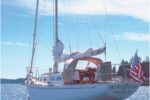
A good old classified helps a Chris-Craft Capitan
Issue 93 : Nov/Dec 2013
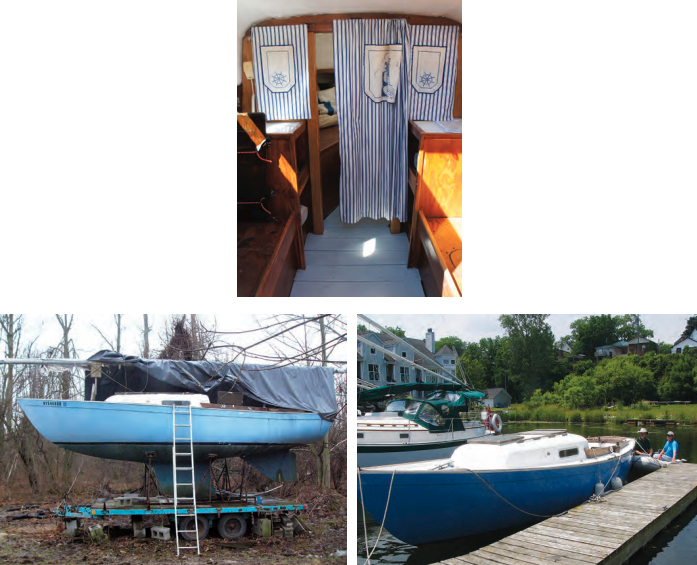
It took two men and 16 years to complete an international effort to save Sophie. She was a little blue sloop, just like the boat in Richard Bode’s popular book about sailing and life, First You Have to Row a Little Boat. Her earlier name was Born Free, and she was very near death when Chris Gateley, the man who would later become my husband, first saw her in 1994 on a late summer day in a boatyard by Lake Ontario’s Sodus Bay. The 26-foot Chris-Craft Capitan, hull #7, had been put on her steel cradle backward. One pad had holed her, another had severely pushed in the bottom. The asking price was $500.
A few months before, Chris had launched a wooden daysailer, a 19-foot Lightning, on the protected waters of Port Bay near his home. He had spent the previous year building a shop to work on the boat, repairing, painting, and varnishing the Lightning and finding a new mast for it. He had never owned a wooden boat before and was shocked when his new boat began to sink during her maiden voyage. Her cedar planking and centerboard trunk had dried out and shrunk and water poured in through the open seams. After sailing and bailing for 20 minutes he returned to the ramp, hauled her out, and towed her back to the shop for more work.
That’s when he saw an ad for a 26-foot fiberglass sloop with a hole in her bottom for $500. Wow! A 26-foot
plastic boat for the same price he had just paid for a leaky wooden Lightning with rot in the centerboard trunk? Off he went, checkbook in hand, to survey the boat. A few days later, the Capitan made her way up the driveway aboard a U-Haul car carrier while the Lightning project went on hold. Indefinitely. He eventually gave away the Lightning — to his brother in Wisconsin.
A sorry state
Sophie turned out to be a considerably bigger project than the Lightning. As on many a boat of her era, the chainplate deck penetrations leaked and the interior plywood bulkhead they were bolted to had rotted. The bolts holding the 1,800-pound cast-iron keel were badly rusted and several sections of the glassed-in wooden stringers that reinforced the boat’s bottom had also rotted. Sophie’s rudder was mounted on a skeg that had already been repaired once and was in need of further strengthening. A split on the forward edge of the rudder blade itself was also in need of repair. Both the forward hatch and the cover over the outboard well needed to be rebuilt. What’s more, the aluminum holding tank had corroded through, leaving an unpleasant aftermath.
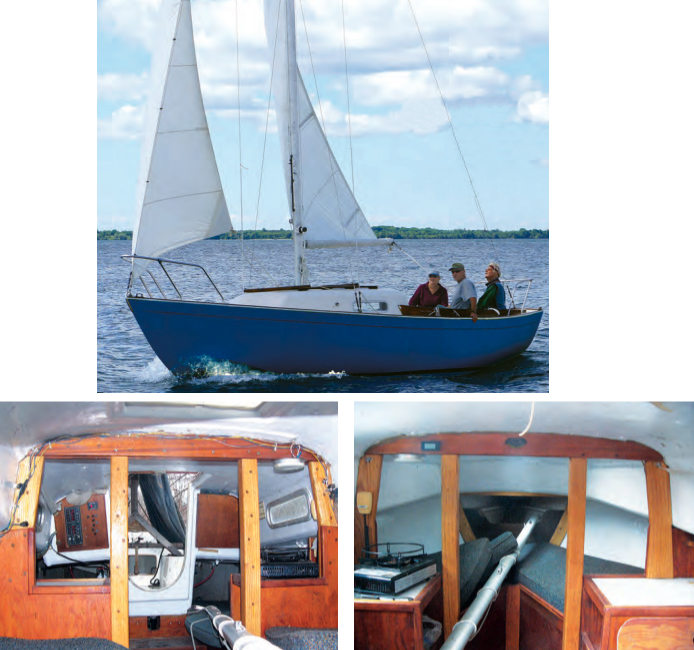
Beneath the grime and neglect, however, Chris could see the boat’s potential. He liked her sweet sheer, her bold bow, and her general businesslike look of determination. Internet research revealed her good pedigree. She was said to be Sparkman & Stephens design #1860, created in 1965 and later modified with a larger cabin to become the Chris-Craft Capri. Modeled to race under the MORC handicap rule of the 1950s, the Capitan, with her big cockpit and small low cuddy cabin, was first and foremost a racer and lively daysailer. If you could tolerate sitting headroom down below, she was surprisingly roomy, with four bunks, a galley of sorts, and a built-in head.
The Capitan was created in an era when racing designs were wholesome and moderate enough to serve as capable coastal cruisers. The 1960s were also a time when sailing families cruised quite happily on yachts of 20 to 25 feet and when wheel steering, pressurized hot water, shorepower circuits, 6-foot headroom, and enclosed heads were not standard features for a Sophie-sized boat.
A workmanlike rebuild
Chris ripped out the rotten main bulkheads and glassed in new ones, and he rebuilt the support for the deck-stepped mast using exterior fir plywood and sturdy ash from his backyard woodlot. He rebuilt the galley and storage shelving and lockers, replaced the keel bolts, redid the forward hatch, made a new cover for the outboard well using plywood and epoxy, and repaired the damage to the bottom. He used close to 5 gallons of polyester resin on the bottom job and beefed up the lightly built hull. He installed a new holding tank and head and purchased a butane stove for the galley. The next spring, he and several friends sanded and primed the badly faded gelcoat and painted it Bikini Blue with a one-part polyurethane paint.
Sophie’s rebuild was a solid workmanlike job using good-quality marine-grade hardware and epoxy. It was not a high-end restoration with teak and mahogany elegance and 10 coats of varnish, though fresh paint and a few pieces of cherry trim from the woodlot did contrast nicely with the varnished fir plywood and ash in the cabin. Her non-skid decks were still in good condition, as was most of her hardware and rigging, but her mainsail was showing its age. Her new owner decided to try to get one more summer out of it with the help of a good deal of duct tape and some seam re-stitching. To his surprise, it lasted five more seasons before a 35-knot wind finally did it in.
The resurrected boat was launched on a quiet summer morning at a boatyard on Little Sodus Bay, New York, and motored to the dock with the help of a couple of friends. She was given a new name, Sophie, after the first command of author Patrick O’Brian’s fictional sea captain, Jack Aubrey. When Chris first sailed his 5,000-pound boat, he said that, after years spent sailing a Sunfish, she felt like the Queen Mary. He took his fine big yacht on several weekend cruises that summer, sailing solo with his faithful dog or sometimes with his younger brother. But then, after just one season, fate sidelined the little blue sloop once again. Her owner fell in love. Another Chris-Craft, a 32-foot Cherokee, came along and caught his eye. With it came yours truly, his future wife.
Chris’ younger brother sailed Sophie around the lake for two more seasons. Then Sophie returned to his rural upstate New York yard on a flatbed trailer and sat. Years passed. Her winter cover shredded, was replaced, and began to shred again. Leaves filled her cockpit and rotted. Mice made their way below, spiders spun their webs, and wasps built nests on board.
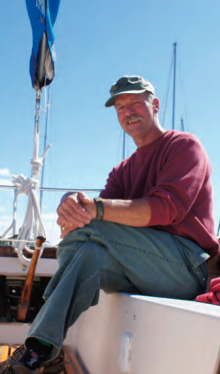
Finally it got to me. I was, after all, in large part responsible for her plight, having talked her owner into buying a share of the 32-foot Cherokee partnership in 1996, which led to our marriage not long after. (Note: Susan wrote of boat partnerships in the May 1999 issue. –Eds.) In the spring of 2009, I put ads up on several websites and sent one to the Good Old Boat classifieds. Within a week, the Good Old Boat ad was seen by another budget boater, this one in Prince Edward County on Lake Ontario’s Canadian shore about 50 miles north of where Sophie sat. He drove down, looked her over, and a deal was made. We were delighted to see Sophie off to Canada aboard a flatbed with her enthusiastic new owner, Bruce Milan.
Sophie’s new caregiver
Poor patient Sophie. Enthusiasm had been sorely lacking over the last 10 years of her life with us. Our enthusiasm had been absorbed, first by her 32-foot big sister, Titania, a Chris-Craft Cherokee, and then by Sara B, the elderly wooden schooner (who last appeared in these pages in the January 2011 issue). Bruce, however, was very enthusiastic. He had dabbled in sailing in years past, getting started with a Styrofoam-hulled 8-footer and later sailing on Lake Superior. After he moved to Prince Edward County, a rural region of limestone outcrops, rolling farm fields, and summer homes surrounded by the best sailing waters on Lake Ontario, the sailing bug bit him pretty hard.
Via email he wrote, “I purchased a beautiful, but somewhat disassembled, plywood dinghy built in about 1960. It was a Zenith, designed by Ian Proctor of Wayfarer fame, and I spent a couple of years sanding and finishing it. Then I realized a racing dinghy was a little past my demographic situation and began looking at larger, more comfortable boats. What I soon found out was that I didn’t like the looks of many of them and they were hopelessly out of reach cost-wise too.” But he recalled when he first saw the Capitan sitting on the trailer, grimy and neglected but with her nose still in the air, he was quite taken with her looks, just as Chris had been 15 years before.
Bruce sent regular email updates on the commissioning and launch.In June 2009, we stopped by Picton with Sara B to see how the Capitan was doing. Bruce met us there and we had a good gam as we checked out the newly painted and refurbished boat, now christened Wave Anvil. Bruce, a blacksmith for 35 years, explains her name by saying, “An anvil in the form of a classic good old boat will slice effortlessly through and over whatever waves she encounters. What better name for a boat as unstoppable as the 1967 Capitan has been than Wave Anvil?”
A windy awakening
But the next summer, Wave Anvil did come to a stop. It took a 35-knot blow to do it. Ironically, Wave Anvil’s former big sister, our Cherokee, was battling up Prince Edward Bay under storm jib and reefed main that afternoon when just 10 miles away off Picton a gust split the Capitan’s old main and tore it asunder. That same windy day also convinced Bruce he could no longer ignore that loose feeling he was getting from the rudder. It was time for some more work.
As Bruce contemplated the urgent need for a new mainsail and possibly a new rudder and skeg, he recalled
a Chris-Craft Capri he’d seen in a nearby boatyard some years back. He had looked at the boat as a possible purchase and decided it was too far gone then. Now, he went back for a second look and found the boat had a good suit of sails and a rudder and skeg assembly that was, if not like new, at least considerably better than the wobbly appendage on Wave Anvil. The Capri’s owner had abandoned her, so he made a deal with the boatyard to “harvest” parts off the hull and then cut it up.
He wrote that the boat was a “gold mine” of parts: “Friday I hauled out a pickup full of rotten junk from below. She pretty much looked like the inside of a dumpster with ruined moldy cushions and clothes and a weird assortment of collected junk the previous owner had left in her. I was severely stung by a wasp in the process as there is a colony on board somewhere. Luckily, I harvested the sails from her last October, as her decayed hatches really leaked this summer and increased the general funk to a high level.”
Bruce drilled some holes in the hull to drain the water, “to aid in the unfunkage for later removal of some of the interior.” He added, “Oddly, she is a rotten wreck and now officially doomed, yet has many very sound components that are specifically and exactly what my boat needs. What luck, except for the wasps!”
The Capri rudder and skeg bolted right onto the Capitan hull and were installed with a “giant glob” of 3M 5200 adhesive. Her bow rail and stern pulpit were fitted, and Bruce salvaged cleats, the galley sink and pump, lifelines and stanchions, a new tiller, winches, and other gear for his boat’s refit. He spent a year on the job and relaunched Wave Anvil in the spring of 2012.
Sibling reunion
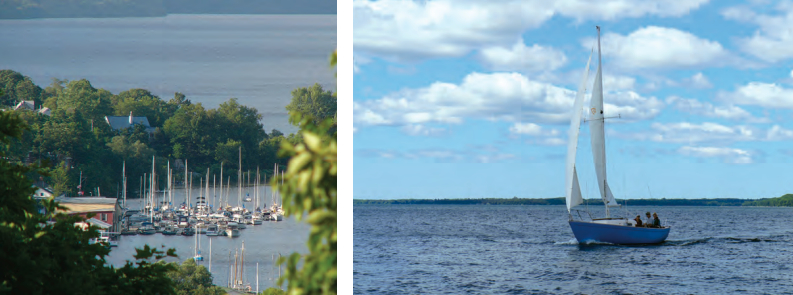
We thought it would be fun to get our Chris-Craft Cherokee over to Prince Edward Bay to sail again with her little sister as they once had while traveling together on a trip to Canada back in 1998. In late June, we met Bruce, his wife, Diane, and sailing friend Bill McBurney for breakfast followed by a photo shoot. It was a glorious day with west winds of 10 to 20 knots and flat water on Prince Edward Bay. The two old Chris-Crafts charged along together for about an hour, the Capitan staying in front of the Cherokee until the bigger boat pulled ahead very slowly once they were in open water and in slightly stronger winds. At last Wave Anvil tacked for home while we continued on our cruise, feeling very satisfied indeed about Sophie’s fate. Today, lucky Capitan hull #7 sails one of the most beautiful areas of Lake Ontario.
As before, this effort was not a perfectionist better-than-new showroom restoration. Bruce, a skilled artisan ironworker, describes his work on the boat as an “everyman approach.” Chris, who writes computer code for a living, knows how difficult and time-consuming achieving the last one percent of perfection can be. Make the repair solid, strong, and well-engineered . . . and then go sailing. Shortly after Bruce bought the boat and got her safely back to Canada, he wrote, “Thanks a million for getting me into a good old boat that’s within my budget. I think I’ll have a great time using her here around Prince Edward County.”
Well, we got ’er done. It took three people in two countries 16 years, and we couldn’t have done it without Good Old Boat magazine’s classified ads!
Susan Peterson Gateley writes and sails on Lake Ontario. Her books, including Living on the Edge With Sara B: a Sailing Memoir and Maritime Tales of Lake Ontario, are available for sale at www.chimneybluff.com. Bruce and Diane Milan run a B&B. Bruce works as an artist blacksmith. See his work at www.pec.on.ca/islandforge.
Thank you to Sailrite Enterprises, Inc., for providing free access to back issues of Good Old Boat through intellectual property rights. Sailrite.com