. . . but you can still enjoy the journey
Issue 96 : May/Jun 2014
We should have known better. Over the years we have tried to plan ahead and have mail waiting for us when we arrived somewhere, but we soon discovered that pre-planning in this way guarantees that we will never arrive at that destination. Anchorages that look perfect on the chart are filled with mooring balls. Post offices that used to be on the water are now 5 miles inland. Weather windows close unexpectedly. Boxes of schoolbooks for our three boys have followed us across the Eastern Seaboard and island hopped across the Caribbean, chasing us, all because we couldn’t get to where we had planned to be. But missing our mail and educational materials was not nearly as stressful as having our children fly to meet us on an island and then being unable to get there ourselves.
In April in North Carolina, a family reunion in June had sounded like a fantastic idea. Our oldest son, Nick, a freshman in college, was going to fly with his girlfriend to meet us in Grenada. The fact that we were still working in St. Croix, almost 500 miles away, was a minor detail. Our hurricane season plan was to sail south like we had in previous years. Being in Grenada by late June would be no problem. Or so it seemed in April.
Though we were conscious of our deadline, Dave had projects to finish and we had a cruising kitty to fill, so by the time we were ready to ride the next available weather window south, we had only a week to get to Grenada, a five-day sail away.
“No problem,” we thought, as we sailed out of Christiansted Harbor. Seven miles to windward, however, we rounded the corner of St. Croix into the full force of the Caribbean trade winds. The winds and waves that had sounded reasonable while we were sitting in the harbor listening to the weather forecast were miserable in reality. After another hour of bashing to windward with a 6-foot swell from one direction and a 4-foot wind wave from another, our captain made an executive decision. No family meeting. No vote. It was a statement. “We’re going to Virgin Gorda to get a better angle on the wind and seas. Tomorrow. Tonight we sleep at Buck Island.” A five-day trip to Grenada ended in five hours, within sight of “home.”
Accidental tourists
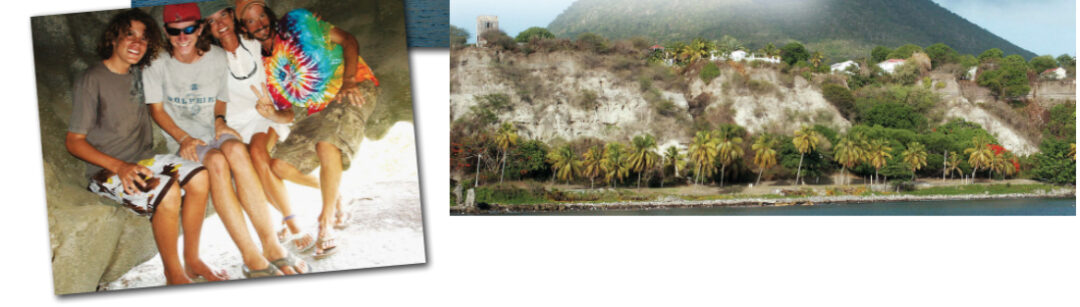
Spanish Town, Virgin Gorda, has become one of our favorite anchorages in the BVI. While we waited for the worst of the seas to subside, we celebrated my 40th birthday. We walked out to The Baths, stopping along the road to find the hollow rock we had discovered a few years earlier. With only a 2-foot opening at the bottom, it was difficult to climb into but, once we were inside, there was standing headroom. While I set up the camera to take a family picture, my heart ached. There were only four of us. The fifth one was going to be in Grenada in three days. We were not going to be there to meet him.
Back in the anchorage, we snorkeled among the rock formations, where 15-foot-tall boulders jutting toward the surface of the water created a funhouse effect as we followed schools of fish through the maze. After dinner and birthday cake, our middle son got online and messaged Nick, who wished me a happy birthday and asked where we were. “What are you doing there? We’ll be in Grenada in a few days!” I promised we would get there as soon as we could and hoped he was resourceful enough to figure it out until we did.
We left Virgin Gorda for Grenada the next day, knowing the kids would land before we arrived but confident they would be “homeless” for only one night. Our passage ended two days later. . . in Saba. The 8-foot seas and 18 knots straight out of the east we had expected, but the constant lightning from the squalls all around us made us nervous, so we altered course once again.
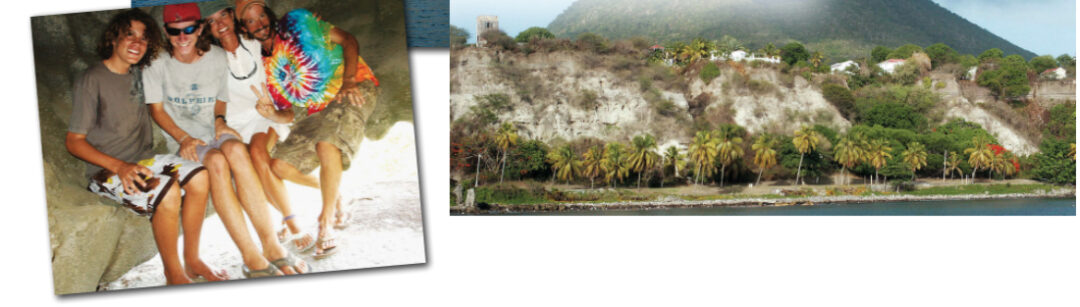
Clouds obscured Saba’s 3,000-foot precipice, but when we picked up a mooring in Ladder Bay, we were within sight of the 800 stairs for which the bay is named. Leading past the old customs house and up to the road, these steps cut into the rock were, until the 1970s, the only way to get supplies onto this 5-square-mile island. On a schedule, with a stranded son, we chose not to go to shore this trip. Instead, we got a good night’s sleep and vowed to leave for Grenada in the morning.
The chop caused by the Saba Banks the next day continually pushed our bow to leeward. By noon, we were 13 nautical miles west of our rhumb line. When we tacked, Statia was directly off our bow. Like an oasis to a desert wanderer, it beckoned to us. After getting slammed by a severe squall and seeing a series of squall lines approaching, we knew we were going to be in for a long and uncomfortable passage. As we sailed near our rhumb line and were preparing to tack back out to sea again, Dave asked the question we were all considering.
“Do we want to keep beating ourselves up or are we going to stop in Saint Eustatius?”
“What about Nick?” I asked.
“We’ll fly them up here and sail them to Grenada to catch their plane home. That buys us another week to get there. He doesn’t even know where we are right now.”
More sights to see
Once we were safely in Statia’s rolly harbor, we had a few days to waste while we waited for the next series of flights from Grenada to Statia. Never ones to sit idle, the four of us became tourists. We explored the waterfront that was once the site of the busiest port in the Eastern Caribbean. During the 1600s, thousands of ships brought goods to Statia’s shores to be sold duty-free and then carried away on other ships. Part of the old commercial port is still visible from the harbor.
On our stroll toward town, we found the Old Slave Road. As I walked up the steep trail, I found myself thinking of those who had been forced up this long path in previous centuries. It was along this road, built by slaves in the 1700s, that slaves brought to the island were led from the port to the trading block. Today, the road ends at the edge of town near Fort Oranje, a fort built by the French in the 1600s that has been fully restored and is well worth exploring. We spent more than an hour wandering around it and admiring the spectacular view of the harbor.
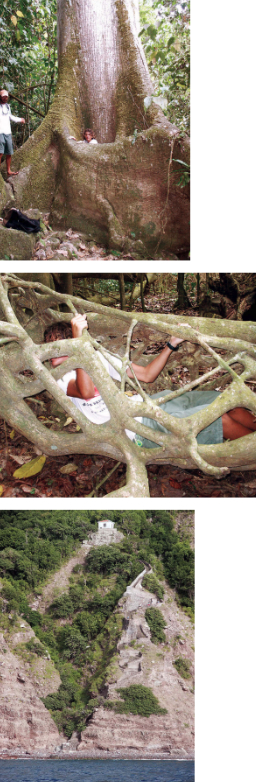
When we cleared into Statia, we had purchased passes allowing us to climb the Quill, a 2,000-foot extinct volcano within easy walking distance of the harbor. After nearly an hour of moderate hiking, we reached the rim of the volcano. We were thrilled to find a path leading into the crater, though the trail became more difficult for the descent. Another world awaited us at the bottom. Even the intense tropical sun cannot penetrate the dense foliage of the rainforest, so the crater is in an eerie eternal twilight. Boulders the size of houses lay where they had landed centuries ago, and enormous trumpet wood trees formed bathtubs with their roots. Our youngest climbed inside a “cage” of tree roots that had grown around a trunk that had since rotted away. We were reluctant to leave this dreamland, but the several-hour hike back to the boat lay ahead.
Three days later, the kids caught a plane out of Grenada. They had spent their days exploring Grenada’s beaches and waterfalls and their nights sleeping at the outdoor airport and in the spare bunks of sympathetic cruisers.
Left to their own devices, they had traveled by bus and foot, eaten in the local restaurants, and within a few days felt like they had become part of the community. They were excited to finally join us on the boat, but glad they had been forced to live on their own for a while on a Caribbean island.
Their flights took them to five islands where they cleared into and out of four countries in one day. They both agreed that the unexpected beginning of their vacation had the best adventures of the entire trip. And even though I would rather have been in Grenada to meet their plane like a responsible parent, I had to admit that the stops we had made along the way were worth the extra worry, work, and money to finally get our family back together.
Cruising is not always the relaxing lifestyle we had dreamed of. Quite often you can’t get to where you most want to be, but if you take the time to enjoy the journey as well as the destination, sometimes that’s OK too.
Connie McBride and her husband, Dave, have been cruising for 12 years, most recently cross-country in a van. They are now back on Eurisko and readying her for the next adventure. Connie writes about the cruising life at www.simplysailingonline.com.
Thank you to Sailrite Enterprises, Inc., for providing free access to back issues of Good Old Boat through intellectual property rights. Sailrite.com